
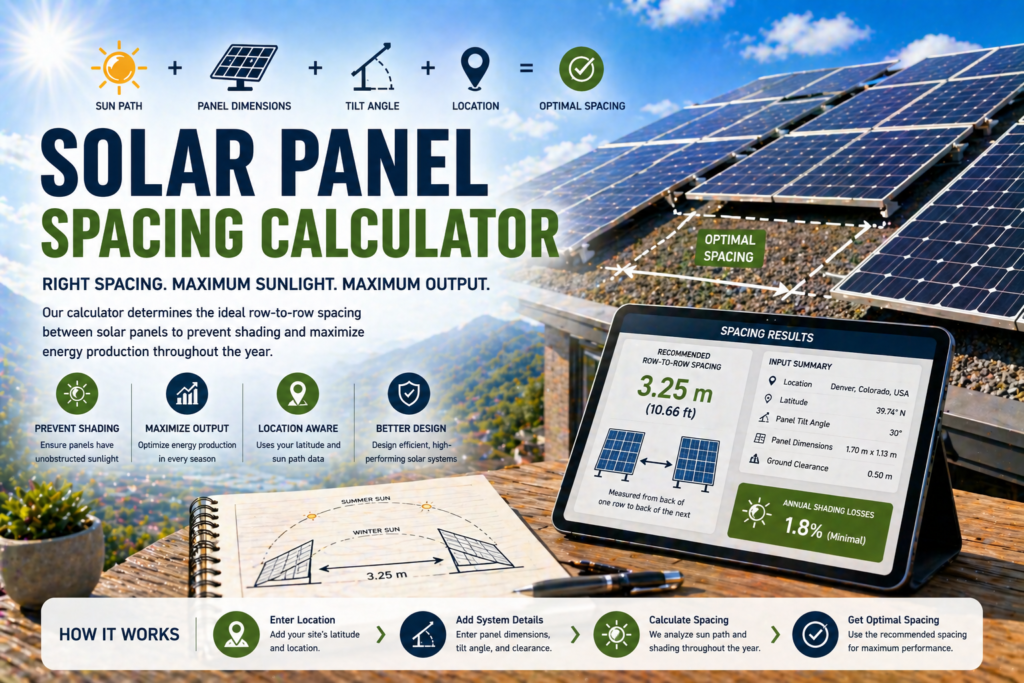
Solar Panel Spacing Calculator
The Solar Panel Spacing Calculator helps determine the correct distance between rows of solar panels to prevent shading and maintain strong solar energy production. Proper panel spacing is especially important for ground-mounted solar arrays and large off-grid solar systems.
When solar panels are installed too close together, the front row can cast shadows on the panels behind it. Even small shadows can significantly reduce solar output because shaded panels produce less electricity.
This calculator estimates the recommended spacing between panel rows using your latitude, panel tilt angle, and panel height so your solar array can capture sunlight efficiently throughout the day and during lower winter sun angles.
How Far Apart Should Solar Panels Be?
Solar panel rows should be spaced far enough apart to prevent one row from shading the next, especially during winter when the sun sits lower in the sky. The correct spacing depends on panel height, tilt angle, and your location’s latitude.
Basic rule of thumb:
Solar Panel Row Spacing ≈ Panel Height × 2 to 3
For example, if the effective panel height is 1.5 metres, the row spacing may need to be roughly 3 to 4.5 metres depending on tilt angle and winter sun position. Higher tilts and higher latitudes usually require more spacing.
Biggest factors that affect panel spacing
- Panel tilt angle
- Panel height above the ground
- Latitude and seasonal sun angle
- Whether winter shading protection is required
- Ground-mounted layout and available land area
Solar Panel Spacing Calculator
Calculate minimum and recommended solar panel row spacing using winter sun angle, panel tilt, latitude, safety buffer, and advanced shading assumptions.
Assumption: this calculator estimates row spacing for fixed-tilt ground or roof arrays using winter sun geometry. Final layouts should still be checked against local obstructions, roof layout, mounting hardware, snow load, and electrical code.
Continue Planning After Panel Spacing
Once you calculate panel spacing, the next step is refining tilt and angle, estimating real-world solar output, and validating whether your full array and system design will perform the way you expect.
Solar Panel Tilt Calculator
Refine your tilt angle so panel spacing and seasonal solar performance work together.
Solar Panel Angle Calculator
Fine-tune panel direction and positioning to complement your spacing layout.
Solar Panel Output Calculator
Estimate how much energy your spaced panel layout can realistically produce.
Solar Array Planner
Validate whether your array size and physical layout align with your solar production goals.
How to Use the Solar Panel Spacing Calculator
This calculator helps you estimate the recommended distance between rows of solar panels so the front row does not shade the row behind it during low sun angles. It is most useful for ground-mounted solar arrays, off-grid systems, and larger multi-row installations.
Enter Panel Height
Start by entering the height of the solar panel row above the ground in metres. This value affects how long the panel shadow becomes when the sun is low.
Add the Tilt Angle
Enter the angle of the solar panel relative to the ground. Steeper panel angles generally create longer shadows and require more space between rows.
Enter Your Latitude
Input the latitude of your installation site. Higher latitudes usually need greater row spacing because the winter sun sits lower in the sky and casts longer shadows.
Review the Spacing Result
The calculator shows the estimated winter shadow length and the recommended distance between panel rows. Use that result as a planning guide for laying out your solar array.
Understanding Your Solar Panel Spacing Results
The Solar Panel Spacing Calculator estimates the minimum distance required between rows of solar panels to prevent shading. When panels are installed too close together, the front row can cast shadows on the row behind it, reducing solar energy production.
Minimum Row Spacing
The recommended spacing value represents the distance needed between panel rows to reduce shading during the lowest winter sun angles.
Winter Shadow Length
The winter shadow length shows how far a panel row may cast a shadow when the sun is lowest in the sky. Solar arrays are often designed around this worst-case scenario.
Why Spacing Matters
Solar panels connected in a string can lose significant output if even one panel is partially shaded. Proper spacing helps keep panels fully exposed to sunlight.
Typical Solar Panel Row Spacing
- Small residential arrays: 2 – 4 metres
- Large ground-mounted systems: 3 – 6 metres
- Higher latitudes require more spacing
- Steeper panel tilts increase shadow length
How Solar Panel Spacing Is Calculated
Solar panel spacing is calculated to reduce or eliminate shading between rows of panels. When the sun is lower in the sky, especially during winter, the front row of panels can cast a shadow onto the row behind it. Proper spacing helps preserve solar production and keeps the array working more efficiently throughout the year.
The calculation usually starts with the height of the tilted solar panel above the ground. That height is then compared with the expected winter sun angle for the installation location. Lower sun angles create longer shadows, which means the rows need to be placed farther apart.
Solar Panel Spacing Formula
Row Spacing ≈ Panel Shadow Length at Lowest Design Sun Angle
A practical simplified estimate is based on panel height, tilt angle, and a conservative winter sun position for your latitude.
For example, a taller panel row or a steeper tilt angle creates a longer shadow. A solar array in a northern location also needs more spacing than the same setup in a lower-latitude region because the winter sun stays lower on the horizon.
Key Factors That Affect Solar Panel Row Spacing
- Solar panel height above the ground
- Panel tilt angle
- Latitude and lowest winter sun angle
- Whether full winter shading protection is required
- Available ground space and layout goals
Example Solar Panel Spacing Calculation
The solar panel spacing calculator estimates the distance required between rows of panels to prevent shading. The following example shows how spacing is calculated using panel height, tilt angle, and latitude.
Example Solar Installation
- Panel height above ground: 1.6 metres
- Panel tilt angle: 30°
- Installation latitude: 40°
- System type: Ground-mounted solar array
Step-by-Step Calculation
1. Determine the effective panel height based on tilt:
Effective height ≈ 1.6 m
2. Estimate the lowest winter sun angle for the location.
3. Calculate winter shadow length from the panel row.
Shadow length ≈ 2.2 metres
4. Add panel base clearance to determine total spacing.
Final Recommended Row Spacing
For this example installation, the recommended spacing between solar panel rows would be approximately:
- Row spacing: about 3.8 metres
- Winter shadow length: about 2.2 metres
- Spacing goal: prevent shading during low winter sun
Solar farms and large off-grid systems often design spacing using winter sun angles to maintain full panel exposure throughout the year.
Did You Know?
South-Facing Panels Produce the Most Power
In the Northern Hemisphere, solar panels that face true south generally receive the most direct sunlight throughout the day, which leads to higher overall energy production.
East and West Panels Still Work Well
Panels facing east or west can still produce strong solar energy, although they usually generate slightly less electricity than south-facing installations.
Angle Adjustments Can Improve Solar Output
Even small improvements in solar panel positioning can increase energy production. A properly aligned solar array can produce noticeably more electricity than poorly positioned panels.
Solar Tracking Systems Follow the Sun
Advanced solar installations sometimes use tracking systems that move panels throughout the day to follow the sun. These systems can significantly increase energy production compared with fixed panels.
Expert Tips for Solar Panel Row Spacing
Panel spacing is one of the easiest places to make expensive mistakes in a ground-mounted solar design. If rows are too close together, winter shading can reduce output. If rows are spaced too far apart, you waste land area and increase installation costs. These practical tips help you strike the right balance.
Design Around Winter Sun First
The lowest winter sun angle creates the longest shadows. If your goal is full-year performance, always check row spacing against winter conditions instead of only summer or annual averages.
Steeper Tilt Usually Means More Space
As tilt angle increases, the effective panel height increases too. That creates longer shadows and forces greater spacing between rows, especially at higher latitudes.
Land Efficiency Sometimes Matters More
Some systems accept a small amount of winter shading so more panels can fit in a limited space. That can make sense for certain solar farms or properties where available land is the real bottleneck.
Leave Room for Access and Maintenance
Row spacing is not only about shadow clearance. You may also need extra room for walking paths, cleaning access, mowing, snow removal, wiring runs, or equipment servicing.
Practical Rule of Thumb
For many ground-mounted systems, row spacing often falls somewhere around 2 to 3 times the effective panel height, but higher latitudes and steeper panel tilts can push that number higher. Use the calculator result as a baseline, then adjust for site access and layout goals.
Solar Panel Spacing Comparison Guide
The distance between solar panel rows varies depending on system design, panel tilt, and installation location. The comparison below shows common spacing strategies used in residential systems, off-grid installations, and large solar farms.
| Solar Array Type | Typical Row Spacing | Spacing Strategy | Performance Notes |
|---|---|---|---|
| Small Residential Ground Mount | 2 – 3 metres | Balanced spacing | Prevents most winter shading |
| Off-Grid Solar Systems | 3 – 5 metres | Winter optimized | Prioritizes year-round energy reliability |
| Large Solar Farms | 3 – 6 metres | Land efficiency balance | May allow minor winter shading |
| High Latitude Installations | 4 – 7 metres | Shadow avoidance | Long winter shadows require more space |
| Solar Tracking Systems | Varies widely | Movement clearance | Extra spacing required for panel rotation |
Why Spacing Design Matters
Solar array spacing directly affects system efficiency, land usage, and installation cost. A well-designed layout prevents shading while still maximizing the number of panels that can fit within the available installation area.
Visual Insight: How Solar Panel Row Spacing Works
Solar panels mounted in rows create shadows behind them when the sun is low in the sky. If the next row of panels sits inside that shadow zone, energy production can drop significantly. Proper spacing allows sunlight to reach every panel during critical production hours.
Morning Sun Position
In the early morning, shadows extend farther behind panels because the sun sits lower on the horizon. Proper row spacing helps ensure the next row still receives usable sunlight.
Midday Sun Position
When the sun is higher in the sky, shadows shorten significantly. Most solar arrays produce their peak electricity output during these midday hours.
Winter Sun Position
Winter sun angles are the lowest of the year, which creates the longest shadows. Solar engineers often design row spacing based on winter conditions to maintain consistent energy production.
Key Insight
Solar arrays designed with proper spacing maintain consistent sunlight exposure across all panel rows. This reduces power losses from shading and helps maximize the overall efficiency of the solar power system.
Planning Your Solar Panel Layout
Solar panel spacing is only one part of a complete solar array design. A well-planned system considers panel tilt, daily energy production, battery storage capacity, and inverter sizing to ensure the entire system works together efficiently.
Once you estimate the correct row spacing, the next step is confirming how much electricity your solar array can produce and how that production matches your energy needs.
Estimate Daily Solar Output
After spacing the panels correctly, estimate how much energy your system can generate each day using the Solar Panel Output Calculator.
Match Production With Energy Use
Calculate how much electricity your home, cabin, or RV consumes with the Solar Power Consumption Calculator.
Size Your Battery Storage
If your system includes battery storage, determine the proper capacity using the Solar Battery Size Calculator.
Complete Solar System Planning
Proper solar panel spacing improves energy production, but the overall performance of a solar power system depends on the balance between solar generation, energy storage, and electricity usage. Planning these components together helps create a reliable and efficient solar setup.
Solar Panel Spacing — Common Questions
Practical answers about solar panel row spacing, shading, winter sun angles, ground coverage ratio, and layout planning for ground-mounted and flat-roof solar arrays.
The correct space between solar panel rows depends on panel length, tilt angle, and the lowest winter sun angle at your location. Northern regions and steeper tilt angles need more spacing because the sun sits lower and casts longer shadows.
For practical planning, calculate the minimum no-shade spacing first, then add a safety buffer. Use the spacing calculator above, then compare your layout with the Solar Panel Tilt Calculator.
Solar panel spacing is based on shadow geometry. The vertical rise of a tilted panel equals panel length multiplied by sin of the tilt angle. Shadow length equals vertical rise divided by tan of the winter sun elevation angle.
Minimum row spacing equals shadow length plus the panel’s horizontal footprint. You can also use the Solar Panel Angle Calculator to compare how angle changes affect your layout.
The biggest drivers are latitude, tilt angle, and panel length. Higher latitudes create lower winter sun angles. Steeper tilt angles raise the back edge of the panel. Longer panels create a larger vertical rise.
Ground slope, snow buildup, maintenance access, nearby trees, roof obstructions, and acceptable winter shading loss can also change the final spacing decision. After choosing spacing, check expected production with the Solar Panel Output Calculator.
Yes. Rows placed too close together can shade each other during winter, morning, and afternoon hours. Even partial shading can reduce production, especially on systems using string inverters.
Wider spacing lowers shading losses but reduces how many panels fit on the site. After choosing a layout, use the Solar Panel Output Calculator to estimate production impact.
Ground Coverage Ratio, or GCR, compares the panel’s horizontal footprint to the total row-to-row spacing. A higher GCR fits more panels into less space but raises shading risk.
A lower GCR reduces shading but requires more land per installed kilowatt. Once your panel layout is clear, use the Solar Array Planner to estimate a practical array layout.
A 1.7 metre panel tilted at 30 degrees at 40 degrees latitude may need roughly 3.2 metres of minimum row spacing. Adding a safety buffer can push the practical recommendation closer to 3.6 to 4.0 metres.
At higher latitudes, the same panel can require much wider spacing because the winter sun angle is lower. Use the Solar Panel Tilt Calculator to compare seasonal tilt assumptions.
Yes. The same spacing logic applies to flat-roof systems with multiple tilted rows. Roof pitch, parapet walls, roof edges, and available run length add extra layout constraints.
For pitched residential roofs where panels are installed flush to the roof surface, inter-row spacing is usually not a concern unless there are multiple raised rows. For broader sizing, use the Solar Panel Spacing Calculator.
Many layouts allow at least 0.6 to 1.0 metres of extra clearance for walking, cleaning, snow removal, and service access. Larger commercial or agricultural systems may need wider aisles.
Local building, fire, and electrical codes take priority over general spacing estimates. After layout planning, use the Off-Grid Solar System Size Calculator to validate the full system plan.
Related Tools for Solar Layout and System Optimization
These tools help refine wiring, efficiency, overall system design, and long-term value without duplicating the main next-step links above.
Solar Wire Size Calculator
Make sure your panel layout is supported by safe, efficient wiring across the system.
Solar Panel Efficiency Calculator
See how panel efficiency affects the value of an optimized spacing and layout strategy.
Complete Solar System Calculator
Bring panel layout decisions into a complete off-grid system validation.
Solar Payback Period Calculator
Estimate how improved layout and reduced shading may affect the long-term value of your system.