
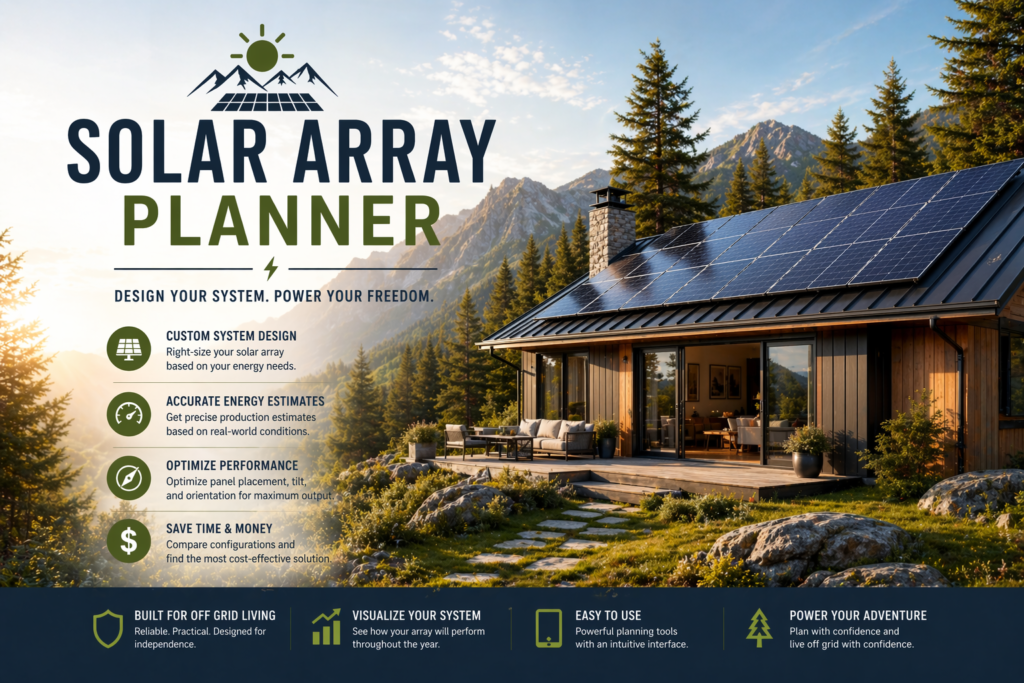
Solar Panel Array Size Calculator
Calculate the exact solar panel array size required to meet your energy needs based on daily consumption, peak sun hours, and real-world system efficiency. This tool helps you determine how many panels you need and the total system capacity for both grid-tied and off-grid setups.
Use Simple Mode for quick estimates or Advanced Mode to model appliances, usage patterns, efficiency losses, and safety margins for a planning-grade solar array design.
How the Calculation Works
A solar panel array size calculator works by matching your daily energy demand to the amount of solar energy your system can realistically produce. The core calculation starts with your daily electricity usage in kilowatt-hours, then divides that by your available peak sun hours and system efficiency. This reveals the minimum solar array size needed to generate enough power each day.
In real-world planning, solar array sizing must also account for inverter losses, battery losses in off-grid systems, wiring inefficiency, temperature effects, and a safety margin. Advanced mode improves accuracy by letting you enter multiple appliances, device quantities, duty cycles, and custom efficiency settings so the result is not just a rough estimate, but a decision-grade sizing model.
Step 1
Calculate your total daily energy use in kWh from appliances, electronics, tools, pumps, lighting, or household systems.
Step 2
Enter your average peak sun hours to estimate how much energy your panels can generate per day in your location.
Step 3
Apply system efficiency losses so the result reflects real solar production rather than ideal lab conditions.
Step 4
Convert the result into total array size in watts or kilowatts, then estimate the number of panels required.
Core formula concept: Daily Energy Use ÷ (Peak Sun Hours × System Efficiency) = Required Solar Array Size. If you also want panel count, divide the final array wattage by the watt rating of each solar panel.
Solar Inverter Size Calculator
Size your inverter the right way — factor in real-world surge loads, appliance inefficiencies, and safety headroom so your system actually runs everything you plug in.
1. Enter Your Loads
Choose a quick estimate or build an appliance-by-appliance load list for the most accurate sizing.
2. Inverter Preferences
These settings shape the recommended inverter class. Leave defaults if you’re unsure.
Sized for your loads
Based on your inputs, here’s the minimum inverter capacity to run everything safely and reliably.
Detailed Breakdown
Common inverter sizes for your load
How Your System Flows
The inverter sits between your DC battery bank and your AC appliances — its size is determined by the biggest load you’ll ever run at once.
Frequently Asked Questions
What size inverter do I need for my off-grid system?
Pure sine vs modified sine — does it really matter?
Why do fridges and motors need so much surge wattage?
Can I use one big inverter instead of sizing carefully?
What’s the relationship between inverter size and battery size?
Should I go 12V, 24V, or 48V?
Continue Planning After Sizing Your Solar Array
Once you estimate how large your solar array needs to be, the next step is validating whether your panels can actually produce enough energy, whether your battery bank can store it, whether your inverter can handle the loads, and whether the full system is balanced properly.
Solar Panel Output Calculator
Check how much energy your planned array can realistically generate in real-world conditions.
Battery Bank Size Calculator
Match your solar array to the battery capacity needed to store enough usable energy.
Solar Inverter Size Calculator
Confirm that your inverter is properly sized for the loads your array and battery system will support.
Complete Solar System Calculator
Bring your array, storage, and power requirements together in one broader system check.
Did You Know
Most Solar Arrays Are Sized Too Small
Many solar systems are undersized because they are based on ideal output instead of real production. Losses from heat, wiring, inverter conversion, and seasonal changes reduce actual performance.
Panel Wattage Changes Panel Count
Two systems can have the same total array size but require a different number of panels depending on whether you use 300W, 400W, or 550W modules.
Sun Hours Drive System Size
A home using the same amount of electricity may need a much larger solar array in an area with 3.5 peak sun hours than in a location with 6 peak sun hours.
Efficiency Loss Can Be Major
Real-world solar systems often operate at only 75% to 85% efficiency after accounting for inverter losses, wiring resistance, dirt, shading, and temperature effects.
Key Insight: Solar array sizing is not just about energy usage. The final result depends heavily on sun hours, efficiency, panel wattage, and how much safety margin you include.
Results Interpretation
Your results show the solar array size required to meet your daily energy demand and the number of panels needed based on your selected panel wattage. These values include real-world efficiency losses and any safety margin applied in advanced mode.
Solar Array Size (kW)
This is the total system capacity required to generate enough electricity daily. Larger values indicate higher energy demand or lower sunlight availability.
Number of Panels
This shows how many solar panels are needed based on your chosen panel wattage. Higher wattage panels reduce the total number required.
Adjusted System Size
In Advanced Mode, this includes safety margin and real-world adjustments to ensure your system performs reliably under varying conditions.
System Classification:
• Small (0.5–2 kW): Basic systems, cabins, or low energy use
• Medium (2–6 kW): Average homes with moderate usage
• Large (6–10 kW): Full homes with higher demand
• Very Large (10+ kW): High consumption or large properties
If your system falls into a higher category, consider optimizing energy usage or increasing system efficiency to reduce overall system size and cost.
Example Calculation
This example shows how to calculate the solar panel array size and number of panels required using real-world inputs including efficiency and panel wattage.
System Inputs
Daily Energy Use: 6 kWh/day
Peak Sun Hours: 5 hours
System Efficiency: 80%
Panel Wattage: 400W
Array Formula
Array Size = Daily kWh ÷ (Sun Hours × Efficiency)
Panel Formula
Panels = (System kW × 1000) ÷ Panel Wattage
Step-by-Step Breakdown
Step 1: Convert efficiency
80% = 0.80
Step 2: Calculate system size
6 ÷ (5 × 0.80) = 6 ÷ 4 = 1.5 kW
Step 3: Calculate number of panels
(1.5 × 1000) ÷ 400 = 1500 ÷ 400 = 3.75 → 4 panels
Step 4: Final result
Required system is 1.5 kW with 4 solar panels
System Size
Panels Required
System Category
Real-World Tip: Always round up the number of panels and consider adding extra capacity to account for seasonal changes, panel degradation, and unexpected energy demand.
How To Use
Use this calculator to determine the exact solar panel array size and number of panels needed for your setup. Follow the steps below to get an accurate and practical system estimate.
Step 1: Enter Daily Energy Usage
In Simple Mode, enter your total daily energy consumption in kWh. In Advanced Mode, add appliances individually for a detailed and accurate calculation.
Step 2: Input Peak Sun Hours
Enter your average daily peak sun hours. This determines how much solar energy your system can generate each day.
Step 3: Set System Efficiency
Adjust efficiency to reflect real-world losses such as inverter conversion, wiring, shading, and temperature impact.
Step 4: Enter Panel Wattage
Input the watt rating of the solar panels you plan to use. Higher wattage panels reduce the total number required.
Using Advanced Mode (Recommended)
Advanced Mode allows you to model your system using real appliance data and apply a safety margin. This provides a far more accurate and reliable system size.
- Add multiple appliances with actual wattage
- Adjust usage hours and quantities
- Set system efficiency based on real conditions
- Apply a safety margin for reliability
Simple Mode
Ideal for quick estimates when you already know your daily energy usage.
Advanced Mode
Best for detailed planning using real appliance data and customizable system variables.
Best Practice: Always round up your results and include a safety margin to ensure your system performs reliably in all conditions.
Expert Tips
Proper solar array sizing goes beyond basic calculations. These expert tips help ensure your system performs efficiently, reliably, and is built for long-term use.
Always Oversize Slightly
Add 10–25% extra capacity to your solar array to compensate for seasonal variation, panel degradation, and unexpected energy demand.
Use High Efficiency Panels
Higher wattage panels reduce the number of panels required, saving space and simplifying installation, especially in limited roof or land areas.
Optimize Panel Placement
Proper tilt, angle, and orientation significantly impact output. Poor placement can reduce production even with a correctly sized system.
Reduce Load First
Lowering your energy consumption with efficient appliances can dramatically reduce the required solar array size and system cost.
Advanced Planning Considerations
- Account for inverter efficiency (90–95%)
- Consider shading and dirt impact on panels
- Factor in seasonal sun hour variation
- Allow for future system expansion
- Use real appliance data whenever possible
Recommended Oversizing
Real System Efficiency
Common Panel Range
Expert Insight: The best solar systems are designed with flexibility, efficiency, and future growth in mind—not just minimum requirements.
Comparison Table
This table shows how different energy usage levels affect solar array size and the number of panels required. Use it to quickly estimate where your system fits.
Key Insight: Increasing panel wattage reduces panel count, but total system size remains the same. System design should balance space, cost, and efficiency.
Visual Insight
Solar array size increases rapidly as energy demand rises. The relationship is not perfectly linear due to system losses, safety margins, and real-world conditions.
Solar Array Growth by Energy Usage
Low Usage (1–3 kWh/day)
Moderate Usage (3–10 kWh/day)
High Usage (10–20 kWh/day)
Very High Usage (20+ kWh/day)
Efficiency Impact
Lower system efficiency increases required solar array size. Small efficiency losses can lead to significantly larger system requirements.
Sun Hours Effect
Locations with fewer sun hours require larger arrays to produce the same amount of energy as sunnier regions.
Planning Insight: Reducing energy usage has the biggest impact on system size. Even small reductions in daily consumption can significantly lower solar array requirements.
Planning Advice
A well-planned solar array ensures consistent performance, lower long-term costs, and the ability to scale as your energy needs grow. Use these principles to design a system that works reliably in real-world conditions.
Size for Real Conditions
Always base your system on real-world efficiency and worst-case sun conditions, not ideal estimates.
Leave Room for Expansion
Plan your system layout and inverter capacity so you can add more panels later without major redesign.
Match Panels to Space
Choose panel wattage based on available installation space. Higher wattage panels maximize output in limited areas.
Optimize System Balance
Ensure your inverter, battery (if used), and solar array are properly matched to avoid bottlenecks or inefficiencies.
Common Planning Mistakes
- Using ideal efficiency instead of real-world values
- Ignoring seasonal variation in sunlight
- Underestimating energy consumption
- Choosing panels without considering space constraints
- Failing to include a safety margin
Recommended Margin
Real Efficiency Range
Panel Wattage Range
Final Advice: The best solar array systems are designed with flexibility, efficiency, and future growth in mind—not just minimum requirements.
Key Expansion Insights
How many solar panels do I need for my home?
The number of solar panels needed depends on your daily energy usage, sun hours, system efficiency, and panel wattage. Most homes require anywhere from 10 to 30 panels, but accurate sizing requires factoring in real-world losses and adding a safety margin.
What size solar array do I need?
Solar array size is calculated by dividing your daily energy usage by peak sun hours and system efficiency. Typical residential systems range from 3 kW to 10 kW depending on energy demand and location.
How do I calculate solar panel requirements accurately?
Accurate calculations require total daily energy usage, peak sun hours, system efficiency, and panel wattage. Advanced calculations also include appliance-level inputs, usage patterns, and safety margins for reliable results.
How does panel wattage affect system design?
Higher wattage panels reduce the number of panels needed for the same system size. This is important for installations with limited space or when optimizing layout and efficiency.
What happens if my solar array is too small?
An undersized solar array will not produce enough energy to meet your needs, leading to reliance on grid power or battery depletion in off-grid systems. Proper sizing ensures consistent and reliable performance.
Solar array sizing, answered
Practical answers to the questions people actually ask after their first pass through the calculator — covering sizing math, seasonal reality, and the trade-offs no spec sheet tells you about.
How do I calculate what size solar array I need?
Work the math in three steps — the calculator does this automatically, but it helps to understand what’s happening under the hood:
- Daily energy — add up the watt-hours of everything you’ll run in 24 hours (the Daily Consumption Calculator handles this).
- Peak sun hours — the equivalent hours per day your location receives at full 1000 W/m² intensity. Typical ranges: 3.5 in the Pacific Northwest, 5.5 in the Southeast, 6.5+ in the Southwest.
- System efficiency — the fraction that survives wiring loss, inverter loss, battery round-trip, temperature, and soiling. Realistic values land between 0.65 and 0.80.
A household using 6,000 Wh/day with 4.5 sun hours at 75% efficiency needs about 1,780 W of panels. Bump that by 15-25% if you want comfortable winter performance.
How many solar panels will I actually need?
Divide the total array wattage by the wattage of each panel, then round up. The trick is choosing panel wattage that matches your goals:
- 100-200 W panels — portable, easy to mount, good for RVs and small cabins. More connections = more failure points.
- 350-450 W residential panels — the sweet spot for most rooftop and ground-mount builds in 2026.
- 500-600 W commercial panels — fewer units to wire but heavy, hard to handle solo, and often incompatible with smaller charge controllers.
Example: a 2,000 W array needs twenty 100 W panels, or six 350 W panels, or four 500 W panels. Same output — very different install experience and cost.
What’s a realistic array size for an off-grid cabin vs. a grid-tied home?
Very different beasts, because off-grid has to survive the worst week of the year while grid-tied can lean on the utility.
- Tiny cabin / weekend use — 400-1,200 W. Lights, phones, small fridge, a laptop.
- Full-time off-grid cabin (efficient) — 2,000-4,500 W. Full kitchen, well pump, electronics, propane for heat/hot water.
- Off-grid home with heat pump / AC — 8,000-14,000 W plus serious battery storage.
- Grid-tied residential — 5,000-11,000 W is the common range, sized to offset the utility bill rather than stand alone.
If you’re off-grid, always size to your worst-month sun hours, not the annual average. A system that’s perfect in July will be starved in December.
Does picking higher-wattage panels change the system size?
Total array watts stay the same — but panel wattage affects nearly everything else:
- Roof/ground space — higher wattage per square meter means less footprint.
- Mounting hardware — fewer panels = fewer rails, clamps, and penetrations.
- Wiring runs — fewer strings to manage, but higher string voltages.
- Charge controller compatibility — high-wattage panels can exceed the Voc ceiling of smaller MPPTs. Always check Voc at the coldest temperature you’ll see.
- Redundancy — if a 500 W panel in a 4-panel array fails, you lose 25% of production. Spreading the same wattage over 12 smaller panels drops that to ~8%.
What actually happens when an array is undersized?
Undersizing fails gradually — and usually in a season you didn’t plan for. The failure modes in order of how you’ll notice them:
- Batteries don’t fully recharge — they sit at partial state-of-charge day after day, sulfating (lead-acid) or losing usable capacity.
- Generator runtime creeps up — you go from “once a month” to “most evenings” in November.
- Depth of discharge goes too deep — you start pulling past the safe DoD and shortening battery lifespan dramatically.
- Seasonal shutdowns — in short-winter-day climates, an undersized system simply can’t keep up and you either add panels, add a generator, or cut loads.
The fix is almost always adding panels, not batteries. Extra panels help you recover from cloudy stretches; extra batteries just give you more capacity to drain when the sun doesn’t come back.
Is it worth oversizing my solar array?
For off-grid systems, yes — almost always. A 20-30% oversize is the single cheapest insurance policy in solar design. It means:
- You recover battery state-of-charge by mid-afternoon instead of sunset, leaving margin for a cloudy tomorrow.
- Winter performance stays usable without emergency generator runs.
- Panel degradation (0.4-0.8% per year) barely matters — the oversize absorbs it.
For grid-tied systems, oversize economics depend on net-metering rules. In states with 1:1 net metering you can essentially “bank” excess summer production against winter usage. In states with avoided-cost compensation (much lower than retail), aggressive oversizing loses money.
How does shading affect array sizing?
A single shaded cell can knock out most of a panel’s output — and in a series string, it drags down every panel wired with it. Shading is the most underestimated variable in off-grid planning.
Three ways to manage it:
- Avoid it — trim trees, relocate the array, use a ground mount instead of a shaded roof. Always the cheapest option long-term.
- Split strings — wire the sunny panels separately from the occasionally-shaded ones so one doesn’t drag the other down.
- Use optimizers or microinverters — each panel reports independently. Adds cost but recovers 15-25% in partially shaded installs.
If shading is unavoidable for part of the day, bump your array size 20-35% to compensate — then model the shaded hours in the advanced calculator.
Should I size my array around my batteries or the other way around?
Start with your loads — daily watt-hours. Everything else flows from that one number.
- Batteries are sized to carry you through your longest cloudy stretch (usually 2-3 days of autonomy).
- Array is sized to refill those batteries in a single worst-case sunny day — typically 10-14% of bank capacity per hour of peak sun.
- Inverter is sized to the biggest simultaneous load, not to the array.
A useful sanity check: your array wattage (in W) should land roughly between 0.8× and 1.4× your battery bank capacity (in Ah at system voltage). Below that range, you won’t recharge fast enough; above it, you’re wasting panels your batteries can’t absorb.
What’s the difference between STC, PTC, and real-world panel output?
Panels are rated three different ways and most people only see the first:
- STC (Standard Test Conditions) — 1000 W/m² of sunlight, 25°C panel temperature, dead-clean glass. This is the number on the spec sheet. You will almost never see it in real life.
- PTC (PVUSA Test Conditions) — a more realistic 1000 W/m² at 20°C ambient with 1 m/s wind. Typically 10-15% lower than STC.
- Real-world output — factor in temperature losses (panels lose 0.3-0.5% per °C above 25°C), soiling, wiring loss, and inverter efficiency. Most installs produce 70-85% of STC on a good day.
When you size an array with the calculator’s 75% default efficiency, you’re already accounting for this gap. Don’t also discount the panel rating — that’s double-counting the loss.
Ready to run the numbers?
Jump back to the planner and get a full array + battery + inverter sizing in under a minute.
Related Tools for Better Solar Array Optimization
After sizing your array, these tools help refine panel positioning, spacing, wire planning, and broader off-grid layout decisions without duplicating the main next-step links above.
Solar Panel Tilt Calculator
Optimize panel tilt to improve seasonal solar capture and overall array performance.
Solar Panel Angle Calculator
Fine-tune the direction and positioning of your array based on sun path and location.
Solar Panel Spacing Calculator
Prevent self-shading and improve layout efficiency by estimating proper panel spacing.
Solar Wire Size Calculator
Check your cable sizing to reduce voltage drop and support safe current flow from your array.