How the Alternative Power System Planner Works
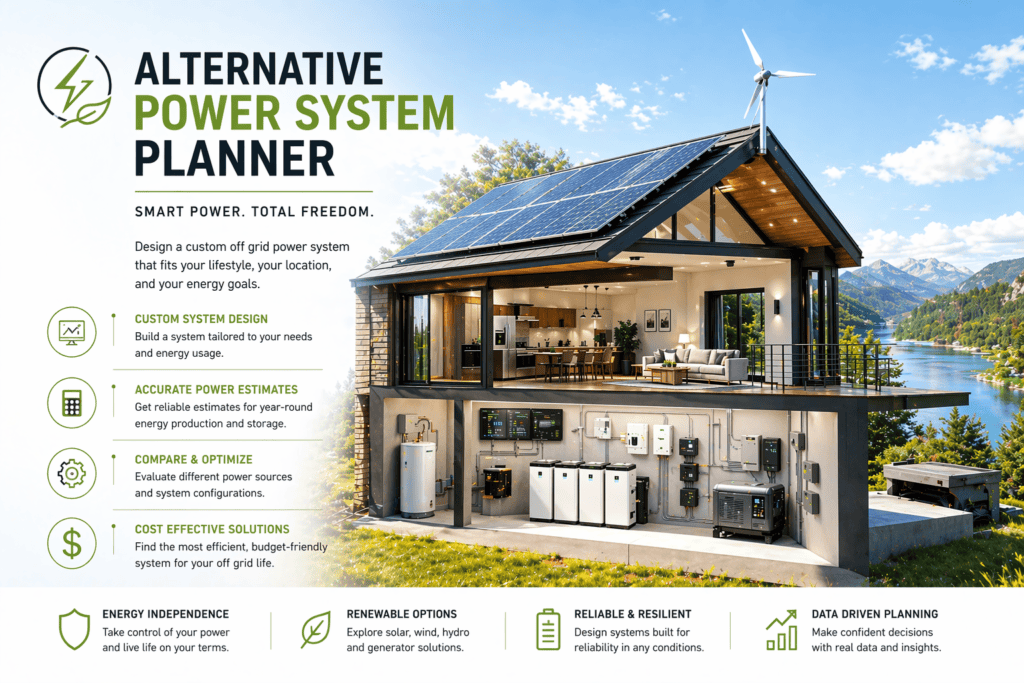
This planner helps you compare off-grid power solutions by analyzing your daily electricity usage, intended use case, and overall budget. Instead of guessing which setup you need, the tool estimates the most practical system type based on the amount of energy you use and how dependable your power needs are.
It evaluates the right balance of solar panels, battery storage, and generator backup so you can choose between a solar-only setup, a hybrid system, or a backup-focused solution. The goal is to give you a realistic starting point for planning a dependable and cost-efficient alternative power system.
Enter Your Power Needs
Start with your daily energy use in watt-hours, then select whether the system is for a home, cabin, RV, or emergency backup. This defines how much power capacity and runtime your setup must support.
Compare System Options
The planner compares different combinations of solar, batteries, and generator backup to determine which solution best fits your energy use, reliability needs, and available budget.
Get a Recommended Setup
You’ll receive a suggested system type, estimated solar size, battery capacity guidance, generator recommendation, and an overall cost range so you can plan your next steps with more confidence.
The right power system is not always the biggest one
Oversized systems waste money, and undersized systems create frustration when you need dependable power the most. This planner helps you find the middle ground by matching your actual energy demand to a more realistic and effective alternative power strategy.
What is the best alternative power system for most off-grid users?
For most people, the best alternative power setup is a hybrid system that combines solar panels, battery storage, and generator backup. Solar handles daily energy production, batteries store power for nighttime or cloudy periods, and a generator adds protection when demand spikes or weather reduces solar output.
A solar-only setup can work for light energy use, but homes, cabins, RVs, and emergency backup systems usually benefit from hybrid planning. The right setup depends on your daily watt-hour usage, how many days of backup you want, and whether you need dependable power year-round or only during outages.
Alternative Power System Planner
Skip the generic calculators. Build a system that actually matches your use case, budget, and reliability needs — now with full inverter sizing, 12/24/48 V recommendation, regional solar estimates, and winter derating built in.
1 Tell us about your setup
Answer a few questions — or switch to advanced mode to build your load list appliance by appliance.
Validate Your System Components
After planning an alternative or hybrid power setup, the next step is validating each major component. These calculators help confirm whether your solar generation, battery storage, inverter capacity, and full system design are properly matched.
Battery Discharge Calculator
Verify your battery discharge to check and validate energy balance and performance.
Solar Panel Output Calculator
Check how much solar energy your system can contribute alongside other power sources.
Battery Bank Size Calculator
Ensure your battery storage can support mixed energy inputs and real-world usage demands.
Solar Inverter Size Calculator
Confirm your inverter can handle combined loads from multiple power sources safely.
How to Read Your Alternative Power System Results
The planner does more than estimate solar wattage or battery size. It helps you understand what kind of system makes the most sense for your usage level, how much reserve power you may need, and where your budget is likely to have the biggest impact on overall system performance.
Recommended System Type
This tells you whether a solar and battery setup, a hybrid system, or a battery plus generator backup design is the most practical match for your energy demand and reliability target. This is one of the most important outputs because it helps prevent overbuilding or choosing the wrong system strategy.
Solar, Battery, and Runtime Guidance
Your solar result shows the estimated array size needed to support daily production. Battery capacity reflects how much stored energy you may want for reserve power, and runtime helps you understand how long your system could support average demand before recharging is needed.
Fit Score and Cost Range
The fit score shows how well the recommended system aligns with your current inputs. The cost range gives you a planning estimate for the total setup and major components, helping you decide whether to keep the design as is, simplify it, or invest in more reliability.
What your results should help you decide
Your results should help you answer three practical questions: What type of system do I really need? How much backup should I plan for? and Am I close to a realistic budget? A good result is not always the largest or most expensive system. In many cases, the smarter setup is the one that gives you dependable coverage without wasting money on unused capacity.
If your estimated cost looks too high, the most effective adjustment is usually reducing daily loads, lowering backup day expectations, or starting with a more focused essential-load system. If your reliability target is high, a hybrid setup often makes more sense than trying to force a solar-only design into a role it may not handle consistently.
Example: Designing an Off-Grid Power System
Here’s a realistic example showing how the planner can be used to design a dependable alternative power system for a small cabin setup.
Example Inputs
System Breakdown
- Solar Array: ~1,000–1,200 W
- Battery Storage: ~7–8 kWh
- Generator Backup: ~3–4 kW
Estimated Cost
$6,500 – $9,000 depending on equipment quality, battery type, and system components.
Why this setup makes sense
With a daily energy demand of around 3.2 kWh and a goal of two days of backup power, a battery-only system would require a relatively large and expensive storage capacity. Adding solar helps recharge the system daily, while a generator provides additional reliability during extended cloudy conditions or higher-than-expected energy usage.
This hybrid approach balances cost and dependability. Instead of oversizing the solar array or battery bank, the system uses a combination of generation and backup sources to maintain power without unnecessary expense.
How to Use the Alternative Power System Planner
Follow these steps to get the most accurate and useful system recommendation. The more realistic your inputs, the better your results will reflect a real-world setup.
Enter Your Energy Usage
In simple mode, enter your total daily watt-hours. In advanced mode, add appliances to build a more accurate energy profile.
Select Your Use Case
Choose whether your system is for a home, cabin, RV, or emergency backup. This changes how the system is optimized.
Set Budget and Backup Goals
Adjust your budget and backup days to balance cost and reliability. Higher backup targets increase system size.
Review Your System Plan
Analyze the recommended setup, cost breakdown, runtime, and upgrade suggestions before making purchasing decisions.
Expert Tips for Designing a Better Power System
These practical insights will help you avoid common mistakes, reduce unnecessary costs, and build a system that performs reliably in real-world conditions.
Design for Reality, Not Ideal Conditions
Solar production varies daily, and battery performance depends on temperature and usage. Always include a buffer in your system design instead of relying on perfect conditions.
Battery Capacity Is More Important Than Panel Size
Many systems fail not because of insufficient solar, but because of limited battery storage. If your system runs out of power overnight, more panels alone will not fix the problem.
Hybrid Systems Provide the Best Reliability
A combination of solar, battery, and generator backup reduces risk. It ensures you still have power during poor weather or unexpected spikes in demand.
Start With Essential Loads First
Identify what absolutely needs to run—refrigeration, lighting, communication—before adding comfort loads. This helps keep your system efficient and cost-effective.
Avoid Oversizing Everything
Bigger systems cost significantly more and often provide diminishing returns. Aim for a system that matches your actual usage instead of planning for unrealistic worst-case scenarios.
Plan for Future Expansion
Choose components that allow for expansion, such as scalable battery systems or additional solar inputs. This makes upgrades easier and more cost-effective later.
Key Insight
The best alternative power system is not the one with the highest capacity—it’s the one that consistently meets your daily needs with the least complexity and cost. Focus on balance, not maximum output.
Solar vs Battery vs Hybrid Power Systems
Understanding the differences between system types helps you choose the right setup for your needs. Each option has advantages depending on cost, reliability, and how often you expect to rely on backup power.
| System Type | Best For | Pros | Limitations |
|---|---|---|---|
| Solar + Battery | Light to moderate off-grid use | Clean energy, low ongoing cost, quiet operation | Limited during poor sunlight, requires larger battery for reliability |
| Battery + Generator | Emergency or backup power | Reliable in all conditions, lower upfront solar cost | Fuel dependency, noise, ongoing operating cost |
| Hybrid System | Full-time off-grid or high reliability | Balanced, dependable, flexible under varying conditions | Higher upfront cost, more complex setup |
Solar + Battery Systems
Ideal when you want a clean and low-maintenance system. Works best when daily usage is moderate and sunlight is consistent.
Battery + Generator Systems
Best suited for backup situations where reliability matters more than efficiency. Provides power regardless of weather conditions.
Hybrid Systems
Combines the strengths of both approaches. Provides consistent power while reducing reliance on fuel and minimizing downtime.
How Alternative Power Systems Work Together
A well-designed system is not just about individual components—it’s about how solar generation, battery storage, and backup power work together to create a stable and dependable energy flow.
How energy flows through your system
During the day, solar panels generate electricity and supply power directly to your loads while charging your battery. When solar production drops, your battery provides stored energy to keep everything running smoothly.
If your energy demand exceeds what your solar and battery can provide, a generator or backup source activates to maintain reliability. This layered approach ensures your system stays functional even under changing conditions.
How to Plan a Reliable Alternative Power System
Planning your system correctly from the start will save you money, prevent performance issues, and ensure your setup works when you need it most. Use the guidelines below to build a system that is both practical and dependable.
Start With Your Daily Energy Use
Your total daily watt-hour usage is the foundation of your system. Underestimating this number is one of the most common causes of system failure.
Match System Size to Real Needs
Avoid designing for unrealistic worst-case scenarios. Build a system that covers your typical usage with a reasonable buffer instead of extreme overcapacity.
Plan Backup Based on Risk
If you depend on consistent power, include generator backup or additional battery storage. For lighter use, a simpler setup may be enough.
Optimize Before Expanding
Improving efficiency and reducing unnecessary loads often has a greater impact than simply increasing system size.
Keep Systems Flexible
Choose components that allow expansion. This gives you the ability to upgrade your system without starting from scratch.
Balance Cost and Reliability
The goal is not the cheapest system or the most powerful system—it’s the one that consistently meets your needs without unnecessary cost.
Final Planning Insight
A well-designed alternative power system is not built around maximum output—it is built around consistency. Focus on creating a system that performs reliably under real conditions, not just ideal scenarios.
Alternative power systems, explained
Answers to the questions that matter most when you’re weighing solar, battery, and generator options — with the real trade-offs generic calculators never tell you about.
What’s the best alternative power system for a home?
“Best” depends on three site-specific variables: how much sun you get, how critical your uptime is, and how remote you are.
- Grid-tied with battery backup — best if you have reliable utility service. You stay connected, pay less through net metering, and only tap batteries during outages.
- Hybrid off-grid (solar + battery + generator) — the most dependable setup for permanent off-grid homes. Solar carries 90-95% of the year; battery smooths evenings and short cloudy periods; generator fills the 5-10% worst-case gap without requiring 50% more panels.
- Solar-only with oversized battery — works beautifully in sun-rich regions (Southwest US, interior Australia) but costs 30-50% more than hybrid to hit the same reliability.
For most homeowners weighing this decision, hybrid wins on cost-per-reliability because the generator is cheap insurance against the tail-end weather events a bigger array would need to cover.
How much battery storage do I actually need?
The formula is straightforward, but the inputs trip people up:
- Daily load — your actual watt-hour consumption, not a guess. Build it appliance by appliance.
- Days of autonomy — how long the battery must carry the full load with zero solar input. 1 day for backup-only; 2-3 days for full-time off-grid.
- Usable DoD — 0.80-0.90 for lithium, 0.50 for lead-acid.
A household using 8 kWh/day wanting 2 days of autonomy on lithium needs 8 × 2 ÷ 0.85 = ~19 kWh of nameplate battery capacity. On lead-acid, the same scenario needs ~32 kWh — which is why lithium’s higher upfront cost pays back fast for most off-grid builds.
Is a generator really necessary in an off-grid system?
Not strictly necessary — but the economics almost always favor having one. Here’s the math:
To cover a 5-day cloudy stretch without a generator, you need either 5 days of battery autonomy (expensive battery bank) or an oversized solar array that can recharge in low-sun conditions (expensive panel bank). A small generator sized to run 20-40 hours per year costs $1,000-$3,000 and solves the same problem.
Generator-free makes sense when:
- You’re in a region with 5+ peak sun hours year-round and rarely see multi-day overcast.
- Noise and fuel logistics are deal-breakers (dense neighborhood, remote cabin with no road access).
- Your loads are highly flexible — you can cut back 50%+ during dark weeks without issue.
For everyone else, a modestly-sized generator is the cheapest reliability you can buy.
Propane, gasoline, or diesel generator — which makes sense?
For off-grid backup use specifically (not primary power), the ranking flips from what you’d see in a construction or RV context:
- Propane — the default choice for most off-grid homes. Stores indefinitely (unlike gasoline), clean-burning, quieter, and pairs with tanks you may already have for heat/cooking. Downside: slightly lower energy density per gallon.
- Dual-fuel (propane/gas) — the practical sweet spot. Run on propane day-to-day; switch to gasoline if propane runs out.
- Gasoline — cheap up front, but fuel goes stale in 6-12 months even with stabilizer. Only makes sense if you use the generator frequently enough to cycle through fuel.
- Diesel — the right answer only above ~10 kW or when you need continuous-duty operation. Overkill for backup use; the maintenance and noise don’t justify the efficiency gain at backup scale.
Can I run a whole house on solar alone?
Technically yes — practically, with real compromises. Two paths exist:
- Grid-tied solar — the grid acts as your “battery.” You produce during the day, push excess to the utility, pull power back at night. Works everywhere grid is available and net metering exists.
- Solar + oversized battery (off-grid) — requires significant oversizing. For a typical 20 kWh/day home, you’re looking at 12-15 kW of solar and 40-60 kWh of battery to ride through winter comfortably. Expect $60K-$100K+ for equipment alone.
The honest truth: unless you’re in the sunbelt and budget-insensitive, solar-alone off-grid means either massive oversizing or dramatic lifestyle adjustments in winter. Most “solar-only” off-grid homes quietly add a generator within two years.
How accurate are system sizing estimates from planners like this one?
Good for planning, not for purchasing. A realistic expectation:
- ±10-15% on sizing (panel wattage, battery kWh) when your inputs are accurate.
- ±20-30% on cost, because equipment pricing varies by brand, installer, and region.
- ±40% or worse if you guessed at daily energy use instead of measuring it.
Before committing, always: measure your actual consumption with a Kill-A-Watt or whole-house monitor for at least a month; get 2-3 quotes from local installers (or price the DIY BOM against sites like Signature Solar or Current Connected); and account for winter sun hours, not summer, if you’re off-grid.
The planner output is a map — not the GPS directions.
What’s the best way to reduce the cost of an alternative power system?
Cost-cutting has a clear pecking order. Work from top to bottom:
- Cut loads first. Every 1 kWh/day you eliminate saves ~$700 in batteries and ~$300 in panels. Swap resistive loads (electric heat, hot water, cooking) to propane or wood. Replace old appliances with efficient ones.
- Go DIY or hybrid-install. DIY panel racking and battery assembly can cut equipment cost 20-40%. Hire a pro only for the AC panel tie-in and permitting.
- Buy the battery twice. Counterintuitive — but starting with a smaller bank and adding more in year 2-3 spreads capital and lets you right-size based on real usage data.
- Tax credits matter. The US residential clean energy credit (30% through 2032) applies to off-grid systems too, including batteries. Don’t skip this on your tax return.
- Don’t oversize “just in case.” Each 10% of oversizing costs 10% more. Oversizing is only worth it when you’ve already cut loads and tightened the design.
Lithium (LiFePO4) vs lead-acid — which should I pick in 2026?
LiFePO4 has won the off-grid battery war. In 2026, the only reasons to still buy lead-acid are very specific:
- You need a truly rock-bottom upfront budget and can tolerate 3-5 year replacement cycles.
- You already own a working lead-acid bank and just want to expand without mixing chemistries.
- You’re in a remote region where LiFePO4 shipping and support are impractical.
For everyone else, LiFePO4 wins on nearly every metric: 3,000-6,000 cycle life (vs 500-1,200 for lead-acid), 80-90% usable capacity (vs 50%), half the weight for the same usable kWh, no ventilation or watering required, and tolerant of partial states of charge that wreck lead-acid banks. The cost gap has closed dramatically — LiFePO4 is now $250-$400/kWh for DIY cells, making it cheaper over its lifespan than lead-acid.
Should I hire a pro or build it myself?
The right answer depends on your comfort with electrical work, your local code requirements, and whether you want warranties and insurance coverage.
Go DIY if: you’re comfortable with 120V/240V AC wiring and DC fundamentals, you live somewhere permits for off-grid systems aren’t required (or are permissive), and you’re willing to study the NEC sections on PV and energy storage. Savings: 30-50% on the total build.
Hire a pro if: you want the 30% federal tax credit without audit risk (pro-installed systems have cleaner documentation), your homeowners insurance requires certified installation, or you’re doing a grid-tied interconnect that requires utility approval. Expect $1.50-$2.50/W of system size for full-service installation.
Hybrid approach (increasingly common): DIY the racking, panels, and battery assembly. Hire a licensed electrician for the service-entrance tie-in, critical-loads panel, and any grid interconnect. This captures 70% of the DIY savings while keeping the parts that really need a licensed signature above board.
When is it worth adding wind or hydro to a solar system?
Rarely — but the cases where it’s worth it are clear-cut.
- Micro-hydro is the best alternative to solar if you have it. A small stream with 20+ feet of head producing even 200W continuously delivers 4.8 kWh/day regardless of weather — equivalent to roughly 1,500W of solar panels in a sunny climate. If you own the site, this is a game-changer.
- Wind only makes sense with average wind speeds above 10 mph and an open site free of turbulence. Below that threshold, a small turbine produces far less than marketers claim and competes poorly with simply adding more solar panels. Real-world residential wind is disappointing in most locations.
- The complementary case: winter wind often picks up when solar production drops. In parts of the Great Plains and coastal regions, a modest wind turbine can smooth the worst month’s output — but verify with a real anemometer at hub height for 6-12 months before committing.
For the vast majority of sites, more solar and a generator beat adding a wind turbine on pure cost-per-kWh.
Ready to plan your system?
Jump back to the planner and get a full sizing breakdown with solar, battery, generator, and cost estimates.
Related Tools for Hybrid System Optimization
These tools help refine system behavior, runtime expectations, wiring, and real-world performance without repeating the main validation steps above.
Solar Generator Runtime Calculator
Estimate how long generator-based or backup systems can run your essential loads.
Solar Battery Runtime Calculator
Understand how long your battery system can sustain your loads between charge cycles.
Solar Wire Size Calculator
Ensure safe and efficient current flow across all system components.
Solar Panel Cost Calculator
Estimate total system costs and compare different power system setups financially.