
Off Grid Solar System Size Calculator
Use this off grid solar system size calculator to estimate solar array capacity, panel count, battery storage and continuous inverter power. Choose “Help me choose my appliances” for a guided start, or “I already know my energy use” for quick entry. Discover how many solar panels you need from your kWh per day, battery needs and running loads.
This is a planning model under stated assumptions. It does not verify installation safety, equipment compatibility, startup surge capacity or uninterrupted power through every weather condition.
Jump to the calculator · Read the sizing guide · Methodology and limitations
Quick Answer: How big should your off-grid solar system be?
For 5 kWh/day, 80% solar delivery, a 25% solar margin and 400W panels:
1.5625kW minimum · 4 panels (1.6kW installed)
3.125kW minimum · 8 panels (3.2kW installed)
The calculator initially uses the lower-sun basis. With two autonomy days, 80% allowed DoD, 90% combined battery-to-load delivery and no extra battery margin, both connected tools give 13.89kWh nominal storage before module rounding. Replace these examples with site-specific seasonal sun values.
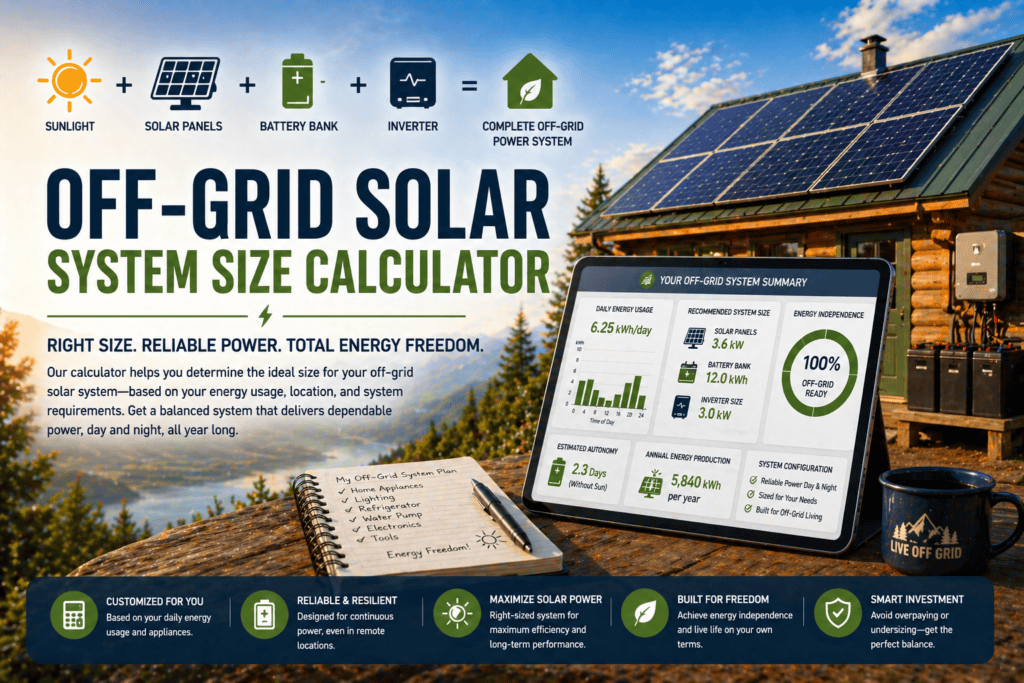
Calculate your off-grid solar, battery and inverter size
Build a preliminary power plan, one appliance at a time. See daily energy, solar panels, battery storage and continuous inverter power, with editable assumptions.
Quick entry · editable 5 kWh worked example
1. What are you powering?
Illustrative use cases only; replace their values with your actual loads and site conditions.
Use peak sun hours for your least sunny operating month. Daylight hours are not peak sun hours.
These answers guide your planning notes. They do not guess your energy use or change your solar settings.
Replaces direct energy and system settings after confirmation. Does not change your appliance list.
3. Review your preliminary plan
Review your daily energy and appliances below. Open settings to enter local seasonal sun hours, autonomy, battery assumptions and panel wattage. Occasional use still needs energy for each occupied day; it is not averaged over unused days.
Detailed solar, battery & sizing settings
Solar Resource & System Settings
Use peak sun hours and the combined solar-array-to-useful-energy efficiency. Stored energy uses a separate editable combined battery-to-AC-load delivery factor (90% initially), including inverter losses once.
Important default: Conservative low-sun sizing is enabled and uses the lower of 5.0 normal or 2.5 low-sun peak hours. This changes the required panel count. Switch to “Normal operating sun hours” only when that basis matches the intended use season.
Illustrative conversion/wiring factor for stored energy reaching loads; do not include losses twice.
Enter a representative lower-production operating period. Solar panels are sized using the lower of this and normal sun hours when low-sun sizing is enabled below.
Illustrative 1.2 × nominal DC voltage; replace with manufacturer charge-voltage factor. Controller selection still requires PV Voc, cold-weather voltage, Isc, and manufacturer limits.
Editable manufacturer-based allowance. Selecting a chemistry starting assumption reloads its example DoD.
Separate from solar/inverter design margin; carried to Battery Bank without adding it twice.
Sizing Preferences
Add safety margin and choose a common panel wattage for panel count.
Optional. Zero means not provided, NOT that equipment has no startup surge. Guided mode derives conservative simultaneous-start demand from entered appliances.
Enter the manufacturer/measured required duration when known. Zero means unknown.
Normal sun and low sun, side by side
Same daily load, efficiency, margin and panel rating; only sun hours change. The main result follows your selected sizing basis.
—
—
Your Preliminary Power Plan
Quick-entry worked example; replace the inputs with your own.
Planning estimates update as valid inputs change; manufacturer specifications still govern equipment selection.
Estimated Solar Production Coverage
Estimated average-day production versus daily load, not guaranteed daily coverage.
—
System Component Summary
Seasonal and startup checks are preliminary.
Planning-level component sizes based on your inputs.
| Component | Recommendation | Why It Matters |
|---|
How This Was Calculated
Solar array kW = daily load kWh ÷ peak sun hours ÷ solar delivery efficiency, then margin is added.
Explore solar system components
These are examples of equipment categories to research after calculating your solar, battery and inverter requirements. Match actual electrical ratings, voltage, protection and manufacturer specifications before buying.
This section contains affiliate links. We may earn a commission.
Renogy 200W Monocrystalline Solar Panel
A panel option to compare with your estimated array wattage, roof area and string design.
Click for the latest price.Victron SmartSolar MPPT 100/50 Controller
Explore MPPT charge control. Its voltage and current limits may be too small for your calculated array.
Click for the latest price.LiTime 12V 100Ah LiFePO4 Battery
Compare usable storage, BMS current, temperature limits and series/parallel permissions.
Click for the latest price.Renogy 3000W 12V Pure Sine Wave Inverter
Compare AC output and surge performance. A 12V inverter does not suit a 24V or 48V bank.
Click for the latest price.How to size an off-grid solar system from your daily loads
Collect daily energy and operating power separately before choosing equipment. A home using 5kWh/day can have very different inverter needs depending on whether its appliances run together. Battery voltage alone does not tell you how much energy is stored.
| Planning question | Input you need | What it controls |
|---|---|---|
| How much energy do appliances use? | Measured kWh/day, or watts × hours × quantity | Daily production and storage demand |
| How much seasonal sunlight is available? | Local peak sun hours for the operating season | Array size, alongside losses and design margin |
| How long must storage cover demand? | Autonomy days, allowed DoD and battery delivery factor | Nominal battery kWh before module rounding |
| Which appliances run or start together? | Concurrent running watts and separate startup data | Continuous inverter estimate and further surge checks |
Is 5kWh per day the same as a 5kW solar system?
No. kWh/day is daily energy; kW is power capacity. With 5kWh/day demand, 2.5 peak sun hours, 80% solar delivery and a 25% array margin, required array capacity is 5 × 1.25 ÷ 2.5 ÷ 0.80 = 3.125kW. Eight 400W panels provide 3.2kW of nameplate capacity after rounding. That result is specific to these assumptions and does not imply a 3.2kW inverter.
Use measured demand from the Solar Energy Consumption Calculator, then compare a proposed battery and daily solar recharge in the Daily Solar Consumption Planner. Choose an actual inverter only after reviewing its continuous and startup specifications against your loads.
How to use the off grid solar system size calculator
- Enter daily energy use in kWh and the simultaneous running load in watts. These are different quantities: energy sizes production and storage, while operating power helps size an inverter.
- Alternatively, choose the guided appliance builder. Daily energy is watts × hours × quantity ÷ 1,000, or measured Wh/day × quantity ÷ 1,000 (measured kWh/day × quantity). Check “Runs together” for appliances that may operate at the same time; checked active appliances are summed as one operating group. Unchecked active appliances form separate groups, each including its full quantity. The largest group sets running power. Separate groups must not overlap with any other group. Unchecking Runs together does not remove an appliance’s daily energy; use Include to exclude it entirely. Starting watts may be entered per appliance; missing starting values remain unverified and no automatic safe inverter model is selected.
- Enter season- and location-specific peak sun hours and solar production efficiency. Peak sun hours are equivalent full-power solar hours, not daylight duration.
- Select the battery depth-of-discharge assumption, autonomy days and nominal system voltage. Check the actual battery specifications rather than treating a chemistry preset as a universal limit.
- Set panel wattage and design margin, then review the array, storage and power results separately.
Solar array sizing formula
Required array kW = daily kWh × (1 + margin fraction) ÷ peak sun hours ÷ solar efficiency. Divide required array watts by one panel rating and round up to a whole panel. Installed array capacity reflects that rounded count.
Battery and inverter assumptions
Nominal battery kWh = daily AC kWh × autonomy days ÷ allowed DoD ÷ combined battery-to-load delivery × (1 + battery capacity margin). The calculator defaults to an editable illustrative 90% battery-delivery factor. Nominal Ah equals nominal battery Wh divided by system voltage. The solar/inverter design margin is separate from the explicit battery capacity margin. Battery Bank Simple mode uses this same combined-factor model; Advanced mode multiplies its separate battery and inverter factors to obtain combined delivery.
Continuous inverter planning watts = simultaneous running watts × (1 + margin), rounded up to 100W. An optional startup demand is displayed separately; blank or zero starting-watt assumptions are explicitly unverified, and inverter selection still requires manufacturer surge curves. The battery-current estimate separately uses a fixed illustrative 90% inverter efficiency: running watts ÷ nominal volts ÷ 0.90.
The controller-current figure is installed array watts divided by a nominal-voltage-based illustrative charging voltage (default 1.2 times nominal). It is an indicative current calculation, not a certified controller recommendation. Panel open-circuit voltage, cold-weather string voltage, input current, charging voltage, controller limits and battery charging limits require equipment-specific checks.
Worked example: 5kWh per day
For this normal-sun worked example, choose the normal sizing basis. Assume 5kWh daily demand, 1,500W simultaneous running load, 5 peak sun hours, 80% solar efficiency, 25% design margin, 400W panels, two autonomy days, 80% allowed DoD and a 24V nominal battery.
- Required array: 5 × 1.25 ÷ 5 ÷ 0.80 = 1.5625kW.
- Panel count: 1,562.5 ÷ 400, rounded up = 4 panels, or 1.6kW installed.
- Modeled daily production: 1.6 × 5 × 0.80 = 6.4kWh.
- Nominal battery: 5 × 2 ÷ 0.90 ÷ 0.80 = 13.8889kWh, approximately 579Ah at 24V.
- Continuous inverter planning: 1,500 × 1.25 = 1,875W, rounded up to 1,900W.
- Indicative controller output-current proxy: 1,600 ÷ (24 × 1.2) = 55.56A. This is not a controller selection rating.
- Estimated running-load battery current: 1,500 ÷ 24 ÷ 0.90 = 69.44A.
These values explain the calculation; they do not establish that a particular 1,900W inverter, battery bank or controller is suitable. Manufacturer ratings, operating voltage, surge requirements and installation design must be checked separately.
Understanding your system-sizing results
A daily energy surplus under average assumptions does not establish that the battery will recover after several low-sun days. Battery autonomy describes the stated stored-energy allowance, while solar production depends on the entered sun and efficiency assumptions. Consider seasonal variation, shading, charging windows and backup arrangements separately.
Use the Solar Array Planner to explore panel-count scenarios, the Battery Bank Size Calculator for storage planning and the Solar Inverter Size Calculator for a separate appliance-power review.
Off-grid solar sizing questions
What size solar system do I need off grid?
There is no single size for every home, cabin or RV. Start with measured daily energy, simultaneous operating power, seasonal solar availability and desired autonomy. This tool estimates sizes from those assumptions.
Does a higher battery voltage create more stored energy?
Energy depends on both voltage and Ah. At equal energy, a higher nominal voltage corresponds to fewer Ah and lower current for the same power; it does not create extra energy. All connected equipment must support the chosen voltage range.
Does the calculator include motor startup?
The tool displays a starting-demand scenario when values are supplied; it does not verify manufacturer surge curves, startup sequence, or battery discharge capacity. Unknown values remain clearly flagged.
Are battery chemistry presets guaranteed limits?
No. The selectable allowed-DoD values are illustrative planning assumptions. Use manufacturer documentation for actual usable capacity, discharge current, charging and temperature limits.
Quick sizing comparison: solar panels and batteries
Illustrative normal-sun examples below assume 5 peak sun hours, 80% solar delivery efficiency, a 25% PV margin, 400 W panels, two autonomy days, 80% usable depth of discharge and 90% battery delivery efficiency. Inverter size depends on simultaneous operating watts, not kWh/day; it cannot be derived safely from daily energy alone.
| Daily demand | Minimum array | 400 W panels | Nominal battery |
|---|---|---|---|
| 2 kWh/day | 0.625 kW | 2 | 5.56 kWh |
| 5 kWh/day | 1.563 kW | 4 | 13.89 kWh |
| 10 kWh/day | 3.125 kW | 8 | 27.78 kWh |
| 20 kWh/day | 6.25 kW | 16 | 55.56 kWh |
Low-sun comparison: At 2.5 peak sun hours, the same rows need minimum arrays of 1.25, 3.125, 6.25 and 12.5kW, or 4, 8, 16 and 32 of the same 400W panels. Storage is unchanged because the load, autonomy and storage factors are unchanged.
These comparisons are not recommended system packages. Change the solar-resource assumptions and evaluate running loads for your location and equipment.
RV, cabin and full-home differences
RV or van systems usually have constrained roof area and battery space, so prioritize measured refrigerator duty cycles, lighting, charging and ventilation. Small cabins often need an allowance for intermittent water pumps and refrigeration. Tiny homes and full off-grid houses can include high-energy electric heating, cooking and air conditioning, which may greatly increase seasonal array and storage needs. Use measured appliance energy rather than relying on category presets.
Battery chemistry and usable depth of discharge
Illustrative defaults in this calculator are LiFePO4 80%, AGM 50%, Gel 60% and flooded lead-acid 50% usable DoD. These are planning assumptions, not universal product limits: verify usable capacity, rated cycle life, temperature limits, charging requirements and sustained discharge current for your specific battery.
For location-specific solar resources, consult NREL PVWatts and use representative monthly or lowest-operating-season solar values rather than assuming the same sun hours all year.
Refine Your System After Initial Planning
Refine the generation, storage and load assumptions with the tools below, then verify actual equipment compatibility and installation requirements separately.
Solar Panel Output Calculator
Estimate production under stated location and setup assumptions; check seasonal resource separately.
Solar Inverter Size Calculator
Compare running and startup requirements, then check manufacturer ratings and surge duration.
Battery Bank Size Calculator
Estimate nominal storage for daily energy use and backup duration.
Battery Series Parallel Calculator
Compare matching battery modules as complete strings at your chosen nominal voltage.
Related Tools for System Optimization and Planning
These tools help refine energy usage, wiring safety, array layout, and cost planning without duplicating the main next-step links above.