
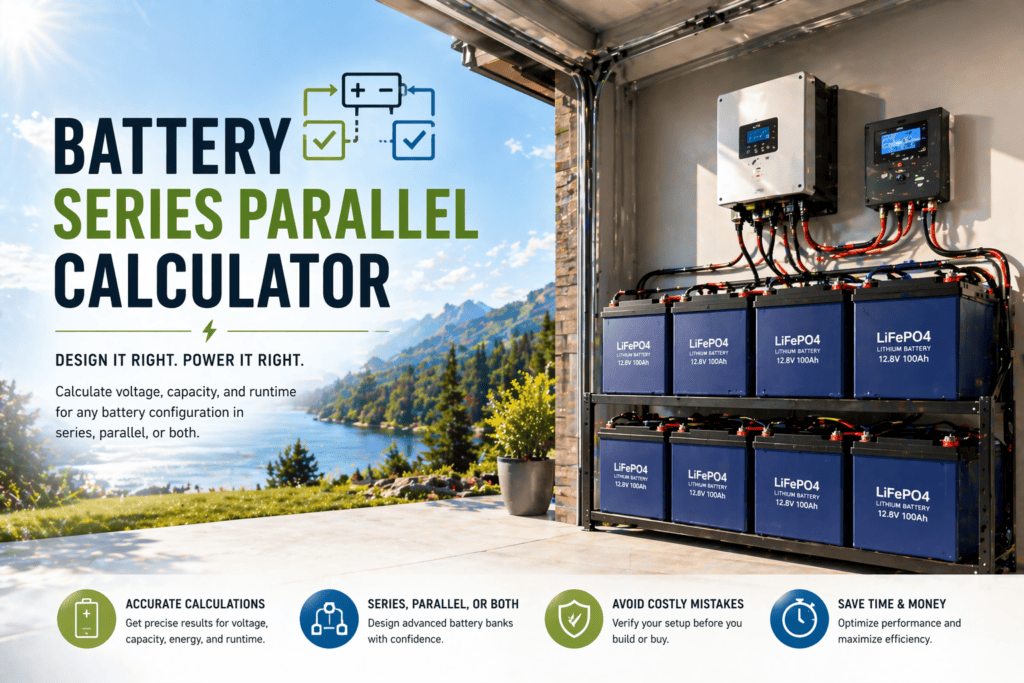
Battery Series Parallel Calculator
Use this battery series parallel calculator to determine how to properly configure your battery bank for off-grid solar systems. Whether you are building a 12V, 24V, or 48V setup, this tool helps you calculate the correct series and parallel configuration, total system voltage, and total battery capacity based on your battery specifications.
This battery wiring calculator goes beyond basic calculations by showing how to connect batteries in series and parallel for solar systems, ensuring your setup is efficient, scalable, and aligned with real-world off-grid power requirements.
How a Battery Series Parallel Calculator Works
A battery series parallel calculator determines how batteries should be connected to reach a target system voltage while maximizing usable storage capacity. It starts with the voltage and amp-hour rating of a single battery, then uses the total number of batteries available and the desired system voltage to calculate how many batteries must be wired in series and how many parallel strings can be built.
In series wiring, voltage adds together while amp-hours stay the same. In parallel wiring, amp-hours add together while voltage stays the same. Most real off-grid battery banks use both series and parallel connections, which is why this battery wiring calculator is useful for building 12V, 24V, and 48V battery banks correctly and efficiently.
Enter the voltage and amp-hour rating of a single battery, such as 12V 100Ah.
The calculator determines how many batteries must be placed in series to reach 12V, 24V, or 48V.
After voltage is matched, the remaining batteries are used to increase total capacity through parallel connections.
The tool outputs final voltage, total amp-hours, total watt-hours, and the correct battery configuration format.
Battery Series-Parallel Calculator
Wire your battery bank the right way the first time. Get the exact series count, parallel strings, total voltage, usable kWh, discharge current, cable gauge, and chemistry-aware configuration quality — before you buy a single terminal lug.
1 Define your battery bank
Start simple — or go advanced for chemistry, load-based autonomy, and cable/current calculations.
2 Series vs. parallel — the idea
Series wiring stacks voltage (12V + 12V = 24V) while keeping capacity the same. Parallel wiring keeps voltage the same but adds capacity (100Ah + 100Ah = 200Ah). Most real banks use both — series strings to hit target voltage, then multiple strings in parallel for enough kWh.
Your battery wiring plan
Enter your batteries and target voltage on the left, then calculate to see the exact series-parallel layout and bank-level specs.
3 Bank breakdown
🔋 Chemistry, current & cable
Real-world specs based on the chemistry you chose — usable DoD, max safe discharge, recommended cable gauge, and cycle life.
Wiring layout preview
Each horizontal row is one series string. Multiple rows run in parallel to multiply capacity.
Why this configuration
Recommended next step
Cost estimate
Planning highlights
Smart upgrade path
Continue Planning After Battery Configuration
After configuring your batteries in series or parallel, the next step is verifying total capacity, estimating runtime, understanding charge time, and confirming your full system is properly balanced.
Battery Bank Size Calculator
Confirm your total battery capacity meets your daily energy needs and system requirements.
Solar Battery Runtime Calculator
Estimate how long your configured battery bank will power your loads.
Solar Battery Charge Time Calculator
Understand how long it takes to recharge your configured battery bank.
Complete Solar System Calculator
Validate your battery configuration within your full off-grid system.
Battery Series Parallel Calculator Example
Here is a practical example of how a battery series parallel calculator works. Assume you have 8 batteries, each rated at 12V 100Ah, and you want to build a 48V battery bank. The calculator first determines how many batteries are needed in series to reach the target voltage, then uses the remaining batteries to increase total capacity through parallel strings.
In this case, the result is clean because 48V divides evenly by 12V. That means the battery bank can be built without leftover batteries, and the final configuration is easy to understand, wire, and scale.
48V target ÷ 12V per battery = 4 batteries in series
8 batteries total ÷ 4 per string = 2 parallel strings
The bank layout becomes 4S × 2P
Total output = 48V 200Ah = 9,600Wh nominal energy
What this means in plain terms
You would build two separate 48V strings, and each string would contain four 12V batteries connected in series. Those two strings would then be connected in parallel to double the total amp-hour capacity.
That is exactly why this battery wiring calculator matters. It translates battery count into an actual bank structure instead of leaving you with a raw number and no clear wiring plan.
How to Use the Battery Series Parallel Calculator
This battery series parallel calculator is built to help you turn a pile of batteries into a workable bank design. You can use simple mode if you already know your battery specs and target voltage, or advanced mode if you want more control over how the bank should be configured.
The key is to enter accurate battery data first. Once the calculator knows your battery voltage, amp-hour rating, total battery count, and target system voltage, it can show whether your bank divides cleanly and how the final wiring layout should be structured.
Start with the voltage and amp-hour rating of one battery, then enter the total number of batteries you have available.
Select or enter the voltage you want the completed bank to deliver, such as 12V, 24V, or 48V.
The calculator will determine how many batteries need to be wired in series and how many parallel strings can be built from the remaining count.
Check the final configuration format, total capacity, total energy, and the visual wiring layout before building the bank.
Best way to use this tool
Start with simple mode to verify the basic configuration. Then switch to advanced mode if you want to test different battery counts, custom system voltages, or layout priorities. This gives you a better feel for whether your battery bank is cleanly designed or needs to be reworked.
What to watch for
If the result leaves unused batteries, creates too many parallel strings, or forces a large bank into a low-voltage setup, that is usually a sign the battery count or overall system design should be adjusted before you build anything.
Expert Tips for Battery Series and Parallel Wiring
A battery series parallel calculator can tell you the layout, but building a battery bank properly still depends on wiring discipline, voltage planning, and keeping the entire bank balanced. This is where most DIY setups go wrong.
These expert tips help you move beyond just getting the math right. They help you build a cleaner, safer, and more scalable off-grid battery bank that performs properly under real load conditions.
Use batteries with the same voltage, capacity, chemistry, and age. Mixed batteries create uneven charging and discharging, which weakens the entire bank.
Fewer parallel strings are usually better. Once you get into too many parallel paths, balancing becomes harder and wiring quality matters much more.
Small banks can work at 12V, but larger off-grid systems are cleaner and more efficient at 24V or 48V because current drops as voltage rises.
Do not start connecting batteries blindly. Confirm the exact series and parallel structure first, then plan cable routing, fuse protection, and connection order.
Amp-hours only tell part of the story. Always connect the final bank back to total watt-hours so you understand how much real energy storage you have.
If you plan to expand later, make sure the architecture supports it. Expansion is easier when the original system voltage and string layout were chosen correctly.
Most important expert rule
A battery bank that looks correct on paper can still be a bad design in practice. The best layouts are not just mathematically valid — they are also clean to wire, easy to balance, safe under load, and realistic to maintain long term.
Series vs Parallel Battery Wiring Explained
Understanding the difference between series and parallel wiring is critical when using a battery series parallel calculator. Each method changes your battery bank in a completely different way, and most off-grid systems require a combination of both.
The table below breaks down how series and parallel wiring affect voltage, capacity, and overall system design so you can quickly see which one does what.
| Wiring Type | What Changes | Voltage Effect | Capacity Effect | Best Use Case |
|---|---|---|---|---|
| Series | Stacks batteries end-to-end | Increases voltage | Stays the same | Reaching 24V or 48V systems |
| Parallel | Connects batteries side-by-side | Stays the same | Increases capacity (Ah) | Increasing storage without raising voltage |
| Combined | Uses both methods together | Increases to target level | Increases total storage | All real off-grid battery banks |
How Battery Wiring Actually Looks (Series vs Parallel)
Understanding battery wiring becomes much easier when you can visualize how the connections work. Series wiring builds voltage by linking batteries end-to-end, while parallel wiring increases capacity by stacking multiple strings together.
Common Battery Wiring Mistakes to Avoid
A battery series parallel calculator can give you the correct layout, but many real-world systems still fail because of poor wiring decisions. These mistakes often reduce performance, shorten battery life, or create safety risks.
Avoiding these issues is just as important as getting the math right. Most of them come from misunderstanding how series and parallel connections actually behave under load.
Combining batteries with different capacities, voltages, or ages causes uneven charging and discharging, which can damage the entire bank.
Wiring the wrong number of batteries in series leads to incorrect system voltage, which can damage inverters and other components.
Large numbers of parallel connections make balancing difficult and increase the risk of uneven current flow between battery strings.
High-capacity systems at low voltage create excessive current, requiring thicker cables and causing more heat and efficiency loss.
Poor connections and undersized cables increase resistance, reduce efficiency, and can become a serious safety hazard over time.
Connecting batteries without a clear plan often leads to messy wiring, imbalance issues, and systems that are difficult to maintain or expand.
Reality check
Most battery failures in off-grid systems are not caused by bad batteries — they are caused by bad wiring decisions. A clean, balanced, and properly planned layout will outperform a larger system that was put together without a clear structure.
How to Plan a Better Battery Bank Layout
A battery series parallel calculator gives you the correct structure, but good system design goes beyond that. The goal is not just to make the numbers work — it is to create a battery bank that is efficient, scalable, and easy to maintain.
The best battery banks are planned with voltage, capacity, expansion, and real-world wiring in mind from the beginning, rather than trying to fix problems after the system is already built.
Decide whether your system should be 12V, 24V, or 48V before choosing batteries. Larger systems should almost always move to higher voltage to reduce current and improve efficiency.
Make sure your battery count divides evenly into the required series configuration. Clean groupings prevent wasted batteries and simplify wiring.
Keep the number of parallel strings as low as possible. Fewer parallel paths make the system easier to balance and maintain over time.
If you expect to grow your system, choose a voltage and layout that can scale without forcing a full redesign later.
Always build the bank with identical batteries. Mixing different batteries later is one of the fastest ways to reduce system performance.
Always connect your configuration back to watt-hours or kilowatt-hours so you understand what your system can actually power.
Planning insight
The best battery bank is not the one with the most batteries — it is the one with the cleanest design. A well-structured layout with the right voltage and balanced wiring will outperform a larger system that was poorly planned.
Battery Series Parallel Calculator – Related Searches & Use Cases
This battery series parallel calculator covers a wide range of real-world battery wiring scenarios, from small 12V setups to large 48V off-grid systems. Users searching for this tool are typically trying to understand how to connect batteries correctly and safely.
Below are common keyword variations and search intents that align with how people actually look for battery wiring solutions.
Long-tail search coverage
- how to connect batteries in series and parallel for solar
- how many batteries in series for 48V system
- how to wire 12V batteries to make 24V or 48V
- series parallel battery bank configuration explained
- how to build a battery bank for off grid solar
- battery wiring diagram series vs parallel
Search intent breakdown
Users searching these terms are typically in the build or planning stage. They are not just learning concepts — they are actively trying to wire batteries correctly for solar or off-grid systems and need clear, accurate configuration guidance.
Series, parallel & bank sizing — answered
Everything you need to wire a battery bank correctly the first time: voltage math, parallel string limits, chemistry gotchas, cable sizing, and the safety rules that keep your system from becoming a fire hazard.
Basics
Start here — the fundamentals of series vs. parallel and how banks are described.
Q1What is the difference between series and parallel batteries?+
Series wires batteries end-to-end (positive of one to negative of the next) to add voltages. Two 12V 100Ah batteries in series = 24V 100Ah.
Parallel wires all positives together and all negatives together to add capacity. Two 12V 100Ah batteries in parallel = 12V 200Ah.
4S × 2P bank uses series for voltage and parallel for extra runtime.Q2What does 4S × 2P mean?+
4S means 4 batteries are wired in series to produce the target voltage. 2P means you have 2 of those series strings connected in parallel to double the capacity.
Example with 12V 100Ah modules: 4S × 2P = 8 total batteries, 48V at 200Ah (9.6 kWh).
The notation is useful because it tells you both the output voltage (S count × module voltage) and the capacity multiplier (P count × module Ah) in a single shorthand.
Q3Why would I ever choose series over parallel (or vice-versa)?+
It’s not really a choice — your inverter and charge controller dictate the bus voltage, and your runtime need dictates capacity. You use series to hit the required voltage, then parallel to add the Ah you need.
That said, series-heavy banks are preferred because higher voltage = lower current for the same power. Lower current means smaller, cheaper cables and fewer heat losses. A pure parallel bank at 12V for a home-sized load is usually the wrong answer.
Q4Do series and parallel affect charging the same way?+
Yes — and your charger needs to match. A charger set to 12V will not properly charge a series-built 24V or 48V bank. Always configure your solar charge controller and inverter-charger to the total bus voltage, not the individual battery voltage.
For parallel-only banks, the charger sees the nominal voltage of a single module, but the total charge current is split across the strings, so you need a controller rated for the full combined current.
Wiring configurations
Common bank layouts, cable runs, and the “method” tricks that keep parallel strings balanced.
Q5How many batteries do I need for a 12V, 24V, or 48V system?+
Divide the target voltage by your battery’s nominal voltage. Common combinations:
| Target bus | Using 12V | Using 6V | Using 2V cells |
|---|---|---|---|
| 12V | 1 series | 2 in series | 6 in series |
| 24V | 2 in series | 4 in series | 12 in series |
| 48V | 4 in series | 8 in series | 24 in series |
Add parallel strings on top of that for more capacity. A 48V home system often ends up as 4S × 1P (one string of four batteries) with large-Ah lithium modules, or 4S × 2–3P with smaller 100Ah modules.
Q6What is “diagonal” or “cross-diagonal” wiring and why does it matter?+
In a parallel bank, the main positive and main negative should leave the bank from opposite corners — not from the same end. This forces current to travel an equal cable distance through every battery, keeping the strings balanced.
Without diagonal wiring, the battery closest to the load does most of the work, discharges fastest, and ages prematurely while the far battery sits mostly unused.
Q7How many strings can I safely put in parallel?+
Most manufacturers recommend no more than 3–4 strings in parallel for lead-acid and up to 4 strings for drop-in lithium (LiFePO4) unless the BMS specifically supports more.
Every extra parallel string introduces imbalance risk. At 5+ strings, circulating currents, connection resistance variation, and charge/discharge drift become hard to control. If you need more capacity, go higher voltage (24V → 48V) or use larger-Ah individual batteries instead of stacking more parallel strings.
Q8What size cable do I need between the batteries?+
Size cable based on peak continuous current, not average. Calculate peak current as max continuous watts ÷ bus voltage, then pick cable that handles that at a safe temperature and voltage drop under ~3%.
| Current | Short runs (<5 ft) |
|---|---|
| Up to 50 A | 6 AWG |
| Up to 100 A | 2 AWG |
| Up to 200 A | 2/0 AWG |
| Up to 300 A | 4/0 AWG |
| 400 A+ | Dual 4/0 or 500 MCM |
This is another reason 12V is a bad fit for bigger systems — 3000W on 12V is 250A (needs 4/0 cable), but on 48V it’s only 63A (fits fine on 4 AWG).
Sizing & voltage
Picking the right bus voltage and bank capacity for your actual loads.
Q9Is it better to use 12V, 24V, or 48V systems?+
It depends on your continuous power draw and total stored energy. Our calculator picks automatically, but the general rule is:
- 12V — RV, van, or small cabin with <1500W continuous and <2 kWh storage. Simple, but cable-heavy above that.
- 24V — Mid-sized cabins, larger RVs, workshop backup with 1500–3000W and 2–5 kWh storage.
- 48V — Any whole-home, off-grid cabin, or system with ≥3000W continuous or ≥5 kWh storage. Standard for every modern hybrid inverter.
Higher voltage = smaller cables, less heat, and compatibility with the best hybrid inverters (which are almost all 48V).
Q10How do I calculate total usable energy in my bank?+
Total watt-hours = bus voltage × total amp-hours. Then multiply by the usable depth of discharge for your chemistry:
- LiFePO4: 90% usable (most brands allow 80–100%)
- NMC lithium: 85% usable
- AGM, flooded, gel: 50% usable for good cycle life
Example: a 48V 200Ah LiFePO4 bank = 9,600 Wh × 0.9 = 8,640 Wh usable ≈ 8.6 kWh.
Q11How long will my bank run my loads?+
Divide usable watt-hours by your average continuous load in watts, then subtract ~10–15% for inverter inefficiency.
Example: 8,640 Wh usable ÷ 500W average = ~17 hours before inefficiency, or roughly 14–15 hours of real runtime at 500W continuous.
Q12How much headroom should I build in?+
Plan for at least 1.3× your calculated daily load, plus an extra day of autonomy if you rely on solar only. Add an additional 15–20% for winter if you’re in a cold climate where sun hours drop and lithium charge efficiency falls.
So if you need 4 kWh per day, size for roughly 5.2–6 kWh of daily usable storage, and 10–12 kWh total if you want two days of autonomy.
Chemistry & mixing
What you can and can’t combine in a bank — and why it matters.
Q13Can I mix different batteries in the same bank?+
No. Always use identical batteries — same brand, same model, same capacity, same age, ideally same production batch. Mixing causes:
- Charge imbalance — the weakest battery overdischarges while the strongest overcharges.
- Circulating currents in parallel strings that waste energy and generate heat.
- Rapid aging of the healthier batteries to match the weakest one.
Q14Should I pick LiFePO4, AGM, or flooded lead-acid?+
For 95% of new off-grid builds, the answer is LiFePO4. It delivers 3–5× the cycle life of AGM, uses 90% of its rated capacity (vs. 50%), weighs half as much, and handles high discharge rates without capacity loss.
Choose AGM if upfront cost is the hard constraint (about 25% cheaper per kWh). Choose flooded only if you want the lowest cost-per-kWh and you’re willing to water cells, ventilate a battery room, and equalize every month or two.
Avoid gel unless you have a very specific use case — it’s slow-charging and expensive without the longevity benefits of lithium.
Q15Can I add more batteries to my existing bank later?+
Only if the new batteries are the same model, same capacity, and have similar cycle history to the existing ones. Adding fresh batteries to an aged bank means the old cells will pull down the new ones and you’ll lose most of the gain.
If your existing bank is more than 18 months old, it’s usually better to build a completely new bank and either sell or repurpose the old one (backup, shed lighting, etc.) rather than mixing.
Safety & troubleshooting
Fuses, BMS, imbalance symptoms, and what to do if things go wrong.
Q16Do I need a fuse on every battery?+
You need a Class-T or ANL fuse on the main positive leaving the bank, sized slightly above your maximum continuous current. For parallel strings, best practice is to add a string-level fuse on each parallel string’s positive lead so a shorted cable in one string doesn’t dump current from all the others.
Class-T fuses are preferred for lithium because they interrupt very high short-circuit currents cleanly — standard ANL may not.
Q17How can I tell if my batteries are out of balance?+
Measure each battery’s resting voltage (after at least an hour of no charge or discharge) with a multimeter. They should all be within ±0.05V for lithium and ±0.2V for lead-acid.
Larger deltas mean one or more batteries are out of sync. Common causes: uneven cable lengths, a failing cell, or a BMS cutting one string off early. Rebalance by charging to 100% and letting a dedicated balancer or your BMS do its work; if the delta returns within days, you have a weak battery that needs to come out of the bank.
Q18Can I charge LiFePO4 batteries below freezing?+
No — charging LiFePO4 below 32°F (0°C) causes permanent lithium plating and capacity loss. Most quality drop-in LiFePO4 batteries include a BMS that blocks charging below freezing, but discharging at cold temperatures is fine down to about −4°F (−20°C).
If you’re in a cold climate, either (a) keep the battery bank in a heated enclosure, (b) buy batteries with built-in self-heating, or (c) use a charge controller that can read battery temperature and pause charging automatically.
Ready to plan your exact bank?
Use the Battery Series & Parallel Calculator to model your configuration — voltage, Ah, cable gauge, and fit score in seconds.
Related Tools for Battery System Optimization
These tools help refine battery performance, wiring safety, solar input, and real-world system behavior without duplicating the main configuration steps above.
Solar Battery Discharge Calculator
Analyze how your battery drains under different loads and usage scenarios.
Appliance Runtime Calculator
Estimate how long specific appliances will run on your configured battery system.
Solar Wire Size Calculator
Ensure your wiring supports safe current flow across your battery bank.
Solar Panel Output Calculator
Check how much solar energy is available to charge your battery system.