
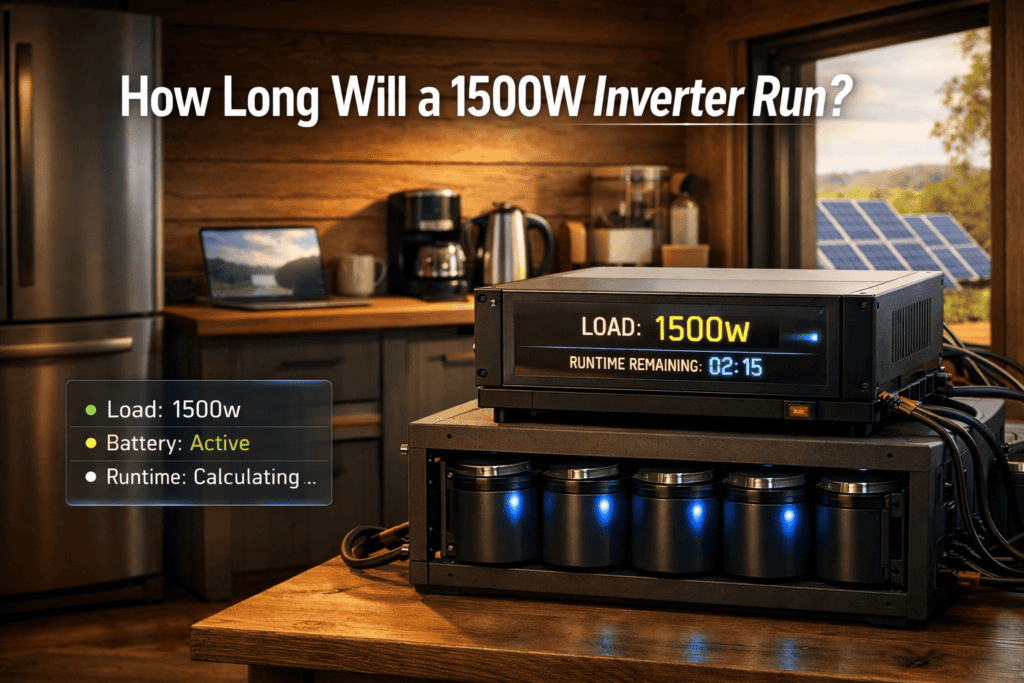
Battery Runtime for 1500W Inverter
1500W Inverter Runtime — Hero
Inverter Runtime Guide 1500W
How Long Will a
1500W Inverter Run?

Use this Battery Runtime for 1500W Inverter Calculate real-world 1500W inverter runtime from battery size, voltage, inverter efficiency, and actual power draw.

A 1500W inverter does not determine runtime on its own. Runtime depends on how much usable battery energy you have and how many watts your appliances are actually drawing.

Use this page to get a fast runtime estimate, understand the battery math behind the number, and dial in a precise answer for your off-grid or backup power setup.

Runtime = Battery Wh × DOD × Efficiency ÷ Load Watts
Inverter Size
1500W
Max rating — not a runtime guarantee.
Typical Runtime
0.5–4+ hrs
Varies by bank size and actual load.
Main Driver
Battery Wh
Usable energy decides everything.
1500W inverter connected to a lithium battery bank in an off-grid power setup
BATTERY BANK 1500W INVERTER DC → 120/240V AC ~90% Efficiency AC LOADS RUNTIME OUTPUT Xh YYm Energy Source DC→AC Convert Loads
Runtime at Common Load Levels
300W
~5.8h
750W
~2.3h
1500W
~1.2h
Based on 12V 200Ah LiFePO4 — 80% DOD, 90% efficiency. Load is the biggest lever on runtime.
Quick Answer Featured Snippet Target

How long will a 1500W inverter run?

A 1500W inverter will only run as long as your battery bank can supply the load. For example, a 12V 100Ah battery stores about 1,200Wh before losses, so at a full 1500W load, runtime may be only around 30 to 45 minutes in real conditions. Lower loads can extend runtime significantly.

The exact runtime depends on battery voltage, battery capacity, usable depth of discharge, inverter efficiency, and the actual watt draw of the appliances connected. A 1500W inverter running a 300W load will last much longer than the same inverter running near full capacity.

Full 1500W Load
0.5–1.0 hrs
Small to mid-size battery banks drain very quickly at full inverter load.
Medium Load
2–5 hrs
Common for moderate appliance loads on a decent battery bank.
Light Load
5+ hrs
Much longer runtime is possible when real load stays well below inverter max.
Quick formula:
Runtime (hours) = Usable Battery Watt-Hours ÷ Actual Appliance Load (W)
Calculation Explanation How It Works

How to calculate 1500W inverter runtime

Inverter runtime is determined by how much usable energy your battery has and how fast your appliances are consuming that energy. The inverter itself does not create power — it only converts it.

Core formula
Runtime (hours) = Usable Battery Watt-Hours ÷ Actual Load (W)

Step 1: Calculate battery energy (Wh)

Multiply battery voltage by amp-hours:

12V × 100Ah = 1200Wh

Step 2: Apply usable capacity

Not all battery energy is usable:

Lithium: ~90% usable
Lead-acid: ~50% usable

Step 3: Account for inverter efficiency

Inverters are not 100% efficient:

Typical efficiency: 85–95%

Step 4: Divide by actual load

Example:

1000Wh ÷ 300W = ~3.3 hours

What actually affects inverter runtime

• Battery size (Ah and voltage)
• Battery type (lithium vs lead-acid)
• Depth of discharge limits
• Inverter efficiency
• Actual appliance watt draw
• System losses and wiring

Using this Battery Runtime for 1500W Inverter calculator, you will see why a 1500W inverter, can run for minutes in one setup and hours in another. The inverter rating is only the limit — the battery and load determine the actual runtime.

1500W Inverter Runtime Calculator
Battery Bank 24V · 200Ah DC 1500W INVERTER Pure Sine · 90% eff ← Runtime This AC Active Load AC Loads Runtime @ 300W — hrs Inverter Load —% of 1500W Usable Energy — Wh after DOD + losses
Runtime
— hrs
Usable Energy
— Wh
Inverter Load
—%
Battery Draw
— A

1500W Inverter Runtime Calculator

Use Simple Mode for a fast estimate. Switch to Advanced Mode to account for battery chemistry, depth of discharge, inverter efficiency, battery health, reserve cutoff, DC appliance use, and system losses — and see how runtime changes across different load levels.

Planning note: Runtime values are estimates based on the inputs entered. Actual runtime changes with battery age, temperature, inverter model, cable losses, appliance cycling, and low-voltage cutoff settings. Use manufacturer specs and local electrical code before wiring a real system.
Fast Estimate

Simple Runtime Inputs

Assumes lithium battery, 90% DOD, 90% combined inverter efficiency. Best for a quick ballpark.

Load Presets
Inverter utilization —% of 1500W
Use DC mode for 12V fridges, DC fans, DC lights, or loads that bypass the inverter.
Runtime Output

System Results

Estimated Runtime
Run the calculator to see your result
Total Battery Wh
Usable Wh
DC Draw (Amps)
Inverter Load
What This Means
Enter your values and calculate to see a plain-English explanation of your runtime result.
Next Step
Complete the calculator above to get a recommended next action for your setup.
Recommended Setup
Run the calculator to see suggested system voltage, battery size, inverter headroom, cable/fuse awareness, and next calculator checks.
Real-Life Use Practical Planning

How to use this inverter runtime in real life

Your runtime result is only useful if you apply it to real usage scenarios. A 1500W inverter is often used to power multiple devices, but your actual runtime depends on how those devices are used throughout the day.

If you are running high-load appliances

Devices like microwaves, coffee makers, and power tools can quickly push your system toward the inverter’s maximum output. Even short bursts at high wattage can drain your battery faster than expected.

If you are running moderate loads

Appliances like refrigerators, TVs, and laptops typically draw less power over time. This is where inverter systems become practical, as runtime increases significantly compared to peak loads.

If this is part of an off-grid system

The inverter should never be sized alone. Your solar panels must recharge the battery fast enough to replace the energy used, otherwise your runtime will steadily decline over time.

If you are building a backup system

Backup systems should be designed with margin. If your runtime result is tight, increase battery capacity. Real outages rarely happen under ideal conditions.

Use this decision rule

Step 1
Identify your actual load, not the inverter’s maximum rating.
Step 2
Compare runtime against how long you need power in real scenarios.
Step 3
If runtime is too short, increase battery size or reduce load.

Best use of this page

Use this page to understand inverter runtime first, then move into battery sizing, solar production, and full system planning tools. Runtime is only one part of a complete off-grid energy system.

Results Interpretation What Your Runtime Means

How to interpret your 1500W inverter runtime result

Your result tells you whether your battery bank is undersized, workable, or strong for the load you want the inverter to run. The biggest mistake is assuming the inverter rating means you can run large loads for a long time. It does not. The battery determines that.

Under 1 Hour
Very short runtime
This setup is too tight for most real-world use. The battery bank is small relative to the load.
1 to 3 Hours
Limited but usable
This can work for short backup use, brief appliance runs, or temporary heavy loads.
3 to 8 Hours
Solid range
This is a practical runtime range for many off-grid and emergency power scenarios.
8+ Hours
Strong setup
This usually means the load is moderate or the battery bank is properly sized for extended runtime.

A higher runtime usually means

• Larger usable battery capacity
• Lower actual appliance load
• Better inverter efficiency
• More practical off-grid usability

A lower runtime usually means

• Battery bank is too small for the load
• Load is too heavy for sustained use
• Battery chemistry limits usable energy
• System losses are reducing runtime

The reality most people miss

A 1500W inverter is a power handling limit, not a promise of long runtime. Running close to 1500W without a properly sized battery bank will drain the system fast.

If your result is borderline, the fix is usually a larger battery bank, a lower actual load, or both. The load profile matters just as much as the inverter size.

Example Calculation Real-World Walkthrough

Example: how long a 1500W inverter will run

Here is a realistic example using a 12V 200Ah lithium battery bank, a 90% inverter efficiency, and a real appliance load well below the inverter’s maximum rating. This gives a useful answer instead of the misleading assumption that inverter size alone determines runtime.

Example setup

Battery bank: 12V 200Ah lithium
Usable depth of discharge: 90%
Inverter efficiency: 90%
Actual load: 500W
Inverter size: 1500W maximum

Final result

3.9 hours
In this example, the 1500W inverter would run a 500W actual load for about 3.9 hours before reaching the usable battery limit.

Step-by-step calculation

1. Total Battery Energy
12V × 200Ah
= 2400Wh
2. Usable Capacity
2400Wh × 0.90
= 2160Wh
3. After Inverter Losses
2160Wh × 0.90
= 1944Wh
4. Runtime
1944Wh ÷ 500W
= 3.9 hours

What this example shows

Even with a fairly strong battery bank, runtime drops quickly as load increases. A 1500W inverter can support large loads, but unless you also have serious battery capacity, it will not run those loads for long. The inverter rating tells you what it can handle — the battery tells you for how long.

Pro Tips Expert Insights

Pro tips to get more runtime from a 1500W inverter system

If your runtime result is shorter than expected, the issue is usually not the inverter itself. It is battery capacity, load management, or system inefficiency. These are the moves that improve runtime the most in the real world.

1. Watch actual load, not inverter size

A 1500W inverter only tells you the maximum it can handle. If your real appliance load is 250W, runtime will be far better than if you are constantly pulling 1200W to 1500W.

2. Increase battery voltage when possible

Higher-voltage battery systems like 24V or 48V are usually more efficient for larger inverter loads. They reduce current draw and can perform better under sustained power demand.

3. Lithium usually makes more sense

Lithium batteries give more usable capacity and maintain voltage better under load. For inverter-heavy systems, they usually deliver noticeably better runtime than lead-acid at the same rated amp-hours.

4. Avoid running near full load for long

Running close to 1500W for extended periods drains batteries fast and adds more stress to the inverter system. Heavy loads are usually fine in short bursts, but poor for long-duration runtime.

5. Reduce idle and phantom loads

Inverters and connected appliances can pull power even when not doing much. Small unnecessary loads add up, especially over several hours, and quietly cut into runtime.

6. Build for margin, not the minimum

If your calculator result just barely covers your use case, the system is undersized. Real conditions, battery aging, and heavier-than-expected loads will expose that fast.

Best next move

If this page shows your runtime is too short, the smartest fix is usually increasing usable battery capacity first, then checking your actual load profile. Guessing based on inverter size alone is how people end up with weak systems.

BATTERY 12–48V DC Source 1500W INVERTER DC → AC 85–95% Efficiency AC LOADS 120/240V AC RUNTIME Xh YYm Wh × DOD × Eff ÷ Load Watts
FAQ 20 Questions Schema Ready Last updated: April 2026

1500W Inverter Runtime — FAQ

Everything you need to know about runtime, battery sizing, load limits, and system efficiency for a 1500W inverter — from the formula behind the math to real-world setup tips.

Estimate note: Runtime estimates vary based on battery age, battery temperature, inverter efficiency, appliance cycling, wiring losses, reserve settings, and actual usable battery capacity. Use these numbers for planning, then verify with your battery and inverter manuals.
Runtime BasicsQ1 – Q4
1How long will a 1500W inverter run on a 100Ah battery?

On a 12V 100Ah LiFePO4 battery, a full 1500W load runs for approximately 30–40 minutes in real-world conditions. That assumes about 80% depth of discharge and 90% inverter efficiency.

Runtime FormulaRuntime (h) = (Ah × Voltage × DOD × Efficiency) ÷ Watts
Example: (100 × 12 × 0.80 × 0.90) ÷ 1500 = ≈ 0.576 h, or about 35 minutes

Reducing load makes a dramatic difference. A 500W load on the same battery runs about three times longer. Use the 1500W inverter runtime calculator to model your actual battery and load.

Load12V 100Ah LiFePO412V 200Ah LiFePO424V 100Ah LiFePO4
200W4h 19m8h 38m8h 38m
500W1h 44m3h 28m3h 28m
1000W52m1h 44m1h 44m
1500W35m1h 09m1h 09m
Assumes 90% inverter efficiency and 80% DOD.
2What is the formula for calculating inverter runtime?

Runtime is driven by stored energy, safe usable capacity, inverter efficiency, and the actual load in watts.

FormulaRuntime (h) = (Battery Ah × Voltage × Depth of Discharge × Inverter Efficiency) ÷ Load Watts

For total system runtime across multiple appliances, use the Solar Battery Runtime Calculator.

3Does inverter size affect runtime?

No — inverter size does not directly determine runtime. The inverter rating is the maximum AC power it can deliver. Runtime depends on battery capacity and actual load wattage.

Use the Solar Inverter Size Calculator to check continuous and surge capacity.

4How much does load level affect runtime?

Load has a direct linear effect. Halving the load doubles runtime. A 1500W inverter usually performs best when normal loads stay around 20–75% of rating.

Load% of 1500W12V 200Ah LiFePO424V 200Ah LiFePO4
150W10%11h 31m23h 02m
300W20%5h 46m11h 31m
600W40%2h 53m5h 46m
900W60%1h 55m3h 50m
1500W100%1h 09m2h 18m
🔋Battery Sizing & ChemistryQ5 – Q8
5What battery size do I need for a 1500W inverter?

For meaningful runtime, start with at least 12V 200Ah LiFePO4. That provides roughly 1,728Wh delivered after DOD and inverter efficiency, giving about 1h 09m at full 1500W or 3h 28m at 500W.

Use the Battery Bank Size Calculator for daily energy use and autonomy days.

6What is the difference between LiFePO4 and AGM batteries for inverter use?

LiFePO4 offers more usable capacity, longer cycle life, and better high-discharge performance. AGM is cheaper upfront but usually limited to 50% DOD and degrades faster under repeated high-current loads.

ChemistryMax DODTypical CyclesInverter Performance
LiFePO480–90%3,000–6,000+Excellent
AGM50%400–600Moderate
Gel60%500–800Fair
Flooded Lead-Acid50%300–500Poor at high rates
7What is depth of discharge and why does it matter?

Depth of discharge is the percentage of total battery capacity you should use before recharging. A 200Ah LiFePO4 battery at 80% DOD gives 160Ah usable, while a 200Ah AGM at 50% DOD gives only 100Ah usable.

8How does 12V vs 24V vs 48V affect inverter performance?

Higher voltage reduces DC current, which lowers cable size, heat, and voltage drop. For permanent 1500W systems, 24V is usually better than 12V, and 48V is best when the system may grow.

VoltageDC Amps at 1500WShort-run Cable
12V~139A2/0 AWG
24V~69A4 AWG
48V~35A8 AWG

Verify your actual run with the Solar Wire Size Calculator.

🔌Loads & AppliancesQ9 – Q12
9Can a 1500W inverter run a refrigerator?

Yes. Most refrigerators draw 100–400W running and surge to 3–4 times that at compressor startup. A 1500W inverter with a 3000W surge rating handles most fridges. Use the Refrigerator Solar Runtime Calculator for fridge-specific runtime.

10Can a 1500W inverter run a microwave?

Compact 700–900W output microwaves usually work. Full-size 1100W output microwaves are near the limit, and 1500W output microwaves usually draw around 1900W and will overload the inverter. For full-size microwaves, use a 2000W inverter or larger.

11What appliances can a 1500W inverter power?

It can run TVs, laptops, lights, refrigerators, compact microwaves, coffee makers, and many small tools. It is not ideal for window AC units, large microwaves, space heaters, or high-surge tools.

For full daily load planning, use the Appliance Runtime on a Solar Battery Calculator.

12What is surge power and why does it matter?

Surge power is the short startup spike needed by motors and compressors. Most 1500W inverters have 2500–3000W surge ratings. If a fridge, pump, or tool startup spike exceeds that peak rating, the inverter can trip even when running watts seem acceptable.

Efficiency & LossesQ13 – Q16
13What is the typical efficiency of a 1500W inverter?

Quality pure sine wave inverters typically run around 88–95% efficient, with the best efficiency around 50–80% of rated load. Idle draw can consume 5–25W even when no appliance is running.

14Is it bad to run a 1500W inverter at full load continuously?

It is within spec for many units, but not ideal long term. Staying below 75–80% of rated output keeps the inverter cooler, improves efficiency, and preserves surge headroom. If you often use 1500W, move up to a 2000W inverter.

15What reduces inverter runtime the most?

The biggest losses come from high load wattage, small batteries, restrictive DOD, low inverter efficiency, undersized cables, poor connections, cold batteries, and aging battery cells.

16How do I calculate DC amps drawn from my battery?
DC Current FormulaDC Amps = Load Watts ÷ (System Voltage × Inverter Efficiency)
1500W at 12V and 90% efficiency = 138.9A
1500W at 24V = 69.4A
1500W at 48V = 34.7A
🛠Setup & Best PracticesQ17 – Q20
17What wire gauge do I need for a 1500W inverter?

For short runs, a 12V system usually needs about 2/0 AWG, 24V about 4 AWG, and 48V about 8 AWG. Longer runs require heavier wire to reduce voltage drop. Confirm your setup with the Solar Wire Size Calculator.

18What fuse size do I need for a 1500W inverter?

Use an external DC fuse near the battery. Typical planning values: 200A at 12V, 100A at 24V, and 60A at 48V. Final fuse sizing must protect the cable and match the inverter manufacturer’s manual.

19Should I use a modified or pure sine wave inverter?

Use pure sine wave. Modified sine wave can cause heat, noise, poor motor performance, and compatibility problems with modern electronics, CPAP machines, refrigerators, and variable-speed devices.

20How can I extend runtime on a 1500W inverter system?
Reduce load
The fastest way to gain runtime.
Add battery Ah
Doubling Ah doubles runtime.
Use LiFePO4
More usable capacity than AGM.
Add solar charging
Recharge while loads run.

For full system design, use the Complete Solar System Calculator.

Run your exact 1500W inverter setup

Enter your battery voltage, Ah, chemistry, reserve level, health, and appliance load to estimate runtime with real-world losses included.

Open the 1500W Inverter Runtime Calculator →
Scroll to Top