
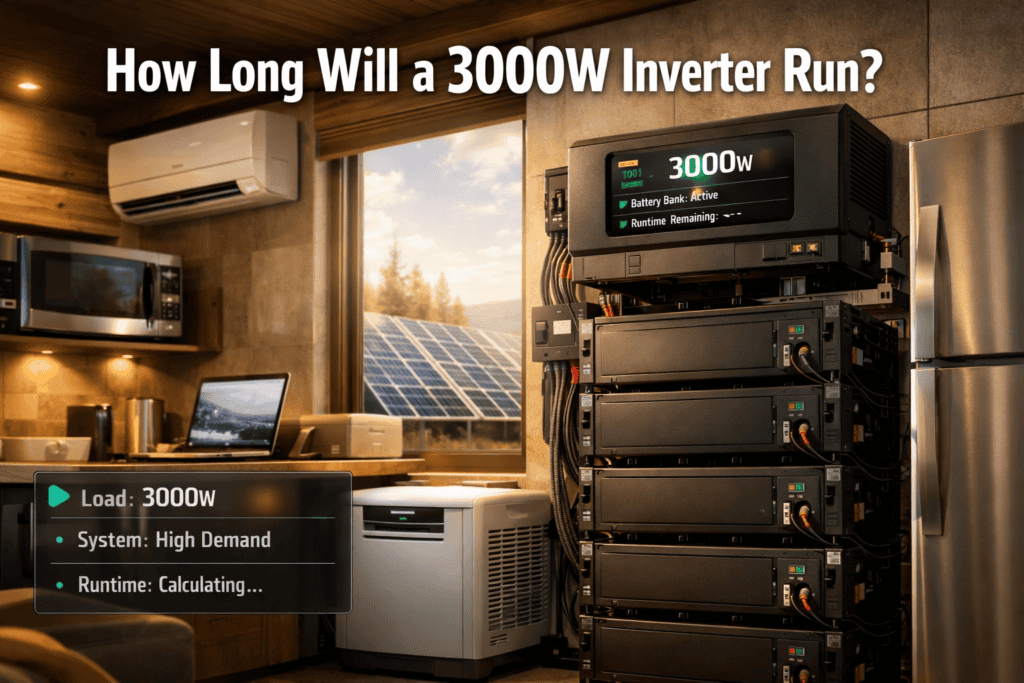
How Long Will a 3000W Inverter Run?
Use this 3000w inverter runtime calculator that’s based on battery size, voltage, efficiency, and actual appliance load.
A 3000W inverter is built for heavy loads, but runtime still depends entirely on your battery bank and how much power you are actually using.
Use this page to estimate runtime quickly, understand the key factors that impact performance, and calculate a realistic answer for your off-grid, RV, or backup power system.
How long will a 3000W inverter run?
A 3000W inverter will run only as long as your battery bank can supply the load. For example, a 12V 100Ah battery (≈1200Wh before losses) may run a full 3000W load for just 15 to 25 minutes in real-world conditions. Lower loads increase runtime significantly.
Runtime depends on battery voltage, total capacity, usable depth of discharge, inverter efficiency, and the actual watt draw of your appliances. Running near 3000W will drain batteries extremely fast unless you have a large battery bank.
How to calculate 3000W inverter runtime
A 3000W inverter does not determine runtime. It only defines the maximum load capacity. Runtime is controlled by how much usable energy your battery bank can deliver and how much power your appliances are actually consuming.
Step 1: Calculate total battery energy
Multiply voltage by amp-hours:
48V × 100Ah = 4800Wh
Step 2: Apply usable capacity (DoD)
Lithium ≈ 90%
Lead-acid ≈ 50%
Step 3: Account for efficiency losses
Typical inverter/system efficiency:
85–95%
Step 4: Divide by real load
Example:
3888Wh ÷ 1500W = ~2.6 hours
What impacts 3000W inverter runtime the most
This is why a 3000W inverter can run for minutes in one setup and hours in another. The inverter defines the capability. The battery and load determine how long it actually lasts.
3000W Inverter Runtime Calculator
Estimate how long a 3000W inverter will run from a battery bank. Use Simple Mode for a fast estimate or Advanced Mode for battery chemistry, depth of discharge, inverter efficiency, system losses, and surge-load warnings.
Inputs
Covers wiring loss, connection loss, heat, and real-world inefficiency.
Results
Continue Planning After Daily Energy Calculation
After calculating your daily energy usage, the next step is sizing your battery bank, determining solar panel requirements, confirming inverter capacity, and validating your full off-grid system.
Battery Bank Size Calculator
Convert your daily consumption into the correct battery storage size.
Solar Array Planner
Determine how many solar panels you need to meet your daily energy demand.
Solar Inverter Size Calculator
Ensure your inverter can handle your full daily load.
Complete Solar System Calculator
Validate your energy usage within a full system planning tool.
How to use this 3000W inverter runtime in real life
A 3000W inverter is designed for serious loads, but that also means your battery bank must be built to support it. This result only becomes useful when applied to real usage scenarios.
Heavy appliance usage
Air conditioners, microwaves, kettles, and power tools can push your system toward the 3000W range quickly. Even if the inverter can handle it, runtime will collapse without a large battery bank.
Mixed load strategy
The smartest way to use a 3000W inverter is not to run everything at once. Stagger loads and avoid peak stacking to dramatically increase usable runtime.
Off-grid system balance
A powerful inverter with a weak battery bank is one of the most common system mistakes. Your solar input, battery storage, and inverter load must all be balanced together.
Backup power planning
If you are designing for outages, your runtime should exceed your minimum needs by a safe margin. Systems that barely meet demand on paper usually fail in real conditions.
Simple decision framework
What this page should lead you to
This calculation is just the entry point. From here, the next step is always battery sizing, total energy usage planning, and system balancing. That is where real off-grid performance is determined.
How to interpret your 3000W inverter runtime result
Your result shows whether your battery bank is badly undersized, borderline, or properly matched for a high-demand inverter system. With a 3000W inverter, this matters more because larger loads can empty even a decent battery bank very quickly.
Higher runtime usually means
Lower runtime usually means
The reality most people miss
A 3000W inverter is a power-handling capability, not a promise of long runtime. The bigger the load you actually run, the faster your battery bank disappears.
If your result is borderline, the fix is almost never a bigger inverter. The fix is usually more battery capacity, better load control, or a better-balanced system.
Example: how long a 3000W inverter will run
Here is a realistic example using a 48V 100Ah lithium battery bank, a 90% inverter efficiency, and a real appliance load that stays well below the inverter’s full 3000W rating. This gives a useful runtime answer instead of assuming inverter size alone determines performance.
Example setup
Final result
Step-by-step calculation
What this example shows
Even with a higher-voltage battery bank, runtime still drops fast when power demand climbs. A 3000W inverter can support serious loads, but unless the battery bank is built to match, high-load runtime will stay short. The inverter rating tells you what the system can handle. The battery tells you how long it can keep going.
Pro tips to get more runtime from a 3000W inverter system
A 3000W inverter is where weak system design gets exposed fast. If runtime is disappointing, the answer is almost always better battery capacity, better load control, and better system balance — not just a bigger inverter.
A 3000W inverter only tells you what the system can handle at peak. It tells you nothing about how long it will run. The real metric is usable battery watt-hours against actual appliance load.
A 3000W inverter on 12V is usually not the right setup. Higher-voltage battery banks reduce current draw, improve efficiency, and are far better suited for serious inverter loads.
At this inverter size, lead-acid starts becoming a weak fit unless you massively oversize the bank. Lithium gives more usable capacity, better voltage stability, and stronger real-world performance under load.
A microwave, AC, kettle, and other high-watt appliances running together can crush runtime. Spread those loads out instead of creating short, brutal spikes that empty the battery bank fast.
If you want to run a 3000W inverter regularly, weak solar charging is a bad match. High-load systems need enough solar input to replace battery energy quickly, otherwise runtime keeps shrinking day after day.
High-demand systems punish bare-minimum sizing. Battery aging, warm weather, partial charging, and worse-than-expected loads all show up fast. If the system only works on paper, it is undersized.
Best next move
If this page shows weak runtime, fix the battery bank first and the load profile second. A 3000W inverter without enough battery behind it is just a high-capacity way to run out of power faster.
Frequently asked questions
Common questions about 3000W inverter runtime, battery sizing, wiring, surge loads, and real-world performance.
A 12V 100Ah battery stores 1,200Wh. After 90% depth of discharge and 90% inverter efficiency, you have roughly 972 usable watt-hours. At a full 3000W load, that is about 19 minutes. At a more realistic 1,500W load, expect around 38 minutes. For meaningful runtime, a 24V or 48V system with a substantially larger battery bank is strongly recommended.
A 48V 100Ah lithium battery, about 4,800Wh total, is a practical minimum for moderate loads. For 2–4 hours of runtime at average loads, a 48V 200Ah bank is much more realistic. Lead-acid banks should usually be larger than lithium equivalents because their safe depth of discharge is commonly around 50%.
A 48V 100Ah battery stores about 4,800Wh. With 90% depth of discharge and 90% inverter efficiency, usable energy is roughly 3,888Wh. At a full 3000W load, that gives about 1 hour and 18 minutes. At 1,500W, runtime is about 2 hours and 35 minutes.
Yes, many 3000W inverters can run smaller air conditioners. Many window units and mini-splits draw roughly 900–1,500W while running, but compressor startup surge can be 2–3 times higher. A pure sine wave inverter with enough surge rating is strongly recommended. Without solar input, runtime depends heavily on battery size and may only be 1–3 hours.
No. Runtime is determined by usable battery capacity in watt-hours and the actual power draw of your connected loads. A 3000W inverter running a 500W load will last about as long as a 1000W inverter running the same 500W load on the same battery, assuming similar efficiency. Inverter size determines maximum load capacity, not runtime.
In most cases, yes. A 3000W inverter pulling from a single 12V 100Ah battery will drain it very quickly and may cause voltage sag that triggers low-voltage cutoff early. For practical use, a 3000W setup usually needs a much larger battery bank, preferably at 24V or 48V.
12V is usually not the best choice for a 3000W inverter because the current draw is extremely high. At full load, a 12V system can pull well over 250A after inverter losses. That requires very short cable runs, large cable, proper fusing, and careful installation. For most serious 3000W systems, 24V is the minimum practical option and 48V is better.
For a 3000W system running sensitive electronics, motors, compressors, refrigerators, air conditioners, pumps, or variable-speed equipment, pure sine wave is the better choice. Modified sine wave inverters are cheaper, but they can cause heat, hum, poor motor performance, and possible appliance damage over time.
Sustaining a continuous 3000W output from solar alone usually requires roughly 3,500–4,500W of panels after real-world losses. In practice, most off-grid systems use solar to recharge the battery bank rather than power the inverter directly. For RVs, cabins, and backup systems, 1,000–2,000W of solar paired with a suitable lithium battery bank is a common starting range.
It depends on battery voltage, capacity, chemistry, and target runtime. As a rough planning point, a 48V 100Ah lithium bank is a practical minimum, while 48V 200Ah or more is better for longer runtime. With 12V batteries, you usually need multiple batteries in series and/or parallel to reach a safer system voltage and enough usable watt-hours.
Wire gauge depends on system voltage, cable length, allowable voltage drop, insulation rating, temperature, and fuse size. At 12V, a 3000W inverter can pull well over 250A, so very large cable may be required. At 24V and 48V, current is lower, but you still need to calculate wire size for your exact installation and follow the inverter manufacturer’s wiring and fuse recommendations.
Fuse size depends on inverter input current, system voltage, cable size, and manufacturer instructions. A 3000W inverter at 12V may need a much larger fuse than the same inverter at 24V or 48V because current is far higher. Do not guess fuse size. Match the fuse to the inverter manual and the ampacity of the cable protecting the circuit.
Related Inverter and System Planning Tools
Compare different inverter sizes and refine your system design without duplicating the main next-step links above.
2000W Inverter Runtime Calculator
Compare runtime performance with a smaller inverter setup.
1500W Inverter Runtime Calculator
See how runtime improves with lower inverter loads.
Solar Battery Runtime Calculator
Estimate total battery runtime under heavy load scenarios.
Solar Inverter Size Calculator
Confirm whether 3000W is the correct inverter size for your system.