
How Many Solar Panels to Run a Refrigerator
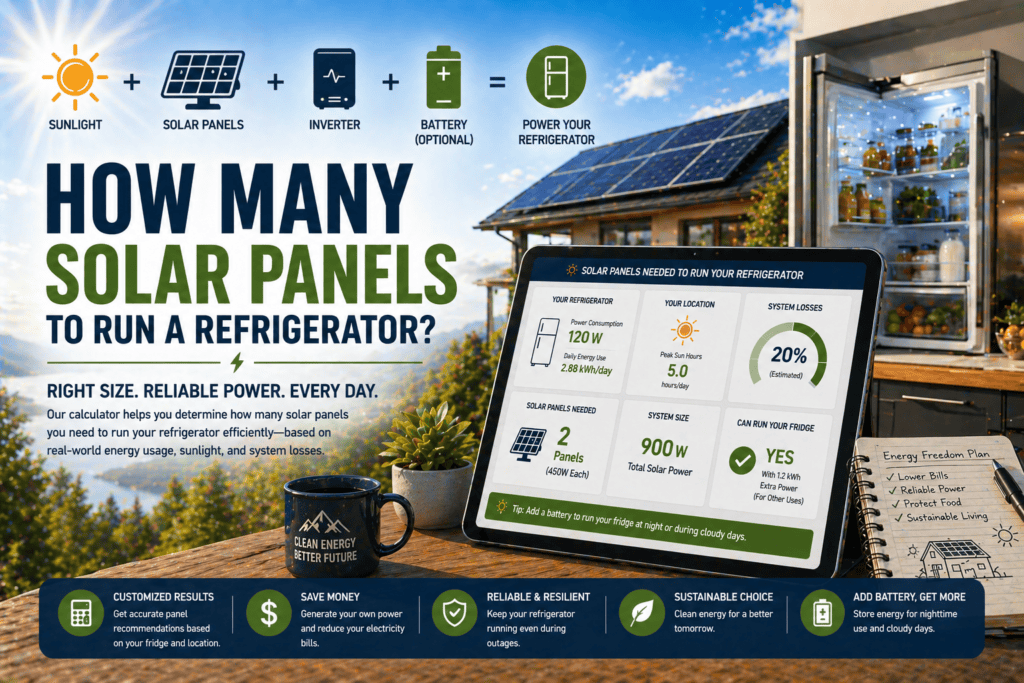
If you are trying to figure out how many solar panels to run a refrigerator, the answer depends on more than just the fridge itself. You need to look at daily energy use, panel wattage, sunlight hours, system losses, battery storage, and whether you want the refrigerator to run only during the day or continue through the night.
A small efficient refrigerator may only need a modest solar setup, while a larger household fridge usually needs more panel capacity and often a battery-backed system. That is why a simple “one-size-fits-all” answer is usually wrong.
This guide will help you estimate the right number of solar panels for your refrigerator, understand the key sizing factors, and use a calculator to get a more realistic answer for your off-grid or backup power setup.
Most refrigerators need 1 to 4 solar panels depending on size and conditions
To answer the question how many solar panels to run a refrigerator? A typical refrigerator uses around 1 to 2 kWh per day, which usually requires 1 to 4 solar panels (300W–400W each) depending on sunlight hours, panel efficiency, and system losses. Smaller energy-efficient fridges may run on fewer panels, while larger or older units require more.
If you want your fridge to run 24/7 (including overnight), you will also need a properly sized battery system in addition to solar panels.
Refrigerator Solar Panel Calculator
Estimate how many solar panels you need to run a refrigerator using daily fridge energy use, panel wattage, sun hours, real-world losses, battery charging overhead, and reliability margin.
Simple Inputs
Solar Recommendation
Advanced Inputs
Advanced Solar Recommendation
Continue Planning After Panel Estimate
Once you estimate how many solar panels are needed to run a refrigerator, the next step is confirming actual panel output, checking battery storage, validating fridge runtime, and making sure the full system works together properly.
Solar Panel Output Calculator
Verify how much real-world energy your proposed panel setup can actually produce.
Battery Bank Size Calculator
Make sure you have enough battery storage to keep the fridge running when solar production drops.
Refrigerator Solar Runtime Calculator
Test how long your refrigerator can run once battery size and solar charging are factored in.
Complete Solar System Calculator
Bring your fridge, solar panels, battery bank, and system demand into one broader validation step.
How to use this solar panel result in real life
Knowing how many solar panels you need to run a refrigerator only matters if you apply it to a real system. The panel count must match your actual use case, whether that means daytime-only operation, battery charging for overnight use, or a full off-grid setup with other appliances running at the same time.
If you only want to run the fridge during the day
Your system can be smaller if the panels are directly supporting the fridge while the sun is up. Even then, you still need enough production to cover real output losses and temporary drops from clouds, angle, and heat.
If you want the fridge running overnight
Now the panel count must also support charging a battery bank during the day. This is where many people undersize the system. You are no longer just powering the fridge — you are powering it and refilling storage for later.
If this is part of an RV or cabin system
The fridge should never be sized in isolation. Lights, fans, charging devices, pumps, and inverters all add to the daily energy demand. Your refrigerator may be the headline load, but it is rarely the only one that matters.
If you are building a backup power system
Backup systems should be designed for bad days, not perfect days. If your panel result is borderline, increase the array size. Reliability matters more than theoretical minimums when food preservation depends on the system.
Use this simple decision rule
Best use of this page
Use this page to estimate the solar array needed for your refrigerator first. Then move into a broader solar output, battery sizing, and daily energy use calculator to build the full system properly.
This page answers the panel question. The full power plan still depends on battery storage, inverter sizing, and your total daily load.
How to interpret your solar panel result
The number of panels you get from the calculator is not just a number — it tells you whether your solar setup is undersized, workable, or strong for running a refrigerator reliably. The mistake most people make is building too close to the minimum.
A higher panel count means
A lower panel count means
The reality most people miss
The calculator gives you a theoretical minimum. Real systems need margin. Weather, panel angle, seasonal variation, and system inefficiencies all reduce real-world output.
If your result is borderline, increase your panel count. Undersizing a solar system is one of the most common and expensive mistakes in off-grid design.
Solar Panels Needed for a Refrigerator (Real Example)
Let’s walk through a realistic scenario to show how many solar panels are needed to run a typical refrigerator using common assumptions.
Fridge Usage
Typical fridge uses about 1,500 Wh per day
Solar Panel
Using a 400W solar panel
Sun Hours
Assume 5 sun hours/day
System Efficiency
Apply 80% efficiency (losses)
Calculation Result
Each panel produces:
400W × 5h × 0.8 = 1,600 Wh per day
Fridge needs:
1,500 Wh per day
➜ Panels Required: 1 panel (minimum)
In real conditions, you should use 2 panels instead of 1 to account for cloudy days, seasonal changes, and system inefficiencies. Running at the exact minimum leaves no margin for reliability.
Pro tips to reduce the number of solar panels needed
If your result shows a higher number of panels than expected, the solution is not always adding more panels. Often, the better move is improving efficiency, reducing load, and optimizing system design.
The lower your daily kWh usage, the fewer panels you need. Use energy-efficient fridges, keep them full, minimize door openings, and improve airflow around the unit.
A 400W panel produces significantly more energy than a 200W panel. Fewer higher-watt panels can reduce system complexity and installation space.
Panels that are poorly angled or partially shaded can lose a significant portion of their output. Proper positioning can reduce the number of panels needed.
High-quality inverters, proper wiring, and efficient charge controllers reduce energy loss and improve total system output.
Efficient battery systems reduce energy waste during charging and discharging, meaning more of your solar energy actually powers your fridge.
Sunlight is not constant. Weather, seasons, and dirt buildup reduce panel output. Always design your system to handle less-than-ideal conditions.
The smartest approach
The best systems balance panel count, battery storage, and energy usage. Reducing demand and improving efficiency often saves more money than simply adding more panels.
Solar Panels for Refrigerators — Expert FAQ
These answers explain how to size solar panels for a refrigerator in real-world conditions, including battery storage, inverter surge, cloudy weather, panel losses, and off-grid reliability.
How many solar panels do I actually need for a refrigerator?
Most refrigerator solar setups need between 2 and 6 solar panels, depending on fridge energy use, panel size, sun hours, battery charging losses, and how much reliability you want.
A modern refrigerator often uses around 1 to 2 kWh per day. In average conditions, that usually means roughly 400W to 1,200W of solar panel capacity for a practical system.
Can one solar panel run a refrigerator?
One solar panel can sometimes help run a very efficient fridge, but it is usually not enough for a standard household refrigerator if you need reliable day-and-night operation.
A single 400W panel may produce enough energy on a good sunny day, but it leaves very little margin for cloudy weather, hot panel conditions, battery losses, or overnight use.
Do I need a battery to run a fridge on solar?
Yes, if you want the fridge to run continuously. Solar panels only produce power when sunlight is available, but a refrigerator cycles throughout the day and night.
Without a battery, the fridge may shut off when clouds pass, when solar output drops, or after sunset. That is not acceptable for food storage.
What size inverter do I need for a refrigerator?
Many refrigerators only use 100–300 running watts, but startup surge can be much higher. The inverter must handle both the running load and the compressor startup surge.
For a standard household fridge, a 1,000W to 2,000W pure sine wave inverter is commonly used, depending on the fridge size and whether other loads are running at the same time.
What reduces solar output the most?
The biggest real-world solar losses come from shade, heat, poor panel angle, dirty panels, wiring losses, charge controller losses, and battery charging losses.
- Shade: Can severely reduce output, even if only part of the panel is shaded.
- Heat: Hot panels usually produce less than their rated wattage.
- Poor angle: Bad tilt or orientation can reduce daily production.
- Battery losses: Charging and discharging are never 100% efficient.
How much battery capacity do I need for a fridge?
Battery capacity depends on daily fridge energy use and how long you want the fridge to run without sun. A fridge using 1.5 kWh/day needs at least 1.5 kWh of usable battery storage for one day.
For off-grid use, you should also account for battery depth of discharge, inverter losses, and cloudy-day backup.
Is a 12V, 24V, or 48V system better for running a refrigerator?
Small RV or portable fridge systems can work on 12V, but larger off-grid setups are usually better at 24V or 48V because they reduce current and wiring stress.
If the refrigerator is part of a full cabin, RV, or home backup system, 24V or 48V is often cleaner and more efficient than trying to push everything through a 12V setup.
Should I oversize the solar panels for a refrigerator?
Yes, within reason. A refrigerator is a critical load, so designing for the exact theoretical minimum is a bad idea.
Oversizing by 25–50% helps cover cloudy weather, heat loss, battery charging overhead, and seasonal changes. For remote or full-time off-grid systems, a larger safety margin may be justified.
Can a solar generator run a refrigerator?
Yes, but only if the solar generator has enough battery capacity, inverter surge rating, and solar input capacity. Many small power stations can run a fridge for a limited time but may not recharge fast enough for continuous use.
Check three numbers: usable battery watt-hours, inverter surge rating, and maximum solar input. All three matter.
What is the biggest mistake when sizing solar for a refrigerator?
The biggest mistake is sizing only for the fridge’s running watts instead of daily energy use and startup surge.
Running watts tell you how much power the fridge uses while operating. Daily kWh tells you how much energy must be replaced by solar. Startup surge tells you whether the inverter can actually start the compressor.
Related Tools for Fridge and Solar System Planning
These tools help refine panel layout, battery behavior, and appliance comparisons without duplicating the main next-step links above.
Solar Array Planner
Refine total panel count and array size if your fridge is only one part of the system.
Solar Panel Tilt Calculator
Improve production by optimizing panel tilt for better daily fridge support.
Solar Battery Discharge Calculator
Understand how battery drain behaves during refrigerator cycling and overnight use.
Air Conditioner Runtime Calculator
Compare a fridge setup against a much heavier appliance load to understand system scaling.