
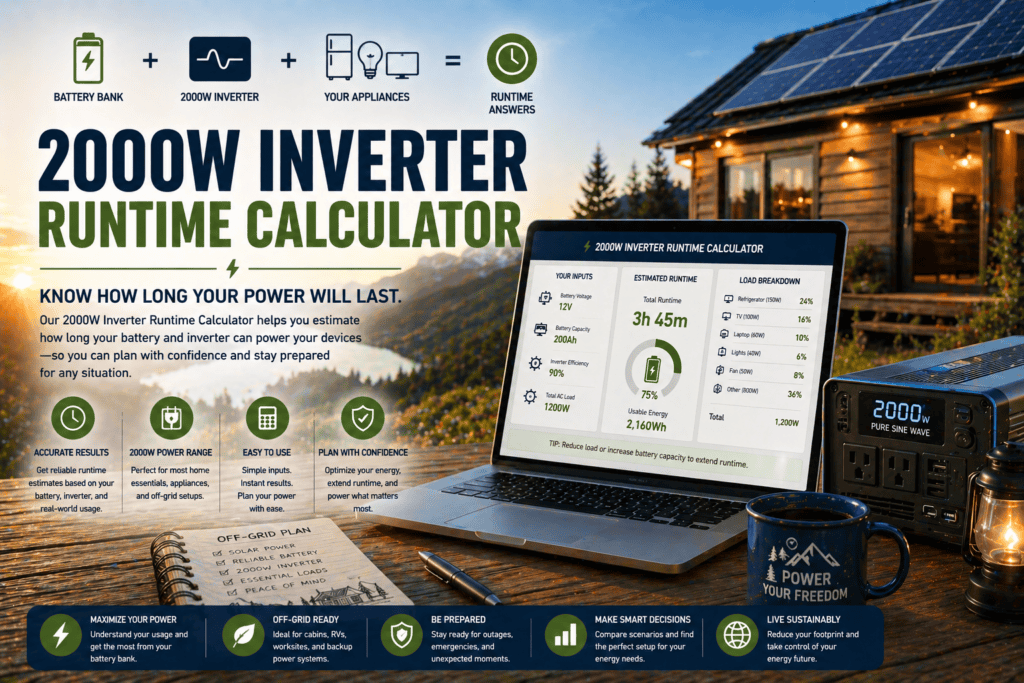
2000W Inverter Runtime Calculator
Inverter Runtime Guide 2000W
2000W Inverter Runtime Calculator?

Calculate real-world 2000W inverter runtime from battery size, voltage, inverter efficiency, and actual power draw.

A 2000W inverter does not determine runtime on its own. Runtime depends on how much usable battery energy you have and how many watts your appliances are actually drawing.

Use 2000W Inverter Runtime Calculator page to get a fast runtime estimate, understand the battery math behind the number, and dial in a precise answer for your off-grid or backup power setup.

Runtime = Battery Wh × DOD × Efficiency ÷ Load Watts
Inverter Size
2000W
Max rating — not a runtime guarantee.
Typical Runtime
0.5–6+ hrs
Varies by battery bank size and actual load.
Main Driver
Battery Wh
Usable energy decides everything.
2000W
Battery Bank → Inverter → AC Loads
Runtime at Common Load Levels
300W
~7.5h
750W
~3.0h
2000W
~1.1h
Based on a larger battery example. Inverter size does not create runtime — battery watt-hours and load draw do.
Quick Answer Featured Snippet Target

How long will a 2000W inverter run?

A 2000W inverter will only run as long as your battery bank can supply the load. For example, a 12V 100Ah battery (≈1200Wh before losses) may run a full 2000W load for only 20 to 35 minutes in real-world conditions. Lower loads significantly increase runtime.

The exact runtime depends on battery voltage, battery capacity, usable depth of discharge, inverter efficiency, and the actual watt draw of connected appliances. Running at full inverter capacity drains batteries extremely fast.

Full 2000W Load
0.3–0.7 hrs
Extremely fast battery drain unless you have a large battery bank.
Medium Load
2–4 hrs
More realistic for mixed appliance usage.
Light Load
4+ hrs
Possible when load stays well below inverter capacity.
Quick formula:
Runtime (hours) = Usable Battery Watt-Hours ÷ Actual Load (W)
Real-Life Use Practical Planning

How to use this 2000W inverter runtime in real life

Your runtime result matters only if you apply it to a real power scenario. A 2000W inverter is usually chosen for heavier appliance loads, but that also means battery drain can become a serious problem if the system is not sized properly.

If you are running large appliances

Microwaves, kettles, coffee makers, power tools, and small air conditioners can push load very high very quickly. Even if the inverter can handle it, runtime may be extremely short unless your battery bank is substantial.

If you are running mixed household loads

A 2000W inverter often works best when loads are moderate and staggered rather than all running at once. That gives much better runtime than assuming the system will sit near full load continuously.

If this is part of an off-grid system

Your battery bank and solar charging system must support the inverter load together. A strong inverter with weak battery storage is a bad system design. The full setup has to stay balanced.

If you are building backup power

Backup power should be designed for reliability, not minimum survival. If your runtime is borderline on paper, increase battery capacity before trusting the system in a real outage.

Use this decision rule

Step 1
Base your calculation on the real appliance load, not the full 2000W rating.
Step 2
Compare runtime against how long you actually need those appliances to run.
Step 3
If the result is too short, increase battery storage or reduce simultaneous load.

Best use of this page

Use this page to estimate 2000W inverter runtime first, then move into battery sizing, daily energy usage, and broader off-grid planning tools. Runtime is just one part of building a system that actually works.

Calculator Tool Simple + Advanced Mode 2000W

2000W Inverter Runtime Calculator

Use Simple Mode for a fast runtime estimate from battery voltage, capacity, and actual load. Switch to Advanced Mode to factor in battery chemistry, depth of discharge, inverter efficiency, and system losses for a much more accurate answer.

BATTERY 12–48V DC Source 2000W INVERTER DC → AC 85–95% Efficiency AC LOADS 120/240V AC RUNTIME Xh YYm Wh × DOD × Eff ÷ Load Watts Energy Source Power Converter Connected Loads Result
Simple Inputs
Quick Load Presets
Simple Mode assumes LiFePO4 chemistry — 90% DOD and 90% inverter efficiency. For other battery types use Advanced Mode.
Results
Estimated Runtime
Usable Battery Energy
DC Draw from Battery
Inverter Utilization
Enter values above and calculate.
Setup Verdict
Enter values and calculate to see your runtime estimate.
Recommended Next Steps

Continue Planning After 2000W Runtime Estimate

After estimating runtime for a 2000W inverter, the next step is confirming your battery capacity, verifying solar input, ensuring proper wiring, and validating your full system setup.

Calculation Explanation How It Works

How to calculate 2000W inverter runtime

A 2000W inverter’s runtime is governed by usable battery energy and your actual load. The inverter rating is just the ceiling—it does not determine how long the system will run.

Core formula
Runtime (hours) = Usable Battery Watt-Hours ÷ Actual Load (W)

Step 1: Total battery energy (Wh)

Multiply voltage by amp-hours:

12V × 200Ah = 2400Wh

Step 2: Usable capacity (DoD)

Apply depth of discharge:

Lithium ≈ 90%
Lead-acid ≈ 50%

Step 3: Inverter/system efficiency

Account for losses:

Typical range: 85–95%

Step 4: Divide by real load

Example:

1944Wh ÷ 800W = ~2.4 hours

What impacts 2000W inverter runtime the most

• Battery bank size (Ah × voltage)
• Battery chemistry (lithium vs lead-acid)
• Depth of discharge limits
• Inverter efficiency
• Actual appliance watt draw
• Wiring and system losses

This is why a 2000W inverter can run for minutes in one setup and hours in another. The inverter defines the maximum load—your battery and usage pattern define the runtime.

Results Interpretation What Your Runtime Means

How to interpret your 2000W inverter runtime result

Your result shows whether your battery system is undersized, balanced, or strong for the load you want to run. With a 2000W inverter, this matters even more because higher loads can drain batteries extremely fast.

Under 1 Hour
Very weak setup
Battery capacity is far too small for sustained use at this load level.
1 to 3 Hours
Limited runtime
Works for short bursts or backup, but not ideal for extended use.
3 to 8 Hours
Balanced system
Good range for many off-grid and backup scenarios with moderate loads.
8+ Hours
Strong system
Indicates a properly sized battery bank or lower real-world load usage.

Higher runtime means

• Larger battery capacity
• Lower average load
• Better efficiency
• More usable real-world performance

Lower runtime means

• Battery bank is too small
• Load is too high
• Inefficiencies are reducing output
• System is not balanced

The key takeaway

A 2000W inverter allows you to run larger loads, but it does not increase runtime by itself. In fact, higher-capacity inverters often lead to faster battery drain if the load increases.

If your runtime is too short, the solution is almost always increasing battery capacity or reducing load—not upgrading the inverter.

Example Calculation Real-World Walkthrough

Example: how long a 2000W inverter will run

Here is a realistic example using a 24V 200Ah lithium battery bank, a 90% inverter efficiency, and a real appliance load that stays well below the inverter’s maximum rating. This gives a useful runtime answer instead of assuming the inverter size alone controls performance.

Example setup

Battery bank: 24V 200Ah lithium
Usable depth of discharge: 90%
Inverter efficiency: 90%
Actual load: 1000W
Inverter size: 2000W maximum

Final result

3.9 hours
In this example, the 2000W inverter would run a 1000W actual load for about 3.9 hours before reaching the usable battery limit.

Step-by-step calculation

1. Total Battery Energy
24V × 200Ah
= 4800Wh
2. Usable Capacity
4800Wh × 0.90
= 4320Wh
3. After Inverter Losses
4320Wh × 0.90
= 3888Wh
4. Runtime
3888Wh ÷ 1000W
= 3.9 hours

What this example shows

Even with a fairly strong 24V battery bank, runtime still drops fast when load increases. A 2000W inverter can handle large appliances, but unless the battery bank is sized properly, high-load runtime will remain short. The inverter rating shows what it can support, while the battery bank determines how long it can sustain it.

Pro Tips Expert Insights

Pro tips to get more runtime from a 2000W inverter system

If your runtime result is too short, the answer is usually not a bigger inverter. A 2000W inverter already handles large loads. The real fix is better battery sizing, smarter load management, and a more efficient overall system.

1. Manage real load aggressively

A 2000W inverter encourages people to run too many devices at once. That is where runtime gets destroyed. Stagger appliance use whenever possible instead of stacking heavy loads at the same time.

2. Higher voltage systems perform better

A 24V or 48V battery system is usually a better match for a 2000W inverter than 12V. Higher voltage reduces current draw and tends to improve efficiency and stability under heavier loads.

3. Lithium is usually the right choice

Large inverter systems demand strong usable capacity. Lithium batteries usually give more usable energy, better voltage stability, and far better performance under higher loads than lead-acid systems.

4. Do not design around the bare minimum

If your runtime result barely covers your target usage, the system is undersized. Heat, battery aging, partial charging, and heavier-than-expected loads will expose that weakness fast.

5. Eliminate wasted energy

Inverter idle draw, phantom appliance loads, and poor wiring all quietly reduce runtime. A tighter system wastes less power and gives more useful runtime from the same battery bank.

6. Match solar charging to inverter ambition

A 2000W inverter paired with weak solar recharging is a bad balance. If you want to use larger loads regularly, your solar side needs enough output to restore that battery energy quickly.

Best next move

If this page shows your runtime is weak, increase usable battery capacity first and reduce simultaneous appliance load second. That is almost always a better fix than focusing on inverter size alone.

BATTERY 12–48V DC Source 2000W INVERTER DC → AC 85–95% Efficiency AC LOADS 120/240V AC RUNTIME Xh YYm Wh × DOD × Eff ÷ Load Watts Energy Source Power Converter Connected Loads Result
FAQ 20 Questions FAQ Schema Included

2000W Inverter Runtime — FAQ

Answers to the most common questions about 2000W inverter runtime, battery sizing, load limits, efficiency, and system setup — including the math behind every estimate.

Safety note: These answers are planning estimates only. Always follow your inverter, battery, fuse, cable, BMS, and local electrical code requirements before installing or operating a system.

Runtime Basics Q1 – Q4
1 How long will a 2000W inverter run on a 100Ah battery?

On a 12V 100Ah LiFePO4 battery at 90% DOD and 90% inverter efficiency, a full 2000W load will last about 26–29 minutes. The usable energy is only 972 Wh — divided by 2000W that’s under half an hour. Reducing load significantly extends runtime.

Runtime Calculation Usable Wh = 100Ah × 12V × 0.90 DOD × 0.90 Eff = 972 Wh
Runtime = 972 ÷ 2000W = 0.486 h (about 29 min)
Load (W)12V 100Ah LiFePO412V 200Ah LiFePO424V 200Ah LiFePO4
200W4h 51m9h 43m19h 26m
500W1h 57m3h 53m7h 46m
1000W58m1h 57m3h 53m
2000W29m58m1h 57m
Assumes 90% inverter efficiency, 90% DOD (LiFePO4).

Model any combination in the 2000W inverter runtime calculator.

2 What is the formula for calculating 2000W inverter runtime?

The same runtime formula applies regardless of inverter size. Three inputs drive the result: stored battery energy, how much of that energy you can safely use (DOD), and how efficiently the inverter converts DC to AC.

Step 1 — Usable energy Usable Wh = Battery Ah × Voltage × DOD
Example: 200Ah × 24V × 0.90 = 4,320 Wh usable
Step 2 — Apply inverter efficiency Delivered Wh = Usable Wh × Inverter Efficiency
Example: 4,320 × 0.92 = 3,974 Wh to loads
Step 3 — Divide by load Runtime = Delivered Wh ÷ Load Watts
Example: 3,974 ÷ 1000W = 3.97 h (3h 58m)

The 2000W runtime calculator runs all three steps for you. For system-wide energy planning, the Solar Battery Runtime Calculator covers total daily load across all devices.

3 Does a bigger inverter increase runtime?

No — inverter size has no effect on runtime. The 2000W rating defines the maximum AC power the inverter can supply at any instant. What determines runtime is your battery’s stored energy divided by the actual wattage your loads draw.

Running 500W from a 2000W inverter gives identical runtime to running 500W from a 1500W inverter — assuming the same battery and efficiency. The inverter size only matters when you need to confirm it can handle your combined load and surge without tripping.

Use the Solar Inverter Size Calculator to verify your inverter matches your load profile. Compare against a 3000W inverter if you need more continuous or surge headroom.

4 How much does load level affect runtime?

Load level has a direct, linear impact — halving your load exactly doubles your runtime. The sweet spot for a 2000W inverter is operating at 30–60% of its rating (600–1200W) to balance efficiency, component temperature, and battery life.

Load% of 2000W24V 200Ah LiFePO424V 400Ah LiFePO4
200W10%19h 26m38h 53m
500W25%7h 46m15h 33m
1000W50%3h 53m7h 46m
1500W75%2h 35m5h 11m
1800W90%2h 09m4h 19m
2000W100%1h 57m3h 53m
Assumes 90% inverter efficiency, 90% DOD (LiFePO4).

Use the Appliance Runtime Calculator to model your real daily load across all devices.

🔋 Battery Sizing & Chemistry Q5 – Q8
5 What battery size is needed for a 2000W inverter?

Battery size depends entirely on required runtime and load. A 24V 200Ah LiFePO4 bank (≈3,888 Wh usable) gives about 1h 57m at full 2000W or just under 4 hours at 1000W. For sustained or overnight backup, 400Ah+ is a practical minimum.

Battery (24V LiFePO4)Usable WhRuntime @ 2000WRuntime @ 500W
100Ah1,944 Wh58m3h 53m
200Ah3,888 Wh1h 57m7h 46m
300Ah5,832 Wh2h 55m11h 39m
400Ah7,776 Wh3h 53m15h 33m
Assumes 90% DOD, 90% inverter efficiency.

The Battery Bank Size Calculator sizes your bank based on daily energy needs and desired days of autonomy.

6 What is the best battery chemistry for a 2000W inverter?

LiFePO4 is the clear choice for a 2000W inverter. At full 2000W output a 24V system draws over 90A DC — a sustained high-current demand that lead-acid chemistries handle poorly, with significant voltage sag, reduced usable capacity, and accelerated degradation.

ChemistryMax DODCyclesHigh-Rate Performance24V 200Ah Usable Wh
LiFePO480–90%3,000–6,000+Excellent~3,888 Wh
NMC Lithium80–85%1,500–3,000Excellent~3,672 Wh
AGM50%400–600Poor at >1C~2,160 Wh
Gel60%500–800Fair~2,592 Wh
Flooded Lead-Acid50%300–500Poor~2,160 Wh
Usable Wh at 90% eff for lithium, 85% eff for lead-acid. 2000W at 24V draws ~93A — near or above 1C for many AGM banks.
7 What is depth of discharge (DOD) and how does it affect runtime?

Depth of discharge (DOD) is the percentage of a battery’s rated capacity you can safely draw before recharging. Exceeding DOD limits degrades the battery — often permanently for AGM. DOD is one of the most impactful variables in the runtime calculation.

DOD Impact — 24V 200Ah battery, 1000W load LiFePO4 at 90% DOD → 4,320 Wh × 0.90 eff = 3,888 Wh → 3h 53m
AGM at 50% DOD → 2,400 Wh × 0.85 eff = 2,040 Wh → 2h 02m
LiFePO4 delivers 90% more runtime from the same 200Ah bank

Always apply DOD before calculating runtime. The 2000W inverter runtime calculator includes DOD presets for all major chemistries.

8 How does battery voltage affect a 2000W inverter system?

Higher voltage dramatically reduces DC current draw, which means thinner cables, less heat, and lower resistive losses. A 2000W load at 12V draws roughly 185A DC — requiring very heavy cabling on short runs and careful fuse sizing. At 48V, that same load draws about 46A, which is much easier to manage, but the final wire gauge still depends on run length, insulation rating, temperature, installation method, fuse size, and acceptable voltage drop.

System VoltageDC Amps @ 2000WMin. Cable (short run)Energy per 100Ah
12V~185AVery heavy cable required1,200 Wh
24V~93AHeavy cable required2,400 Wh
48V~46ASmaller cable possible on short runs4,800 Wh
Assumes 90% inverter efficiency. Cable size must be calculated for distance, voltage drop, temperature, insulation rating, fuse size, and local code.

24V is the practical minimum for a 2000W inverter; 48V is the preferred choice for any serious installation. Check cable sizing with the Solar Wire Size Calculator.

🔌 Loads & Appliances Q9 – Q12
9 Can a 2000W inverter run a microwave or coffee maker?

Yes — a 2000W inverter comfortably runs full-size kitchen appliances that pushed a 1500W unit to its limits. A 1200W output microwave draws ~1,600W input, running at 80% utilization on a 2000W inverter. A 1500W output model draws ~1,900W — still within spec and with safer headroom than a 1500W inverter.

ApplianceRunning WattsSurgeOn 2000W Inverter
900W Microwave (output)~1,200W1,300W✅ Easy — 60% load
1200W Microwave (output)~1,600W1,700W✅ Good — 80% load
1500W Microwave (output)~1,900W2,000W⚠️ At limit — watch surge
Coffee Maker800–1,500W1,600W✅ Yes
Toaster800–1,500W1,600W✅ Yes
Electric Kettle1,200–1,500W1,600W✅ Yes, with margin

Runtime at these loads will be short unless you have a large battery bank — a 1500W kettle will drain a 12V 100Ah battery in under 40 minutes. See the 2000W runtime calculator for exact estimates.

10 Can a 2000W inverter run a refrigerator and other appliances simultaneously?

Yes — unlike a 1500W inverter, the 2000W rating gives enough continuous headroom to run a refrigerator alongside lighting, a TV, a laptop, and other moderate loads simultaneously. The key is keeping the total combined wattage below the inverter’s continuous rating.

Multi-Load Example Fridge (150W running) + TV (120W) + Lighting (60W) + Laptop (80W) = 410W combined
Utilization = 410 ÷ 2000 = 21% — plenty of headroom
Runtime on 24V 200Ah LiFePO4 ≈ 9h 29m

Surge matters too — if the fridge compressor starts while a microwave is running, combined surge could exceed 3,000W. Check that your inverter’s surge (peak) rating covers the worst-case startup scenario. For fridge-specific estimates, use the Refrigerator Solar Runtime Calculator.

11 What appliances can a 2000W inverter power?
ApplianceRunning WattsSurge Watts2000W Inverter
LED TV + streaming80–150W200W✅ Easy
Laptop + monitor80–200W300W✅ Easy
Refrigerator100–400W600–1,400W✅ Check surge
Full-size microwave1,200–1,900W2,000W✅ Yes (verify surge)
Coffee maker / toaster800–1,500W1,600W✅ Yes
Electric kettle1,200–1,500W1,600W✅ Yes, with margin
Power tools (circular saw)1,200–1,800W3,000–4,500W⚠️ Surge may exceed peak
Small window AC (5,000 BTU)500W1,500W✅ Yes
Large window AC (12,000 BTU)1,200W3,600W❌ Surge too high
Electric space heater (1500W)1,500W1,500W✅ Yes, 75% utilization

For full daily energy planning across all loads, the Appliance Runtime Calculator helps model real consumption. Need more headroom for high-surge tools? See the 3000W inverter.

12 How much surge power does a 2000W inverter provide?

Most 2000W inverters carry a peak surge rating of 3,500–4,000W for 1–2 seconds. This covers motor startup spikes from refrigerators (3–4× running watts) and most power tools. Always verify your specific model’s peak spec — budget units often have lower surge ratings than marketed.

Surge Check — Worst-Case Startup Fridge 200W × 4 surge = 800W startup
Microwave 1,200W × 1.2 = 1,440W startup
Combined surge if both start simultaneously = ~2,240W — within 4,000W peak ✅
Always check inverter’s actual peak rating on the spec sheet

The Solar Inverter Size Calculator stacks all your loads and their surge multipliers to confirm whether 2000W is sufficient or whether you should step up.

Efficiency & Losses Q13 – Q16
13 What is the typical efficiency of a 2000W inverter?

Quality 2000W pure sine wave inverters achieve 88–95% efficiency at 40–80% of rated load — the optimal operating range. Efficiency drops at very low loads due to idle draw, and at heavy loads near the 2000W ceiling due to thermal losses.

Inverter TypePeak EfficiencyAt 50% LoadIdle Draw
Budget Modified Sine Wave80–85%78–83%20–35W
Mid-Range Pure Sine Wave88–92%86–90%10–18W
Premium Pure Sine Wave93–96%92–95%5–10W

A 30W idle draw on a 24V system pulls 1.25A constantly — over 30Ah in a day even with no AC loads connected. Look for a 2000W inverter with ECO/search mode to eliminate standby waste.

14 Is it safe to run a 2000W inverter at full load?

Running at 100% of continuous rating is within spec for short durations but degrades component life over time. Most manufacturers rate continuous output at 25°C — higher ambient temperatures derate this. Keeping load below 75% (under 1,500W) keeps temperatures lower and leaves surge headroom.

UtilizationLoad on 2000W InverterStatus
< 75%< 1,500W✅ Optimal — efficient, cool
75–90%1,500–1,800W⚠️ Caution — monitor temperature
> 90%> 1,800W🔴 High stress — reduce if sustained

If your loads regularly reach 2000W, a 3000W inverter would run those loads at a healthier 67% utilization with significant surge headroom.

15 What affects runtime the most in a 2000W inverter system?
FactorPotential ImpactSolution
Load wattageLinear — halve load, double runtimeReduce load or use efficient appliances
Battery bank sizeLinear — double Ah, double runtimeAdd capacity in parallel
Battery chemistry (AGM vs LiFePO4)Up to 80% more runtimeUpgrade to LiFePO4
Inverter efficiency (80% vs 95%)~19% runtime differenceUse premium pure sine wave
Cable losses (>3% voltage drop)3–8% runtime lossUpsize cable gauge
Cold battery (<0°C)Up to 30% less capacityInsulate or heat battery enclosure

The 2000W runtime calculator has a system losses field so you can model cable losses and other inefficiencies alongside DOD and chemistry.

16 How do I calculate DC amps drawn by a 2000W inverter?

DC current is the key number for sizing cables, fuses, and battery bus bars. The formula divides AC watts by system voltage and inverter efficiency.

DC Current Formula DC Amps = Load Watts ÷ (System Voltage × Inverter Efficiency)
At 12V: 2,000 ÷ (12 × 0.90) = 185.2A DC
At 24V: 2,000 ÷ (24 × 0.90) = 92.6A DC
At 48V: 2,000 ÷ (48 × 0.90) = 46.3A DC

185A at 12V makes a 12V system impractical for a 2000W inverter — the cabling cost and heat alone are prohibitive. At 48V, 46A is straightforward to handle safely. Use the Solar Wire Size Calculator for your exact run length and amperage.

🛠 Setup & Best Practices Q17 – Q20
17 What wire gauge and fuse size do I need for a 2000W inverter?

Cable gauge is determined by DC current, not AC wattage. At 12V, a 2000W inverter can pull roughly 185A DC before surge loads, making wire sizing and overcurrent protection critical. Always install the DC fuse close to the battery and size wire/fusing from the inverter manual, battery/BMS limits, run length, voltage-drop target, and local electrical code.

System VoltageDC Amps @ 2000WMin. AWG (≤3 ft)Recommended Fuse
12V~185AVery heavy cable; calculate exact sizeFollow inverter manual / code
24V~93AHeavy cable; calculate exact sizeFollow inverter manual / code
48V~46ASmaller cable possible on short runsFollow inverter manual / code
Planning guidance only. Longer runs require heavier cable to control voltage drop. Always verify wire gauge, fuse type, fuse size, disconnect rating, and terminal temperature limits against your inverter manual, battery/BMS limits, and local electrical code.

Use the Solar Wire Size Calculator for precise cable sizing based on run length and current.

18 What system voltage is best for a 2000W inverter — 12V, 24V, or 48V?

24V is the practical minimum; 48V is the recommended choice. A 2000W inverter at 12V draws 185A DC — so much current that most cables get hot, connections degrade, and battery BMS limits are often triggered. 24V halves the current to 93A. 48V brings it down to a very manageable 46A.

For new builds, 48V gives the best efficiency, lowest cable costs, and the most headroom to grow. Most quality 2000W inverters are available in 24V and 48V configurations. A 1500W inverter is the better choice if you genuinely need 12V.

19 Modified or pure sine wave — which 2000W inverter should I choose?

Pure sine wave is the right choice for a 2000W inverter in virtually all applications. At this power level you’re likely running sensitive electronics, kitchen appliances with microcontrollers, variable-speed motors, or power tools — all of which require clean AC. Modified sine wave at 2000W also runs significantly less efficiently and causes more heat in resistive and motor loads.

Device TypeModified Sine WavePure Sine Wave
Microwaves / ovens⚠️ Reduced output, runs hot✅ Full rated output
Refrigerator / motors⚠️ 15–20% efficiency loss✅ Full efficiency
Power tools (variable speed)❌ May not function✅ Works correctly
Laptops / electronics⚠️ Charger runs hot✅ Works perfectly
LED lighting✅ Works✅ Works

At the 2000W level, the price difference between modified and pure sine wave is small relative to your total system cost. Pure sine wave is the clear choice.

20 How can I extend runtime on a 2000W inverter system?

Five practical strategies — in order of impact:

1. Cut Load Wattage
Replace high-draw devices with efficient alternatives. Running at 1000W instead of 2000W exactly doubles your runtime from the same battery.
2. Increase Battery Capacity
Doubling Ah doubles runtime linearly. Adding a second identical battery in parallel is the most straightforward upgrade.
3. Upgrade to LiFePO4
Moving from AGM (50% DOD) to LiFePO4 (90% DOD) almost doubles usable energy from the same Ah rating — without adding a single cell.
4. Higher System Voltage
48V over 24V halves cable losses and heat. More stored energy reaches your loads rather than being lost as heat in conductors.
5. Add Solar Charging
Solar recharges your battery during the day, making runtime effectively unlimited on sunny days and dramatically extending it on cloudy ones.

For a complete system design covering panels, battery, and inverter together, use the Complete Solar System Calculator or the Solar Battery Runtime Calculator.

Scroll to Top