
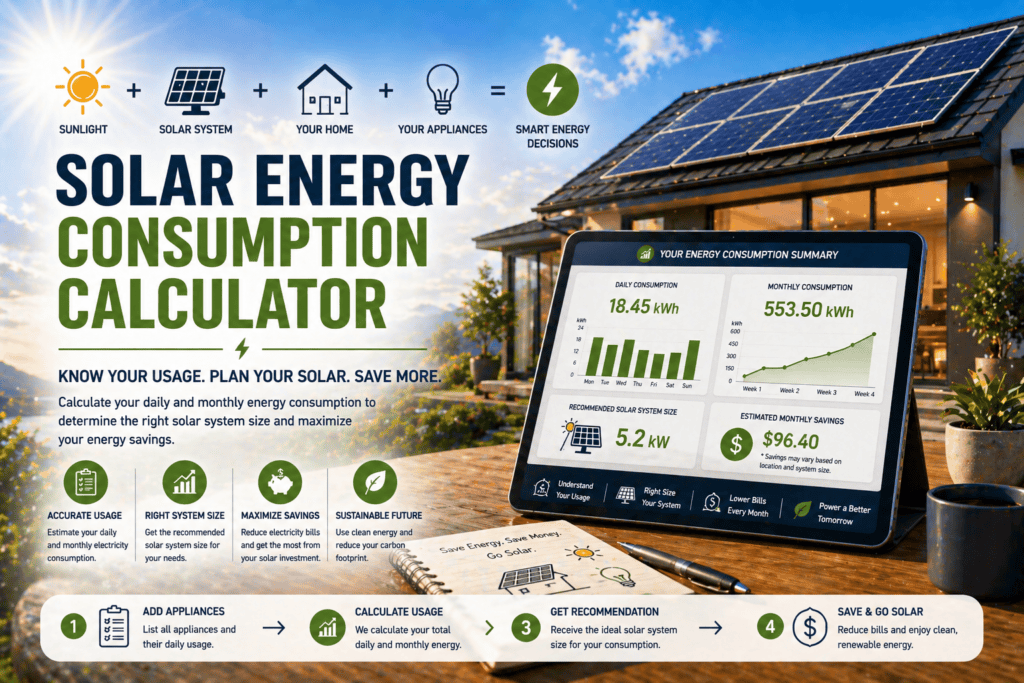
Solar Energy Consumption Calculator (Daily Power Usage & Appliance Load)
Use this Solar Energy Consumption Calculator to build a daily appliance load profile in Wh and kWh for a cabin, RV, home, or backup setup. Simple Mode handles one appliance type and its quantity. Advanced Mode adds multiple loads, duty cycles, AC standby energy, and separate solar-array and battery-capacity estimates under your stated assumptions.
Choose this page when you need to estimate equipment capacity from an appliance list. To compare demand with battery capacity, daily solar recharge, and an inverter you already have in mind, use the Solar Power Daily Consumption Calculator. For a watts-to-Wh conversion, weekly or monthly energy, and entered-rate cost, use the Solar Watt Hours Calculator.
How the Calculation Works
Solar energy consumption is calculated by multiplying the power rating of each device in watts by the number of hours it runs each day. This gives you the daily energy use in watt-hours. Once you total all devices, you can convert that value into kilowatt-hours by dividing by 1,000.
Basic Formula:
Energy Consumption (Wh/day) = Device Watts × Hours Used Per Day × Number of Devices
Advanced Mode multiplies each row by its duty-cycle fraction and adds the additional AC standby allowance. It divides that delivered load by inverter efficiency once. Solar sizing then uses the extra planning margin, solar weather buffer, peak sun hours, and other solar delivery efficiency. Battery sizing uses autonomy days, the planning margin, usable depth of discharge, and nominal voltage. These are separate paths, not one adjusted load to reuse everywhere.
Solar Energy Consumption Calculator
Estimate daily, monthly, and yearly energy use for solar planning. Use Simple Mode for one device or Advanced Mode to build a full appliance profile with duty cycle, standby load, system losses, reserve margin, solar panel estimate, battery estimate, and planning verdict.
Simple Daily Energy Use
Use this when you only need a fast estimate for one device or one appliance type.
Simple Results
Advanced Energy Load Planner
Build an illustrative AC appliance profile. Duty cycle affects energy use, not the running-watt capacity requirement. If entered hours already represent active operating time, set duty to 100%. Inverter efficiency applies to the AC-to-battery energy path once.
System Assumptions
Use location- and season-specific peak sun hours where available.
Advanced Results
Appliance Breakdown
Adjustment Breakdown
Tools to measure your electricity usage
Accurate measurements can improve your appliance load estimates. Choose monitoring equipment suitable for your supply voltage, outlet or panel, and skill level.
This section contains affiliate links. We may earn a commission.
P3 Kill A Watt P4400 Electricity Usage Monitor
Measure plug-in appliance watts and energy over time to improve your daily load estimates.
Click for the latest price.Kasa KP125M Energy-Monitoring Smart Plugs (2-Pack)
Track compatible plug-in loads over longer periods; check outlet rating and Wi-Fi requirements.
Click for the latest price.Emporia Vue 3 Whole-Home Energy Monitor
Compare whole-home and circuit-level energy consumption. Electrical-panel installation requires a qualified professional.
Click for the latest price.Klein Tools CL390 AC/DC Clamp Meter
A diagnostic instrument for qualified users measuring current; never clamp around both conductors together.
Click for the latest price.Continue Planning After Energy Usage Calculation
Once you calculate your daily energy consumption, the next step is sizing your battery bank, determining how many solar panels you need, confirming inverter capacity, and validating your full system design.
Battery Bank Size Calculator
Convert your daily energy usage into the correct battery storage capacity.
Solar Array Planner
Determine how many panels you need to generate enough daily energy.
Solar Inverter Size Calculator
Compare running and startup power needs with the inverter manufacturer’s ratings.
Complete Solar System Calculator
Bring your energy usage into a full system validation and planning tool.
How To Use
Use Simple Mode for watts × hours/day × quantity. Use Advanced Mode to build a load profile and examine the separate energy, solar, battery, running-power, and startup-power results. The advanced model assumes the listed consumption passes through an inverter; account for direct DC loads separately.
Simple Mode
Enter one device’s wattage, how many hours it runs each day, and how many of that device you use. The calculator will return daily, monthly, and yearly energy consumption.
Advanced Mode
Build a complete appliance profile, customize every row, model duty cycle behavior, apply system losses, and create a more accurate planning result for solar panel, battery, and inverter sizing.
Step-by-Step Instructions
1. Choose your mode.
Select Simple Mode for a quick estimate or Advanced Mode for a full customizable energy plan.
2. Enter appliance details.
Enter each appliance’s running watts, hours per day, quantity, duty percentage, and startup watts. Enter zero for unknown startup power, but treat the startup result as potentially understated. If hours already represent actual active runtime, use 100% duty; do not reduce the same runtime twice.
3. Add or remove appliances as needed.
Use the Add Appliance button to create your load profile. Remove rows that do not apply to your setup.
4. Adjust system assumptions.
Set peak sun hours, panel rated power, other solar delivery efficiency, inverter efficiency, extra planning margin, battery autonomy days, voltage, usable depth of discharge, additional AC standby allowance, and solar seasonal/weather buffer. The running and startup results assume all listed appliances operate together; there is no simultaneous-load-factor control.
5. Review the results.
Read Actual Daily Load as appliance energy plus additional AC standby, before losses and planning margins. Monthly and yearly energy repeat that modeled day for 30 and 365 days. Use Adjustment Breakdown to understand the separate solar-array and nominal battery estimates.
Best Practice: Use measured running watts with duty cycle over the entered time window, or average measured watts with 100% duty. Fridge and pump presets are examples; actual duty changes with equipment, climate, and use.
Did You Know
Standby loads and conversion losses can increase required supply energy. Measure background loads and add only AC standby energy that is not already included in an appliance row.
There is no single daily kWh target for every off-grid home. Heating, cooling, cooking, water pumping, climate, and occupancy can change the load substantially; build your own measured appliance profile.
Cycling loads need both running power and operating time. A 150 W appliance running for 24 hours at 35% duty uses 1,260 Wh/day; duty cycle reduces energy over that time window but does not reduce its active running watts.
An extra energy margin is a scenario allowance. It does not establish inverter surge capability or guarantee operation through cloudy weather; those require separate power, production, and autonomy checks.
Example Calculation
This illustrative AC-load example uses the table below with zero additional standby, 90% inverter efficiency, 85% other solar delivery efficiency, 20% extra planning margin, zero weather buffer, 4 peak sun hours, 400 W panels, one autonomy day, 24 V battery voltage, and 80% usable depth of discharge. These are example assumptions, not equipment recommendations.
Example Appliance Inputs
Other solar delivery: 85%
Extra Planning Margin: 20%
Step-by-Step
1. Add all appliance loads together:
1,260 + 480 + 600 + 300 = 2,640 Wh/day
2. Convert delivered AC energy to battery-side energy:
2,640 ÷ 0.90 = 2,933.33 Wh/day.
3. Calculate the solar estimate separately:
2,933.33 × 1.20 × 1.00 ÷ 4 ÷ 0.85 = 1,035.29 W, rounded up to three 400 W panels. The equivalent pre-solar-delivery-loss energy allowance is 4.14 kWh/day; appliance consumption remains 2.64 kWh/day.
4. Calculate nominal battery capacity:
2,933.33 × 1 autonomy day × 1.20 ÷ 0.80 = 4,400 Wh, or 183.3 Ah at 24 V. Other solar delivery efficiency and the weather buffer are not applied to this battery estimate. Startup watts require separate entries.
Results Interpretation
Actual Daily Load is modeled appliance energy plus additional AC standby. Estimated Solar Array is an indicative rated power in W; Estimated Battery is nominal storage in Wh and Ah. Simultaneous Running Load and Simultaneous Startup Load are power figures in W. Daily kWh alone cannot establish inverter capacity.
Key Insight: Keep appliance Wh/day, solar-array W, battery Wh/Ah, and inverter running/startup W separate. Avoid adding the same losses or margins again when transferring results to another calculator.
If your calculated consumption is higher than expected, focus on reducing high-wattage appliances or limiting usage hours. Small adjustments—like switching to LED lighting or reducing runtime—can significantly lower system size and cost.
Expert Tips
Use duty cycle properly. Use 100% when entered hours already count active operation or when watts are an average over the full time window. Apply a measured duty fraction only to running watts over the corresponding window.
Do not size from raw watt-hours alone. A basic appliance total is not enough for serious planning. Always account for inverter losses, overall system efficiency, and reserve margin so your solar setup performs in real conditions rather than only on paper.
Count standby once. Add measured AC background loads not already listed. The additional AC standby field is not a separate model of an inverter’s own DC idle draw.
Model the season explicitly. Change appliance hours and duty cycles for seasonal demand, and use location- and season-specific peak sun hours. The solar weather buffer increases the solar estimate only; it does not change Actual Daily Load or battery autonomy.
Use the result for each component. Read the separate solar and battery estimates alongside Adjustment Breakdown. Check running watts and startup watts independently; a daily energy total cannot confirm inverter suitability.
Comparison Table
These illustrative energy bands help compare load scale; they are not household benchmarks or equipment prescriptions. Solar sunlight, storage autonomy, usable capacity, and simultaneous power requirements still need separate inputs.
Visual Insight
Daily energy demand affects solar production and storage requirements under the chosen assumptions. Inverter capacity depends separately on which loads run together and their startup power; increasing runtime alone can raise daily Wh without raising running watts.
Key Takeaway: Higher energy demand generally requires more production and storage under otherwise identical assumptions; the illustrated bars are conceptual, not plotted to scale. Optimizing your consumption is one of the most effective ways to reduce overall solar system requirements.
Planning Advice
Daily Wh is the starting point for energy planning. Solar production also depends on sunlight and delivery losses, battery capacity on autonomy and usable fraction, and inverter capacity on simultaneous running and startup power.
Start with accurate inputs. The more realistic your appliance data, the more accurate your system design will be. Use actual wattage ratings and estimate usage hours honestly instead of guessing low values.
Test demanding conditions. Compare seasonal load profiles and peak sun hours, and vary autonomy days and the solar weather buffer. Margins are assumptions, not guarantees of reliable operation.
Balance system size and efficiency. Reducing consumption through efficient appliances and smarter usage patterns can dramatically lower system cost. Often, cutting energy use is cheaper than increasing solar capacity.
Keep the adjustment paths separate. Use the solar and nominal battery estimates for their stated purposes and verify assumptions before transferring any result to another sizing tool. Do not apply a second loss allowance to an already adjusted result.
Plan for future expansion. If you expect to add appliances later—such as air conditioning, additional lighting, or electric cooking—account for that now. Designing with expansion in mind prevents costly system upgrades down the road.
Planning Strategy: Measure loads, test seasonal assumptions, and review energy, reserve, and power limits separately. The simplified model supports planning; it does not confirm a complete system’s reliability.
Key Expansion
How do I calculate my daily solar energy consumption?
To calculate your daily solar energy consumption, multiply each appliance’s wattage by the number of hours it runs per day and the quantity used. Then add all devices together to get total watt-hours per day. For equipment sizing, model duty cycles and then apply losses and planning margins separately; do not count them as additional appliance consumption.
What is a good daily kWh usage for an off-grid solar system?
A useful daily kWh target depends on your actual appliances, climate, occupancy, and usage. Compare measured daily energy with the loads you intend to support rather than treating a household range as a design target.
Why is my solar energy usage calculation higher than expected?
Check quantity, hours, duty cycle, and standby energy for double counting. Then distinguish Actual Daily Load from the separate loss and margin adjustments; a larger solar or battery estimate does not mean the appliances themselves consume more energy.
How can I reduce my solar energy consumption?
You can reduce solar energy consumption by switching to energy-efficient appliances, minimizing usage time, and eliminating unnecessary standby loads. Using LED lighting, efficient refrigeration, and optimizing appliance run times can significantly lower your daily energy demand and reduce system size.
How accurate are solar consumption calculators?
The arithmetic follows the entered assumptions. Uncertain wattage, duty cycle, weather, and efficiency limit the estimate’s accuracy. Measure consumption over representative days and compare seasonal scenarios.
Solar Energy Consumption — Common Questions
Clear answers about daily kWh use, appliance loads, duty cycle, system losses, battery sizing, and solar planning assumptions.
Solar energy consumption is the amount of electricity your appliances and devices use over time, usually measured in watt-hours or kilowatt-hours per day. For solar design, daily kWh is the key number because it determines how large your solar array and battery bank need to be.
Multiply watts by hours used per day, then divide by 1,000.
For example, a 100W device running 5 hours per day uses 500Wh, or 0.5kWh per day.
Simple mode gives a fast estimate. Advanced mode is better for real solar planning because it includes duty cycle, inverter efficiency, system losses, standby loads, reserve margin, solar panel estimate, and battery storage estimate.
Duty cycle is the percentage of time a device actually runs at its rated wattage. A fridge may be plugged in 24 hours per day but only run its compressor 30–40% of the time. Using duty cycle avoids overestimating or underestimating daily consumption.
Daily energy use varies with appliances, climate, occupancy, and operating hours. Build a measured load profile for your setup instead of sizing from a generic household range.
Use Actual Daily Load for modeled appliance energy plus additional AC standby. Solar and battery estimates use separate adjustment paths shown in Adjustment Breakdown. Other solar delivery efficiency and the weather buffer affect solar sizing only. Check simultaneous running watts and startup watts separately for the inverter.
The biggest loads are usually air conditioners, electric heaters, water heaters, electric ovens, dryers, large pumps, and full-size refrigeration. Reducing or replacing these loads can shrink the solar array and battery bank dramatically.
Apply inverter efficiency once to the modeled AC load. Other solar delivery efficiency applies only to solar sizing and must exclude that inverter loss. Battery depth of discharge limits usable storage; it is not another energy-conversion efficiency.
Divide your adjusted daily Wh by peak sun hours and system efficiency. For example, 5,000Wh per day ÷ 4.5 sun hours ÷ 0.80 system efficiency = about 1,389W of solar panels. With 400W panels, that rounds up to 4 panels.
Nominal battery Wh = battery-side daily Wh × autonomy days × planning-margin factor ÷ usable depth-of-discharge fraction. For 5 kWh/day of delivered AC load, 90% inverter efficiency, one autonomy day, zero extra margin, and 90% usable depth of discharge, the model gives about 6.17 kWh nominal. Use your battery’s specifications.
Use adjusted average daily energy for panel and battery sizing, but check peak running load and surge load for inverter sizing. Energy consumption determines how long the system runs. Peak watts determine whether the inverter can safely power everything at once.
Yes. Reducing high-draw appliances is often cheaper than buying more panels and batteries. Efficient refrigeration, LED lighting, propane cooking, solar water heating, and avoiding electric resistance heating can cut required system size dramatically.
Related Tools for Energy and System Optimization
These tools help refine production, runtime behavior, wiring, and cost planning without duplicating the main next-step links above.
Solar Panel Output Calculator
Check how much energy your solar system can realistically produce.
Solar Battery Runtime Calculator
Estimate how long your battery bank will run based on your energy usage.
Solar Wire Size Calculator
Estimate cable size and voltage drop under stated conditions.
Solar Panel Cost Calculator
Estimate the cost of building a system that matches your energy usage.
Electricity-use reference
Household appliance demand changes throughout the day and across seasons. The U.S. Department of Energy’s Electricity 101 overview provides context for electricity use. For accurate calculator inputs, measure appliance watts or use reliable manufacturer ratings, then record actual daily runtime and standby consumption.