
Solar Inverter Size Calculator
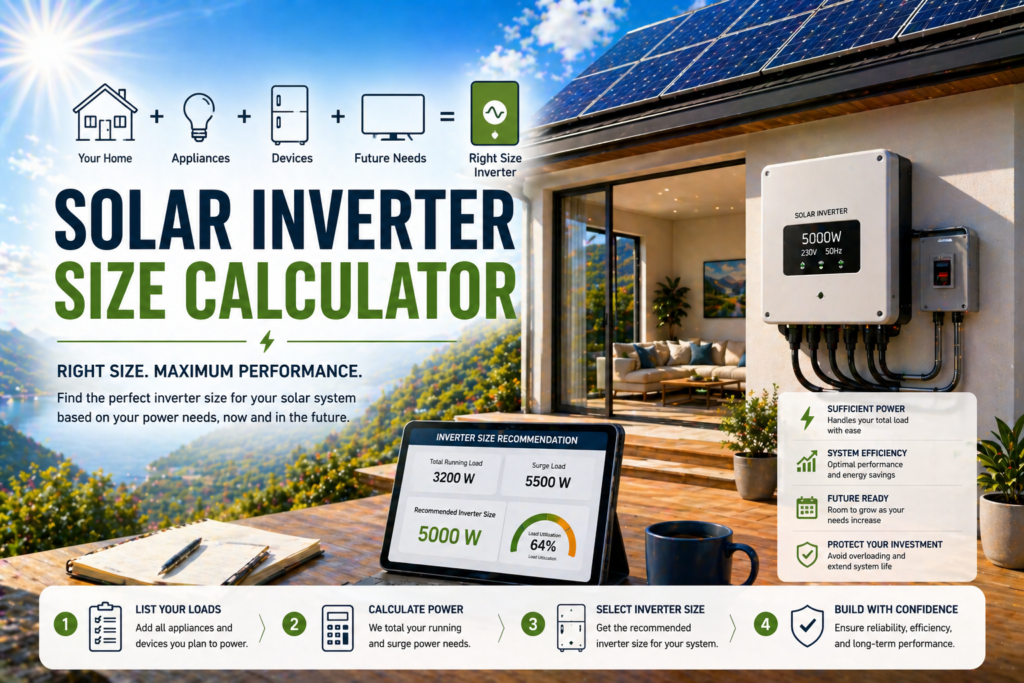
Use this solar inverter size calculator to compare continuous running power and startup requirements for your appliances. Simple mode applies a user-entered surge multiplier; Advanced mode uses individual appliance running and startup watts.
This tool estimates power requirements, not battery runtime. It does not certify an inverter, battery, wiring system or installation. Compare actual manufacturer output, startup duration and DC-side limits separately.
Jump to the solar inverter size calculator · Read the sizing guide · Methodology and limitations
Solar Inverter Size Calculator
Use Simple Mode for a quick estimate, or Advanced Planner Mode to build an appliance load list and estimate continuous watts, startup watts, and battery current.
Simple Inverter Sizing
Enter your total running watts and a few key parameters for a preliminary continuous-power and startup estimate.
System Results
How to use the solar inverter size calculator
- List the appliances that can operate together and obtain running power and startup specifications. Use actual equipment data where possible.
- In Simple mode, enter total running watts, an illustrative surge multiplier and optional planning margin. Enter zero existing inverter watts if you have no existing inverter to compare.
- In Advanced mode, enter running and startup watts for each appliance. Startup watts must be at least running watts; use the same value for a load without a modeled startup spike.
- Assign simultaneous-use groups carefully. Together group loads are combined, including a conservative simultaneous-start assumption. Alone only loads operate with every other listed load off. An appliance that can overlap the group belongs in Together group.
- Enter nominal battery voltage, inverter efficiency and DC delivery loss to estimate battery current. Battery Ah and C-rate provide only an entered continuous-current comparison.
- Review continuous output and startup power separately. The current tool clears results after relevant changes; select Calculate to refresh them.
Continuous inverter sizing formula
Continuous AC target = simultaneous running watts × (1 + planning-margin fraction). The displayed minimum is rounded up to 50W increments. This rounding is a planning convention, not a set of actual available inverter models.
The tool does not reduce instantaneous running power using duty cycle. A cycling device can still demand its full running power while on. Advanced Duty % calculates average AC watts for each scenario (running watts × duty fraction). The displayed average is the larger of the Together group sum and each Alone only scenario. It does not discount inverter sizing or estimate daily energy without operating hours.
Startup requirement assumptions
In Simple mode, startup estimate = running watts × entered surge multiplier. That multiplier is an illustrative assumption, not a measured startup rating.
Advanced mode adds the startup watts of all Together group loads for its conservative simultaneous-start scenario, and compares that sum with the largest Alone only startup. Continuous running demand likewise compares the combined Together group running watts with the largest Alone only running load.
If an Alone only appliance can operate with the Together group in practice, these selections do not represent that scenario. Change the grouping or assess the combined load separately. Startup duration, waveform, power factor/VA and actual inverter capabilities are not established by this arithmetic.
Worked example: 1500W running load
Assume 1,500W combined running power, 20% planning margin and an illustrative 2.5 startup multiplier in Simple mode.
- Continuous AC target: 1,500 × 1.20 = 1,800W.
- Rounded planning minimum: 1,800W.
- Separate startup estimate: 1,500 × 2.5 = 3,750W.
- For a 2,000W existing inverter, running-load utilization is 1,500 ÷ 2,000 × 100 = 75%.
The 2,000W continuous rating alone cannot establish whether the inverter can supply a 3,750W startup for the necessary duration. Simple mode also cannot calculate battery current because it has no battery voltage or efficiency input.
Battery-side current in Advanced mode
Estimated nominal DC current = running AC watts ÷ inverter efficiency ÷ (1 − DC delivery loss) ÷ nominal battery voltage. Efficiency and DC loss affect the source current; they are not added again to the inverter’s AC output requirement.
For 1,500W running load, 24V nominal battery voltage, 90% inverter efficiency and 8% DC delivery loss, the estimate is 1,500 ÷ 0.90 ÷ 0.92 ÷ 24 = approximately 75.48A. An entered 200Ah and 0.5C give an indicative 100A continuous limit.
A current estimate below that entered limit is not proof of battery compatibility. Verify actual battery/BMS discharge ratings, voltage range, low-voltage behavior, startup current, cable losses, protection and equipment instructions separately.
Understanding the solar inverter size calculator results
The continuous planning target applies the entered margin exactly once, then rounds upward to 50 W. There is no additional hidden 20% uplift. Advanced mode also displays a separate duty-weighted average AC load; it is not the inverter capacity target. The comparison table evaluates continuous watts only and explicitly requires manufacturer verification for startup behavior.
Running watts, startup watts and energy are different measurements. Inverter capacity is assessed in power units, while battery autonomy depends on Wh or kWh and operating time. The Appliance Runtime Calculator and Solar Watt Hours Calculator address separate energy questions.
Inverter sizing questions
What size inverter do I need for solar?
Start with the appliances and their simultaneous running and startup requirements, then check the DC source and inverter specifications. Panel wattage alone does not determine the required AC inverter capacity for an appliance-backed battery system.
Does a larger battery mean I need a larger inverter?
Not by itself. More stored energy can extend runtime, while the appliance power requirement determines the needed AC output. Battery discharge limits must still support the inverter demand.
Can I assume surge capacity is twice the continuous rating?
No. Surge power and allowed duration are model-specific. Check manufacturer data; the solar inverter size calculator does not infer an existing inverter’s surge capacity.
Will a planning margin guarantee reliable operation?
No. It increases the continuous target arithmetically. It does not replace checks for startup duration, thermal derating, waveform, voltage compatibility or installation requirements.
Continue Planning After Inverter Sizing
After estimating inverter capacity, check battery discharge capability, expected energy consumption, solar production and wiring requirements against the specifications for your actual equipment.
Battery Bank Size Calculator
Estimate the battery energy capacity needed for your loads; verify continuous and surge discharge limits separately.
Solar Panel Output Calculator
Estimate solar panel energy production to help balance daily electricity use.
Solar Wire Size Calculator
Estimate conductor sizing and voltage drop; verify ampacity, protection, installation conditions and applicable codes.
Complete Solar System Calculator
Consider inverter sizing alongside battery storage, solar production and other system-planning assumptions.
Related Tools for Load and Runtime Planning
These tools help refine runtime expectations, battery behavior, and array planning without duplicating the main next-step links above.
2000W Inverter Runtime Calculator
See how a common inverter size performs with real battery loads and runtime expectations.
3000W Inverter Runtime Calculator
Compare larger inverter scenarios with heavier loads and shorter runtime windows.
Solar Array Planner
Plan the panel array needed to support the energy demand behind your inverter size.
Solar Battery Runtime Calculator
Estimate how long your battery bank can power the loads connected to your inverter.