Solar Panel Efficiency Calculator
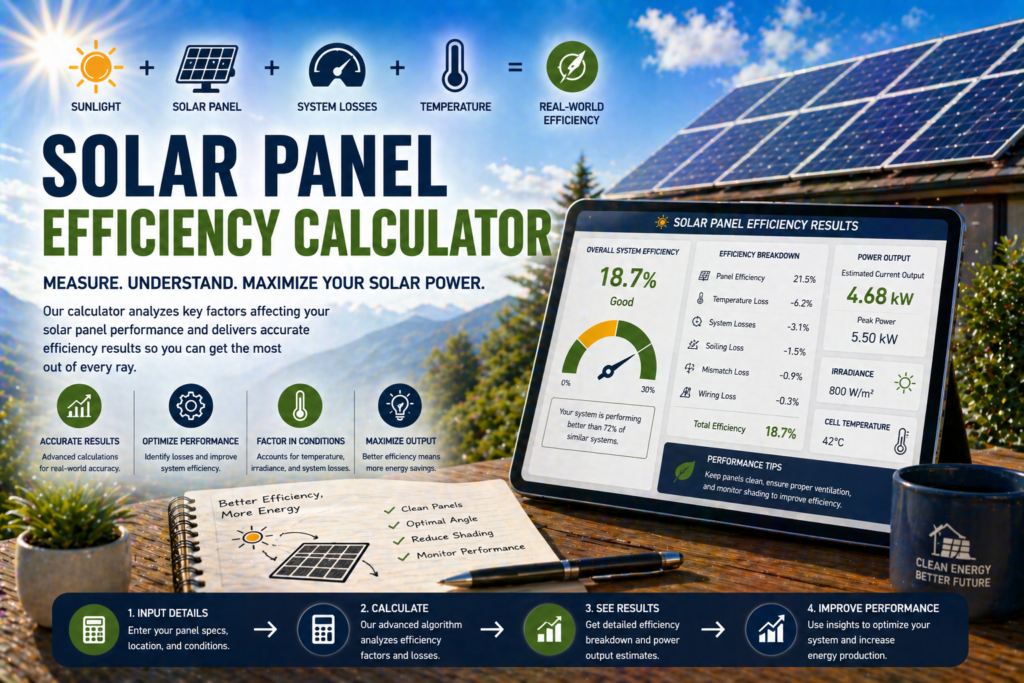
Calculate how efficiently your solar panels convert sunlight into usable electricity. This tool helps you understand real-world performance based on panel specs, sunlight conditions, and system factors.
Use Simple Mode for quick efficiency estimates or Advanced Mode to factor in temperature, shading, panel type, and system losses for a more accurate performance analysis.
How the Calculation Works
Solar panel efficiency measures how much sunlight is converted into usable electricity. It is calculated by comparing the panel’s electrical output to the solar energy hitting its surface area.
In simple terms, efficiency is determined by dividing the panel’s output power by the total solar energy received. Advanced calculations account for real-world losses such as temperature, shading, wiring inefficiencies, and inverter performance.
Step 1
Enter panel wattage (output power under standard conditions).
Step 2
Input panel surface area or dimensions to determine solar input energy.
Step 3
Calculate efficiency as output divided by input energy.
Step 4
Advanced mode adjusts for real-world losses such as temperature and system inefficiencies.
Core formula: Efficiency (%) = (Panel Output ÷ Solar Input Energy) × 100. Higher efficiency means more electricity generated from the same sunlight.
Solar Panel Efficiency Calculator
Compare solar panels side-by-side using efficiency, real-world losses, roof area, location-based sun hours, and estimated daily energy output.
Location-Based Solar Data
Current estimate uses latitude-based solar logic. Manual override is available below.
Real-World Loss Factors
Compare 3 Panel Choices
| Panel | Watts | Area m² | Price |
|---|---|---|---|
| Panel A | |||
| Panel B | |||
| Panel C |
Continue Planning After Panel Efficiency Analysis
Once you understand your panel efficiency, the next step is checking real-world solar output, validating array size, estimating system cost, and seeing how efficiency affects long-term value.
Solar Panel Output Calculator
See how panel efficiency translates into actual real-world energy production.
Solar Array Planner
Check whether higher or lower efficiency changes the number of panels you need.
Solar Panel Cost Calculator
Compare how panel efficiency may affect overall system cost and equipment choices.
Solar Payback Period Calculator
Estimate how more efficient panels may shorten your payback timeline.
How To Use
Use this calculator to determine how efficiently your solar panels convert sunlight into electricity. Follow these steps to get accurate results.
Step 1: Enter Panel Output
Input the panel’s rated output in watts (W), usually found on the panel specification sheet.
Step 2: Enter Panel Area
Enter the surface area of the panel in square meters (m²).
Step 3: Enter Solar Irradiance
Input the sunlight level in W/m². Standard test conditions use 1000 W/m².
Step 4: Use Advanced Mode
Adjust for temperature losses and system inefficiencies to get a real-world efficiency value.
Using Advanced Mode (Recommended)
Advanced Mode provides a more realistic efficiency calculation by factoring in environmental and system losses.
- Adjust for temperature-related efficiency loss
- Include system losses from wiring and inverter
- Simulate real-world operating conditions
- Compare theoretical vs actual performance
Simple Mode
Best for quick efficiency calculations based on standard conditions.
Advanced Mode
Best for detailed performance analysis and real-world system evaluation.
Best Practice: Always evaluate real-world efficiency rather than relying solely on manufacturer ratings.
Results Interpretation
Your result shows how efficiently your solar panel converts sunlight into electricity. This helps you understand real-world performance and compare different panels or system setups.
Efficiency Percentage
Indicates how much of the sunlight hitting your panel is converted into usable electricity.
Base vs Real Efficiency
Base efficiency is the theoretical value, while real efficiency includes losses from heat, wiring, and system factors.
System Performance
Higher efficiency systems generate more power from the same sunlight, improving overall energy production.
Efficiency Guide:
• 15–18%: Standard panels
• 18–21%: High efficiency panels
• 21%+: Premium panels
Real-world efficiency is often slightly lower than rated efficiency due to environmental and system factors.
Example Calculation
This example shows how to calculate solar panel efficiency based on output power and solar input energy.
System Inputs
Panel Output: 400W
Panel Area: 2 m²
Irradiance: 1000 W/m²
Formula
Efficiency = Output ÷ (Area × Irradiance)
Goal
Determine how effectively the panel converts sunlight into electricity.
Step-by-Step Breakdown
Step 1: Calculate solar input
2 × 1000 = 2000W input energy
Step 2: Calculate efficiency
400 ÷ 2000 = 0.20 → 20% efficiency
Efficiency
Output
Performance
Real-World Tip: Efficiency decreases slightly in real-world conditions due to heat, shading, and system losses.
Did You Know
Most Solar Panels Are 15% to 23% Efficient
Most residential solar panels convert between 15% and 23% of sunlight into electricity, with premium panels sitting at the higher end of that range.
Heat Reduces Solar Panel Performance
Solar panels work best in strong sunlight, but excessive heat actually lowers efficiency and reduces real-world power output.
Higher Efficiency Does Not Always Mean Higher Value
Higher efficiency panels generate more power in less space, but lower-cost panels can sometimes deliver a better cost-to-output ratio.
Real-World Conditions Matter More Than Lab Ratings
Shading, dirt, wiring losses, temperature, and inverter efficiency all affect actual performance, even if the panel has a strong rated efficiency.
Key Insight: Solar panel efficiency is important, but total system performance depends on installation quality, sunlight conditions, and system losses just as much as the panel rating itself.
Expert Tips
Solar panel efficiency is only one part of system performance. These expert insights help you maximize real-world output and system value.
Don’t Chase Efficiency Alone
Higher efficiency panels are useful when space is limited, but overall system cost per watt is often more important.
Temperature Has a Big Impact
Solar panels lose efficiency as temperatures rise, so proper ventilation and installation matter.
Minimize System Losses
Inverter losses, wiring inefficiencies, and shading can significantly reduce real-world performance.
Optimize Panel Placement
Proper tilt, orientation, and shading avoidance can improve output more than higher panel efficiency alone.
Advanced Efficiency Factors
- Panel type (monocrystalline vs polycrystalline)
- Temperature coefficient of the panel
- Inverter efficiency
- Wiring and connection losses
- Dust, dirt, and shading effects
Typical Efficiency Range
System Losses
Installation Quality
Expert Insight: The most efficient solar system is not just about panel specs—it’s about optimizing the entire system for real-world conditions.
Comparison Table
This table compares solar panel efficiency ranges across different panel types and performance levels.
Key Insight: Higher efficiency panels produce more power in less space, but total system cost and installation quality are equally important for overall performance.
Visual Insight
Solar panel efficiency varies by technology and conditions. This visual shows how efficiency levels compare across different panel types.
Efficiency Comparison by Panel Type
Thin-Film (10–13%)
Polycrystalline (15–17%)
Monocrystalline (17–21%)
Premium Panels (21%+)
Technology Impact
Panel type significantly affects efficiency, with monocrystalline and premium panels leading performance.
Real-World Variation
Actual efficiency varies due to environmental conditions, installation quality, and system losses.
Planning Insight: Higher efficiency panels are ideal when space is limited, but system design and installation quality are just as important.
Planning Advice
Choosing the right solar panel efficiency and system setup ensures you get the best performance and value from your investment.
Match Efficiency to Space
Use higher efficiency panels if roof space is limited. Lower efficiency panels can work well when space is not a constraint.
Optimize System Design
Proper system design, including inverter selection and wiring, can improve overall efficiency more than panel choice alone.
Reduce Loss Factors
Minimize shading, dirt buildup, and system inefficiencies to maintain high performance.
Focus on Cost vs Output
The best system balances efficiency with cost to achieve the highest overall value and return.
Common Efficiency Mistakes
- Choosing panels based only on efficiency rating
- Ignoring system losses and installation factors
- Overpaying for high-efficiency panels without need
- Neglecting maintenance and cleaning
- Not optimizing panel placement and tilt
Typical Range
Loss Factors
System Design
Final Advice: The best solar setup focuses on total system performance, not just panel efficiency, to deliver maximum long-term energy output and value.
Key Expansion Insights
What is solar panel efficiency?
Solar panel efficiency measures how much sunlight a panel converts into usable electricity. Higher efficiency means more power output from the same amount of sunlight.
What is a good solar panel efficiency?
A good solar panel efficiency is typically between 18% and 22%, with premium panels exceeding 21%.
Does higher efficiency mean better solar panels?
Not always. Higher efficiency is beneficial for limited space, but overall system cost, installation, and performance factors also matter.
What affects solar panel efficiency?
Efficiency is affected by panel type, temperature, shading, dirt, system losses, and installation quality.
How can you improve solar efficiency?
Improve efficiency by optimizing panel placement, reducing shading, maintaining clean panels, and minimizing system losses.
Solar Panel Efficiency FAQ
Clear answers about solar panel efficiency, real-world output losses, temperature impact, roof-space planning, and how to compare panels before choosing the best option for your system.
-
Solar panel efficiency is the percentage of sunlight hitting the panel surface that gets converted into usable electricity. A 20% efficient panel converts about 20% of the incoming sunlight into electrical power, while the rest is lost as heat, reflection, or other conversion losses.
Efficiency matters most when space is limited. A higher-efficiency panel can produce more power from the same roof or ground-mount area. If you have plenty of space, cost per watt may matter more than efficiency alone.
Bottom line: Efficiency tells you how much power a panel can produce per square metre, not whether it is automatically the best value. -
A good modern solar panel efficiency rating is usually around 19% to 22%. Standard residential monocrystalline panels often fall near 19% to 21%, while premium panels can reach 22% or higher.
Panels below 17% are usually older, budget-grade, or lower-density options. They can still work, but they need more physical space to produce the same total power as a higher-efficiency panel.
Best practical target: For most homes, cabins, RVs, and off-grid systems, 19% to 21.5% is the sweet spot between performance and cost. -
The basic formula is: solar panel efficiency equals panel wattage divided by panel area multiplied by solar irradiance, then multiplied by 100.
Under standard test conditions, solar irradiance is normally treated as 1,000 watts per square metre. For example, a 400 watt panel with a 2.0 m² area has an efficiency of 400 ÷ (2.0 × 1,000) × 100 = 20%.
Formula: Efficiency (%) = Rated Watts ÷ (Panel Area × 1,000) × 100. -
Rated wattage is measured under ideal lab conditions. Real-world output is lower because panels are affected by heat, wiring loss, inverter loss, dirt, shade, snow, angle, orientation, clouds, and seasonal sunlight changes.
A panel rated at 400 watts may only produce 300 to 360 watts in real use depending on conditions. This is normal and does not mean the panel is defective.
Planning rule: Do not size an off-grid system using nameplate watts only. Use real-world usable output after losses. -
Yes. Solar panels usually become less efficient as they get hotter. Most panels are tested at 25°C cell temperature, but real panels can operate much hotter in direct sunlight, especially on roofs with poor airflow.
A common temperature coefficient is around -0.35% to -0.45% per °C above 25°C. That means a hot panel can lose a meaningful amount of output even on a sunny day.
Practical fix: Leave airflow behind panels when possible. Better ventilation helps reduce heat loss. -
No. Higher efficiency is not always the best financial choice. If you have plenty of roof or ground-mount space, a slightly lower-efficiency panel with a lower cost per watt may produce the same total energy for less money.
Higher-efficiency panels are most worth it when space is limited, when roof sections are partially blocked, when you need maximum output from fewer panels, or when the added output helps avoid needing another roof section or mounting structure.
Best decision metric: Compare cost per usable watt, watts per square metre, warranty, and real-world performance — not efficiency alone. -
Yes, but not by itself. The number of panels you need depends on your daily energy use, peak sun hours, system losses, battery storage needs, and the wattage of each panel.
Efficiency affects how much power you can fit into a limited area. If two panels have the same wattage but one is physically smaller, the smaller one is more efficient and uses less space.
Simple example: A 6,000 watt system needs 15 panels at 400 watts each, but fewer panels if you use higher-wattage modules. -
Solar panels slowly lose output as they age. This is called degradation. Most quality panels lose a small percentage of output each year, commonly around 0.25% to 0.75% annually depending on panel quality and technology.
Heat stress, moisture, poor manufacturing, microcracks, severe weather, and poor installation can speed up degradation. This is why warranty quality and manufacturer reputation matter.
Buying tip: A slightly less efficient panel with a stronger long-term performance warranty can be a better buy than a high-efficiency panel from a weak manufacturer. -
STC efficiency is measured under Standard Test Conditions in a controlled lab environment. It is useful for comparing panels on paper, but it does not represent what the panel will produce every day in real weather.
Real-world efficiency includes temperature loss, inverter loss, wiring loss, dirt, snow, shading, panel angle, and local sunlight conditions. This is the more useful number for actual system planning.
Best practice: Use STC efficiency for panel comparison and real-world efficiency for system sizing. -
The best way to compare solar panels is to look at wattage, efficiency, panel size, cost per watt, usable output after losses, warranty, degradation rate, and how many panels fit in your available mounting area.
A cheaper panel may be the better deal if you have enough space. A more efficient panel may be better if it produces more daily energy from the same roof area or reduces the number of panels needed.
Best comparison: Choose the panel that gives the best combination of usable watts, roof-space efficiency, long-term warranty, and cost per usable watt.
Related Tools for Solar Layout and System Planning
These tools help refine positioning, spacing, system sizing, and broader planning without duplicating the main next-step links above.
Solar Panel Tilt Calculator
Optimize panel tilt to improve the effective performance of your solar modules.
Solar Panel Angle Calculator
Fine-tune panel direction to help maximize usable output from your array.
Solar Panel Spacing Calculator
Reduce shading losses and improve the practical performance of your panel layout.
Off-Grid Power Planner
Bring efficiency assumptions into a broader off-grid system strategy and sizing plan.