
Solar Panel Output Calculator
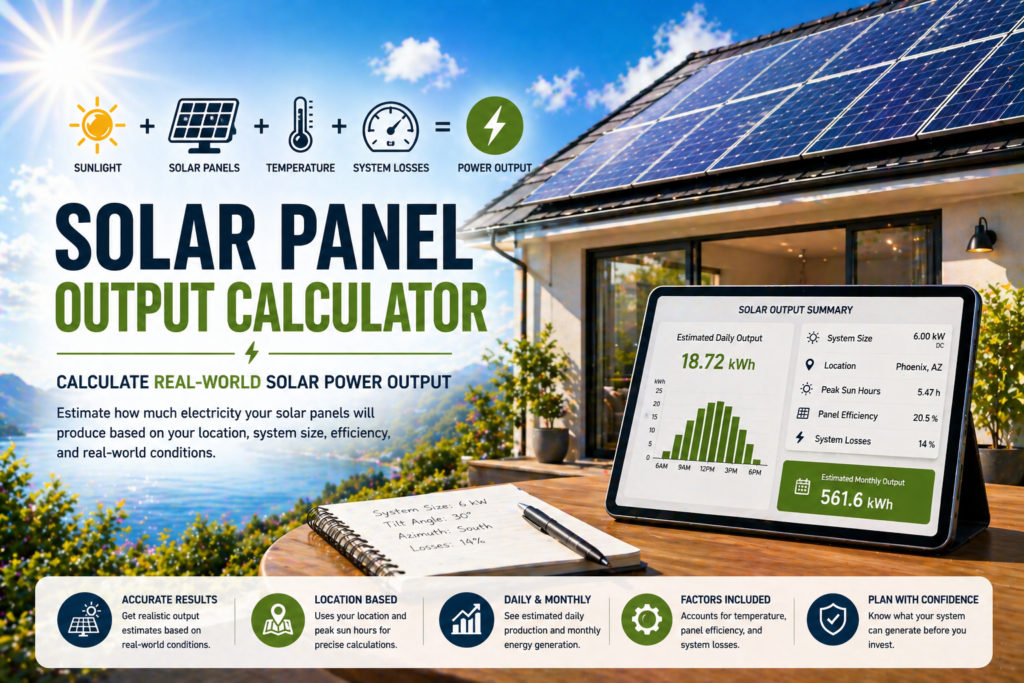
The Solar Panel Output Calculator helps estimate how much electricity a solar panel system can produce each day. Solar production depends on several key factors including panel wattage, the number of panels, average sunlight hours, panel efficiency, and system losses.
By entering your system details, this calculator estimates daily solar energy production in watt-hours (Wh) and kilowatt-hours (kWh). This is useful when planning off-grid systems, designing residential solar installations, calculating battery storage needs, or estimating how much electricity your solar panels can generate in a typical day.
How Much Power Do Solar Panels Produce Per Day?
Solar panels typically produce between 3 and 5 times their rated wattage per day depending on sunlight hours. For example, a 400-watt solar panel receiving about 5 peak sun hours can generate roughly 2,000 Wh (2 kWh) of electricity per day under good conditions.
Basic formula:
Solar Panel Output (Wh/day) = Panel Wattage × Sun Hours × Number of Panels × System Efficiency
For example, if you have 4 solar panels rated at 400 watts each and receive 5 peak sun hours per day, your system could generate approximately 8,000 Wh (8 kWh) of electricity per day before accounting for system losses.
Biggest factors affecting solar panel output
- Number of solar panels installed
- Wattage rating of each panel
- Average daily sunlight hours (peak sun hours)
- Panel tilt, orientation, and shading
- System losses from inverters, wiring, and temperature
How Solar Panel Output Is Calculated
Solar panel output is the amount of electricity your solar system can generate over a given period, usually measured per day. The calculation starts with the rated wattage of your solar panels and the average number of peak sun hours your location receives. From there, the result is adjusted to account for real-world system efficiency.
Peak sun hours represent the equivalent number of hours per day when sunlight intensity averages 1,000 watts per square meter. This gives a more realistic way to estimate solar production than simply counting daylight hours. System efficiency is then used to reflect inverter losses, wiring losses, dirt on panels, heat losses, and other real conditions that reduce total output.
Solar Panel Output Formula
Solar Output (Wh/day) = Panel Wattage × Number of Panels × Peak Sun Hours × System Efficiency
For example, a system with four 400-watt panels produces 1,600 watts of rated power. If that system receives 5 peak sun hours per day and operates at 85% overall efficiency, it would generate about 6,800 watt-hours, or 6.8 kWh, per day under typical conditions.
Key Variables That Affect Solar Panel Production
- Wattage rating of each solar panel
- Total number of panels in the array
- Average daily peak sun hours
- Panel tilt, angle, and orientation
- System efficiency and real-world losses
Solar Output Planner
Simple Mode gives a fast daily output estimate. Advanced Planner Mode models real-world production with full loss analysis.
Array Inputs
Real-World Performance Losses
Goal Validation
Decision Output
Array performance, charging reality, and adequacy verdict.
Continue Planning After Solar Output Estimation
Once you calculate expected solar production, the next step is confirming whether your battery bank can store that energy, whether your inverter is sized correctly, whether your array size is sufficient, and whether the full system stays balanced.
Battery Bank Size Calculator
Check whether your battery storage is large enough to capture and use your solar production effectively.
Solar Inverter Size Calculator
Make sure your inverter can properly handle the loads your solar system is meant to support.
Solar Array Planner
Refine how many panels you need and whether your array size matches your energy goals.
Complete Solar System Calculator
Bring your solar output estimate into a full system check to validate the entire setup.
How to Use the Solar Panel Output Calculator
This calculator helps you estimate how much electricity your solar panel system can generate in a typical day. To get the most accurate result, use realistic panel specifications and average sun hour estimates for your location.
Enter Panel Wattage
Start by entering the rated wattage of one solar panel. Common residential solar panels are often rated between 300W and 450W.
Add the Number of Panels
Enter how many panels are installed in your solar array. The calculator will multiply the panel wattage by the number of panels to find your total system size.
Enter Peak Sun Hours
Input the average daily peak sun hours for your location. This is one of the biggest factors affecting solar energy production and usually ranges from 3 to 7 hours depending on climate and season.
Include System Efficiency
Enter an estimated overall system efficiency to account for inverter losses, heat losses, wiring losses, dirt, and real-world operating conditions. A common estimate is 80% to 90%.
Did You Know?
A 400W Panel Can Produce 1.5–2.5 kWh Per Day
In many sunny locations, a modern 400-watt solar panel can generate between 1.5 and 2.5 kWh of electricity per day depending on sunlight hours and system efficiency.
Solar Panels Rarely Produce 100% of Their Rated Power
Panel wattage ratings are based on laboratory test conditions. In real environments, heat, shading, dust, and electrical losses often reduce actual output.
Peak Sun Hours Are Not the Same as Daylight
Peak sun hours measure solar energy intensity, not daylight length. A location may receive 10 hours of daylight but only 4–6 peak sun hours for solar production.
System Losses Typically Range from 10–25%
Solar systems lose energy through inverters, wiring resistance, heat, and panel mismatch. Most systems operate around 75–90% overall efficiency.
Understanding Your Solar Panel Output Results
The calculator estimates how much electricity your solar panel system can generate in a typical day. The results are shown in watt-hours (Wh) and kilowatt-hours (kWh), which represent the total electrical energy produced by your solar panels over the course of one day.
Watt-Hours (Wh)
Watt-hours measure the total amount of electrical energy produced by your solar panels in a day. This value helps determine whether your solar system can meet the daily energy needs of your appliances.
Kilowatt-Hours (kWh)
Kilowatt-hours are the standard unit used by utility companies to measure electricity. Most residential solar systems produce between 10 and 40 kWh per day depending on system size and location.
System Efficiency
System efficiency accounts for real-world energy losses caused by inverters, wiring resistance, heat, shading, and dust. Most solar systems operate at about 75% to 90% efficiency.
Typical Daily Solar Production Ranges
- Small RV solar system: 1–5 kWh per day
- Cabin or tiny house solar system: 3–10 kWh per day
- Residential rooftop solar system: 10–40 kWh per day
- Large residential solar system: 40–80+ kWh per day
Example Solar Panel Output Calculation
To understand how the solar panel output calculator works, it helps to walk through a real-world example. This example shows how panel wattage, sun hours, and system efficiency determine how much electricity your solar panels can generate each day.
Example Solar System
- Panel wattage: 400 W
- Number of panels: 6
- Peak sun hours: 5 hours
- System efficiency: 85%
Step-by-Step Calculation
1. Calculate total system wattage:
400 W × 6 panels = 2,400 W
2. Multiply by daily peak sun hours:
2,400 W × 5 hours = 12,000 Wh
3. Adjust for system efficiency (85%):
12,000 Wh × 0.85 = 10,200 Wh
Final Estimated Solar Production
Based on this example, the solar system would generate approximately:
- 10,200 Wh per day
- or about 10.2 kWh of electricity daily
Actual solar production can vary depending on seasonal sunlight, shading, panel orientation, and local weather conditions.
Expert Tips for Estimating Solar Panel Output More Accurately
Solar panel output estimates can be very useful, but they are only as good as the numbers you enter. Small mistakes in sun hours, shading assumptions, or system efficiency can lead to unrealistic expectations. These practical tips will help you get a more accurate estimate of daily solar production.
Use Peak Sun Hours, Not Daylight Hours
A location may have 10 to 12 hours of daylight, but only 4 to 6 peak sun hours. Using daylight hours instead of peak sun hours will overestimate solar production.
Be Conservative With Efficiency
Many real-world solar systems operate at about 75% to 90% overall efficiency. If you want a safer planning estimate, use the lower end of that range rather than assuming ideal performance.
Account for Seasonal Changes
Solar output can vary significantly between summer and winter. If you are designing an off-grid system, plan around lower winter production instead of peak summer conditions.
Check for Shading and Orientation Losses
Trees, buildings, roof angle, and panel direction can all reduce production. Even a well-sized solar array can underperform if the installation site has regular shading issues.
Practical Rule of Thumb
For quick planning, many solar systems produce roughly 3 to 5 times the panel wattage per day in watt-hours, depending on sunlight conditions. A 400W panel often produces around 1.2 to 2.0 kWh per day in typical real-world use, but local conditions always matter.
Solar Panel Output Comparison Guide
Solar panel output varies significantly depending on panel wattage, the number of panels installed, and local sunlight conditions. The table below shows approximate daily electricity production for common solar panel sizes assuming about 5 peak sun hours and typical system efficiency.
| Panel Wattage | Panels in System | Estimated Daily Output | Estimated Monthly Output |
|---|---|---|---|
| 350W | 4 panels | ~6 kWh | ~180 kWh |
| 400W | 6 panels | ~10 kWh | ~300 kWh |
| 420W | 10 panels | ~18 kWh | ~540 kWh |
| 450W | 15 panels | ~28 kWh | ~840 kWh |
| 500W | 20 panels | ~40 kWh | ~1,200 kWh |
Why Solar Output Varies
These estimates assume good sunlight conditions and minimal shading. Actual production can vary depending on roof direction, seasonal sun angle, weather patterns, panel cleanliness, and overall system efficiency.
Visual Insight: How Solar Panel Output Scales With System Size
Solar energy production increases as more panels are added to the system. However, the increase is not always perfectly linear due to system losses, shading, and efficiency factors. The visual example below illustrates how daily solar production grows as system size increases.
What This Visual Shows
In this example, each solar panel is assumed to be approximately 400 watts with about 5 peak sun hours per day and an overall system efficiency of roughly 85%. As panels are added, total system output grows quickly.
This type of visualization helps homeowners and off-grid planners quickly understand how system size affects energy production when designing a solar power system.
Planning Advice for Estimating Real Solar Panel Output
A solar panel output estimate is only useful if it matches real conditions. Panel wattage alone does not tell you how much usable energy your system will deliver each day. Sun hours, weather, shading, tilt angle, wiring losses, inverter efficiency, and seasonal variation all affect actual performance. Good solar planning starts with realistic production assumptions rather than ideal laboratory numbers.
Plan Around Lower Production Months
If you are sizing a solar system for year-round use, especially for off-grid living, do not base your design on peak summer output. Winter sunlight hours and weather conditions are often the limiting factor.
Match Output to Your Daily Loads
Solar production should be compared against your real energy demand. Before finalizing system size, total your appliance use with the Solar Power Consumption Calculator so you know whether your panels can cover your expected daily load.
Size Storage Around Production Reality
Battery storage should be based on how much power your panels can realistically recharge each day. After estimating solar production, compare the result with the Solar Battery Size Calculator to avoid building a battery bank your panels cannot refill properly.
Design the Full System Together
Solar panels, batteries, inverters, and charge controllers all need to work together. Panel output is only one part of the design. A balanced system is more important than having a large panel array with weak storage or undersized electronics.
Smart Next Steps
After estimating daily solar production, the next step is to make sure your full system is properly sized for your loads, battery storage needs, and equipment requirements. These related tools help turn solar output into a workable system plan:
- Solar System Size Calculator to estimate the overall system capacity you need
- Solar Panel Requirement Calculator to estimate how many panels are required for your energy goals
- Solar Panel Output Per Day Guide for a broader explanation of daily production factors
Solar Panel Output — Frequently Asked Questions
Practical answers on solar panel watts, daily kWh production, peak sun hours, seasonal changes, shading, system losses, and how to estimate real-world solar output.
Planning note: Solar output estimates vary by weather, season, roof angle, shading, temperature, equipment losses, panel age, and local solar resource.
1How much electricity does a solar panel produce per day?+
A solar panel’s daily electricity production depends on panel wattage, peak sun hours, orientation, temperature, shading, and system efficiency. A 400W panel often produces about 1.2–2.0 kWh per day in sunny-to-moderate locations.
2How many kWh does a 400W solar panel produce?+
A 400W panel usually produces about 1.0–2.2 kWh per day depending on peak sun hours and derating. At 5 peak sun hours and 80% efficiency, expect about 1.6 kWh/day.
3How much power does a 100W solar panel produce?+
A 100W panel commonly produces 300–500 Wh per day after real-world losses. It is good for phones, LED lights, cameras, routers, and small battery maintenance.
4Can solar panels power a house in one day?+
Yes, if the array is sized to the home’s daily energy use. A home using 25 kWh/day may need around 6–8 kW of solar in a 5-sun-hour region after losses.
5How do I calculate solar panel output?+
Multiply total panel watts by peak sun hours, then apply a realistic efficiency factor. Most real systems land around 75–85% after heat, wiring, controller, inverter, dust, and mismatch losses.
6What are peak sun hours?+
Peak sun hours are the equivalent hours of full-strength sunlight at 1000W/m². A day can have 12 daylight hours but only 4–6 peak sun hours.
7What is the difference between watts and watt-hours?+
Watts measure power at a moment. Watt-hours measure energy over time. Solar panel ratings are in watts, while batteries and daily use are usually measured in Wh or kWh.
8How do I estimate monthly solar panel production?+
Calculate daily output first, then multiply by 30. For better accuracy, use month-by-month sun hours because winter and summer production can be very different.
9Why is my solar panel output lower than expected?+
Panels are rated under ideal lab conditions. Real-world output is lower because of heat, shade, tilt, dust, wiring losses, inverter/controller losses, clouds, and seasonality.
10How much solar output is lost from heat?+
Most panels lose about 0.3–0.5% output per °C above rated test temperature. Hot roof panels can run 20–35°C above air temperature.
11How does shading affect solar panel output?+
Shading is one of the biggest output killers. Even a small shadow from a vent, branch, chimney, or roofline can sharply reduce production, especially with series wiring.
12Do solar panels produce power on cloudy days?+
Yes, but much less. Light clouds may reduce output by 20–50%; heavy overcast can reduce it by 70–90%. Off-grid systems need storage or backup for cloudy stretches.
13How many solar panels do I need?+
Divide your daily kWh need by expected kWh per panel. If one 400W panel produces 1.6 kWh/day and you need 16 kWh/day, you need about 10 panels before reserve.
14How much solar do I need to charge a battery?+
Convert the energy you need to replace into Wh, then divide by peak sun hours and charge efficiency. The amount depends on how deeply the battery was discharged.
15Does panel angle affect output?+
Yes. Panels produce best when sunlight hits close to perpendicular. Poor tilt can reduce annual output by 5–20%, and winter output can fall more if panels are too flat.
16Should I size solar output for average or winter conditions?+
For grid-tied savings, annual average is fine. For off-grid reliability, size around the lowest-production season or include generator backup.
17How can I improve solar panel output?+
Remove shade, correct tilt, improve airflow, clean dirty panels, and reduce wire losses. Shade and orientation usually create the largest gains before buying more panels.
18Is it better to add more panels or improve efficiency?+
Fix avoidable losses first. Once shade, tilt, dirt, and voltage drop are handled, adding panels is the simplest way to increase total kWh.
19Do panels lose output as they age?+
Yes. Many panels lose about 0.3–0.8% per year depending on quality and environment. After 20–25 years, many still produce around 80–90% of original output.
20What should I do if output is much lower than calculated?+
Check shade, dirt, tilt, azimuth, wiring voltage drop, controller settings, battery acceptance, inverter draw, weather, and season before assuming panel failure.
Run the numbers for your exact solar setup
Estimate daily kWh from panel wattage, panel count, sun hours, and real-world losses.
Open the Solar Panel Output Calculator →Related Tools for Solar Performance Optimization
These tools help refine panel positioning, spacing, wiring, and financial planning without duplicating the main next-step links above.
Solar Panel Tilt Calculator
Optimize your panel tilt to improve real-world energy production across the year.
Solar Panel Angle Calculator
Fine-tune panel direction and positioning based on location and sun exposure.
Solar Wire Size Calculator
Make sure your wiring can safely and efficiently carry the current from your solar array.
Solar Payback Period Calculator
Estimate how long it may take for your solar production to offset the cost of your system.