
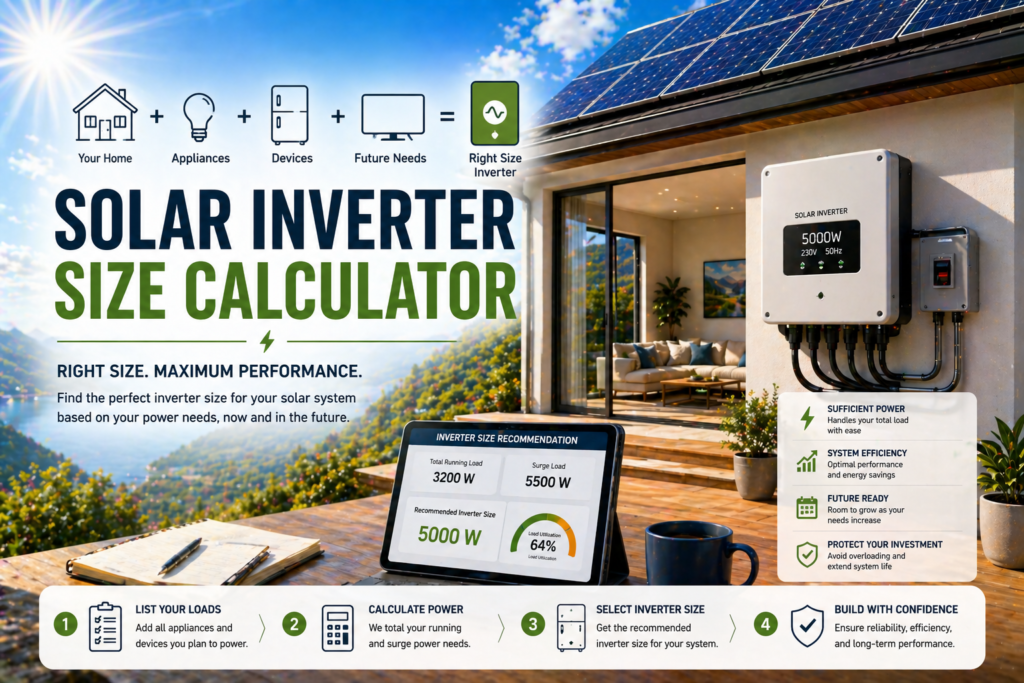
Solar Inverter Size Calculator
Accurately size your inverter with a real-world off-grid planning engine that factors in running loads, surge demand, appliance behavior, and full system constraints. This is not a basic calculator—it’s a decision system designed to validate your setup and prevent costly mistakes.
Instantly determine your minimum inverter size, recommended range, and identify system risks like overload, battery mismatch, or surge failure—before they happen.
How This Inverter Sizing System Works
This tool simulates how your off-grid system behaves in the real world—factoring in appliance loads, startup surges, system losses, and battery limitations—to determine the exact inverter size you need with zero guesswork.
How to Use This Inverter Calculator
Use Simple Mode for a fast estimate, or Advanced Planner Mode for a full system validation. The more accurate your inputs, the more reliable your results.
Choose Your Mode
Use Simple Mode if you already know your total watts. Use Advanced Mode if you want a full breakdown with appliance-level accuracy and system validation.
Enter Your Load
Input your total running watts or add appliances one by one. Include surge values for motors, compressors, and pumps to get accurate peak demand results.
Adjust System Inputs
Set your battery voltage, inverter efficiency, system losses, and safety margin. These values make the results reflect real-world performance—not lab conditions.
Add Existing System (Optional)
Enter your current inverter and battery setup to check if your system is undersized, balanced, or operating too close to its limits.
Run the Calculation
Click calculate to generate your inverter sizing, surge requirements, utilization percentage, and full system validation.
Follow the Recommendation
Use the verdict, warnings, and “strongest next action” to make a clear decision. This is where the tool becomes a planning system—not just a calculator.
Pro Tip
If you’re unsure about exact appliance values, start with realistic estimates and slightly higher surge values. It’s better to oversize your inverter slightly than risk system instability or shutdown during real-world use.
Solar Inverter Size Calculator
Use Simple Mode for a fast inverter size estimate, or Advanced Planner Mode to build an appliance-by-appliance load list with battery validation, surge stacking, and inverter utilization scoring.
Simple Inverter Sizing
Enter your total running watts and a few key parameters for a quick inverter size recommendation.
System Results
Continue Planning After Inverter Sizing
Once you size your inverter, the next step is making sure your battery bank can support the load, your solar panels can keep up with demand, your wire size is safe, and your full system is balanced correctly.
Battery Bank Size Calculator
Confirm your battery bank can deliver enough usable energy for the inverter and connected loads.
Solar Panel Output Calculator
Check whether your solar array can realistically support the power demand on the system.
Solar Wire Size Calculator
Make sure your wiring can safely handle inverter current and reduce voltage drop.
Complete Solar System Calculator
Bring inverter sizing into a full system check to validate your complete setup.
Most Inverter Failures Are Caused by Surge — Not Running Power
Many systems look fine on paper because the total running watts are within limits—but that’s not what causes failure. The real problem is startup surge.
Appliances like fridges, pumps, air conditioners, and power tools can draw 2× to 7× their normal wattage for a few seconds when starting. If your inverter can’t handle that spike, it will shut down instantly—even if your running load is low.
This is why a properly sized system must account for both continuous load and peak surge demand. Ignoring surge is the fastest way to build a system that fails when you need it most.
How to Interpret Your Inverter Sizing Results
A good inverter result is not just about matching watts. You need enough continuous capacity, enough surge headroom, and a battery system that can actually support the inverter under real demand.
This is the lowest inverter size your system should realistically use after adjusting for safety margin and real-world losses. Treat this as the floor, not the ideal target.
This is the smarter planning zone. It gives you extra room for surge events, warm weather performance drops, efficiency loss, and future appliance additions.
This shows the peak startup load your inverter may need to handle. If surge capacity is too low, the inverter can trip even when the running watts seem fine.
This tells you how hard the inverter is working. Lower utilization usually means better stability, lower stress, and more expansion room. High utilization means you are running too close to the limit.
Good / Yes
Your system has workable inverter capacity, reasonable surge support, and acceptable headroom. This is where you want to be.
Tight
The setup may work, but there is not enough margin. This usually means limited future growth, more stress on components, and a higher chance of nuisance shutdowns.
No / Not Recommended
Something is undersized or mismatched. In most cases the weak point is either the inverter itself, battery delivery capability, or unrealistic surge handling.
The Most Important Thing to Watch
The strongest setup is usually not the smallest inverter that technically works. It is the one that can handle your real continuous load, survive startup surges, stay within reasonable utilization, and match the strength of your battery bank. If one part of that chain is weak, the entire system becomes unreliable.
Example Inverter Sizing Scenario
Here is a realistic off-grid example showing how inverter sizing works when running load, startup surge, and battery system limits are all considered together.
Why This Works
A quality inverter in the 2,200W to 2,700W range gives enough room for the adjusted running load while still handling startup demand from appliances like the fridge and pump.
Potential Constraint
The battery bank may still become the limiting factor if too many high-draw appliances start together. This is why inverter sizing must always be checked against battery delivery capability.
Best Next Move
Choose a high-quality pure sine inverter around 2,500W and confirm your battery bank and cable sizing are strong enough to support both continuous load and startup surge.
Real-World Takeaway
In this example, a 2,000W inverter might technically be the minimum safe size, but it would not be the best real-world choice. A properly sized system gives you surge tolerance, lower stress, and enough margin to avoid nuisance shutdowns. That is why the recommended range is usually the better decision than the bare minimum.
Expert Tips for Sizing an Inverter Properly
A strong inverter setup is not about choosing the biggest unit possible. It is about matching continuous load, surge behavior, battery strength, and future expansion in a way that keeps the system stable and efficient.
Do Not Size to the Bare Minimum
The minimum safe inverter size is the floor, not the target. A little extra headroom improves stability, reduces stress, and gives you room for unexpected real-world demand.
Surge Matters More Than People Think
Fridges, pumps, compressors, and some tools can spike hard at startup. A system that looks fine on running watts alone can still fail instantly if surge demand is ignored.
Battery Voltage Becomes Critical as Size Increases
Large inverters on 12V systems mean very high current draw. Once you move into bigger loads, 24V or 48V systems are often the better choice for efficiency, cable sizing, and lower stress.
Quality Matters
Two inverters with the same watt rating are not always equal. Cheap inverters often advertise large numbers but perform poorly under sustained load or startup surge. Quality pure sine units are usually worth it.
Plan for What Starts Together
The most important number is not always total appliance watts. It is what can run or start at the same time. That is where overload and nuisance shutdown usually happen.
Think One Step Ahead
If you plan to add appliances later, size your inverter with expansion in mind now. Replacing an undersized inverter later costs more than choosing properly the first time.
Best Practice
The strongest off-grid setups usually combine a realistic appliance plan, a properly sized pure sine inverter, a battery bank that can actually deliver the current required, and enough margin so the system is not operating on the edge. That combination is what creates reliability.
Inverter Sizing Approaches Compared
Not all inverter sizing methods are equal. Most calculators only use basic wattage math, which leads to undersized or unstable systems. This tool uses a full system planning approach.
Bottom Line
Most inverter calculators only answer one question: “What size inverter matches my watts?” That is not enough. A reliable off-grid system requires matching load, surge, inverter capacity, and battery strength together. That is exactly what this tool is built to do.
Visual Insight: How Inverter Load & Surge Really Work
This visual shows why inverter sizing is not just about total watts. Your system must handle both steady load and sudden surge spikes without crossing the limit.
Running Load is Stable
This is your normal power usage. Most systems are designed around this—but that is only part of the story.
Surge Happens Fast
Startup spikes happen instantly and can exceed inverter limits even when average load looks safe.
Crossing the Limit Causes Shutdown
If surge exceeds inverter capacity—even briefly—the inverter can trip or shut down completely.
What This Means for Your System
A properly sized inverter must stay well below its limit during normal operation and still have enough headroom to absorb surge spikes. If your system regularly approaches the limit, it becomes unstable and unreliable—especially when multiple appliances start at once.
Inverter Planning Advice (What You Should Actually Do)
Use your results to make a clear decision—not just pick a number. A reliable off-grid system comes from choosing the right combination of inverter, battery, and load strategy.
Lock It In Properly
Choose an inverter within the recommended range. Do not downsize to save money—you already have a balanced setup. Focus on build quality, efficiency, and long-term reliability.
Increase Headroom
Move up into the higher end of the recommended range. This reduces stress on your inverter and prevents shutdowns when real-world conditions push your system harder than expected.
Fix the Bottleneck First
Do not just increase inverter size blindly. Identify the weak point—often the battery bank or surge demand— and fix that before upgrading the inverter.
Upgrade Order Matters
If your system is failing, upgrading the inverter alone will not fix it if the battery cannot supply enough current. Always match inverter size to battery capability.
Think in Systems, Not Parts
Your inverter, battery bank, wiring, and appliances all work together. Weakness in one area limits the entire system.
Leave Room for Expansion
If you plan to add appliances later, choose a slightly larger inverter now. It is cheaper and easier than upgrading later.
Final Recommendation
The best inverter choice is not the smallest that works—it is the one that keeps your system stable under real-world conditions. Choose an inverter within the recommended range, confirm your battery bank can support it, and make sure surge demand is fully covered.
Solar Inverter Size — Frequently Asked Questions
Clear answers to the most common inverter sizing questions — from understanding surge watts and battery compatibility to choosing the right voltage and inverter type for your off-grid setup.
What inverter range should you start with?
Inverter Sizing Basics
Q1What size inverter do I actually need? +
You need an inverter that can comfortably handle both your continuous running load and your peak surge demand. The minimum safe size is calculated by taking your total simultaneous running watts, adjusting for inverter efficiency and system losses, and adding a safety margin of 20–25%.
In practice, the right inverter sits within a recommended range — not at the bare minimum. Running at or near the minimum means any surge event or additional load will push your inverter into shutdown territory.
A rough rule: if your total running load is 1,500W, a 2,000W–2,500W inverter is a sensible target. Use the Solar Inverter Size Calculator above to get a recommended estimate specific to your appliances — and pair it with the Appliance Runtime Calculator to understand how long your battery will last at that load.
Q2Is it better to oversize an inverter? +
Moderately oversizing — staying in the recommended range rather than the bare minimum — is almost always beneficial. It reduces thermal stress, allows for surge absorption, and gives room to add loads later without re-engineering the system.
However, extreme oversizing without matching the battery system creates a different problem: a 5,000W inverter on a 100Ah 12V battery will drag the battery down so fast under load that the system becomes useless. The inverter and battery must be sized together.
Q3How do I calculate my total running watts? +
List every appliance that may run at the same time and note its running wattage (not surge). Add them up. That total is your simultaneous continuous load. Appliances that won’t run at the same time — like a washing machine you only run once a day — should be noted separately and factored into surge planning rather than continuous load.
Common running watts for reference:
| Appliance | Typical Running W | Surge W |
|---|---|---|
| Refrigerator | 150–200 | 600–800 |
| Microwave | 1,000–1,500 | 1,200–1,800 |
| LED Lights (10×) | 80–150 | Same |
| Window AC 10,000BTU | 900–1,100 | 2,500–3,500 |
| Water Pump ½HP | 700–800 | 2,000–2,500 |
| TV 55″ + soundbar | 150–180 | 200 |
For a full picture of how long those loads will run your battery down, the Solar Battery Runtime Calculator pairs directly with this step.
Q4What is inverter utilization and why does it matter? +
Utilization is the percentage of your inverter’s rated capacity that your continuous load actually uses. A 3,000W inverter running a 2,100W adjusted load has 70% utilization.
| Utilization | Assessment |
|---|---|
| Below 70% | Excellent — low thermal stress, strong surge reserve, room to expand |
| 70–80% | Good — standard operating zone, modest surge buffer |
| 80–90% | Tight — limited surge margin, no room for new loads |
| Above 90% | Critical — high risk of shutdown, overheating, premature failure |
Surge, Startup & Motor Loads
Q5Why does surge wattage matter so much? +
Motors, compressors, and pumps draw a large spike of current at startup — often 2× to 6× their running watts — that lasts only a fraction of a second but is enough to trip an undersized inverter’s overload protection. This is one of the most common reasons off-grid systems fail to start appliances even when the math on running watts looks fine.
Your inverter must have a surge rating — usually expressed as a peak wattage — that meets or exceeds the startup demand of your highest-surge appliance, plus the running watts of everything else operating at the same time.
Q6How do I estimate surge watts for an appliance? +
If the appliance spec sheet doesn’t list surge or startup wattage, use these multipliers as estimates:
| Appliance Type | Surge Multiplier | Notes |
|---|---|---|
| Resistive (toaster, heater, lights) | 1–1.2× | Very low surge |
| Electronics (TV, laptop, router) | 1.2–1.5× | Minimal spike |
| Microwave, coffee maker | 1.3–1.5× | Short spike |
| Refrigerator / chest freezer | 2–4× | Compressor start |
| Window / portable AC | 3–5× | Largest home surge |
| Water / well pump | 3–5× | Motor-heavy |
| Power tools (saw, drill) | 2–4× | Load-dependent |
For inverter compressor models (found in newer fridges and mini-splits), surge is lower — typically 1.5–2× — because the motor ramps up gradually instead of slamming on at full power.
Q7What is a soft-start module and does it help? +
A soft-start module (sometimes called a micro-air Easy Start or a capacitor soft-start kit) is a device installed on the AC unit or compressor that electronically limits the inrush current during startup. Instead of a 3–5× spike, you get a 1.5–2× ramp.
This is particularly useful for air conditioners on off-grid systems because it can reduce the startup surge enough to run a 10,000BTU AC on a 2,000W–3,000W inverter that would otherwise trip. It won’t fix a severely undersized inverter but it meaningfully reduces surge stress.
Most quality soft-start kits cost $60–$150 and install in under an hour. For anyone running an AC unit off a solar generator, checking the Air Conditioner Solar Runtime Calculator alongside this is strongly recommended.
Q8Can I run two high-surge appliances at the same time? +
In theory yes — but in practice, the most important thing is that they don’t start at exactly the same moment. Surge stacking is the worst-case scenario where two or more motor appliances hit their startup peak simultaneously, combining their surge demands on the inverter at the exact same millisecond.
For the inverter sizing calculation, our Advanced Planner handles this by adding the surge delta (surge minus running) for all simultaneous appliances on top of their combined running load — giving a conservative peak surge estimate.
Stagger start times wherever possible. If you have a smart home controller or timer, programming appliances to start a few seconds apart virtually eliminates stacking risk without requiring a larger inverter.
Battery & System Compatibility
Q9Can my battery limit my inverter performance? +
Absolutely — and this is one of the most frequently overlooked problems. Your battery must be able to deliver the current the inverter demands at your system voltage. If it can’t, the battery voltage sags, the inverter detects low voltage and shuts down, even if the inverter itself is the correct size.
e.g. 24V × 200Ah × 0.5C = 2,400W max continuous
To properly size the battery bank to match your inverter, use the Battery Bank Size Calculator alongside the inverter calculator. They work as a pair — the inverter sets the demand, the battery must meet it.
Q10What does C-rate mean and why does it affect inverter sizing? +
C-rate is the maximum continuous discharge current relative to battery capacity. A 200Ah battery at 0.5C can safely deliver 100A continuous. At 24V that’s 2,400W — which means a 3,000W inverter would demand more than that battery can safely provide.
| Chemistry | Typical C-rate | Notes |
|---|---|---|
| Flooded Lead Acid | 0.2–0.3C | Very limited discharge rate |
| AGM | 0.3–0.5C | Better, but still limited |
| LiFePO4 (lithium) | 0.5–1C (some 2C) | Best for large inverters |
| NMC Lithium | 1–3C | High discharge, less cycle life |
LiFePO4 is the preferred chemistry for off-grid inverter systems above 2,000W. Use the Solar Battery Discharge Calculator to model how quickly your battery drains at different load levels.
Q11How does battery voltage affect how many amps I pull? +
Power = Voltage × Current. The same wattage at a lower voltage means much higher current. High current requires thicker cables, larger fuses, and creates more heat and resistance losses across the system.
| System Voltage | 2,000W Inverter = ~Amps DC | Cable Size Needed |
|---|---|---|
| 12V | ~185A | 4/0 AWG or parallel runs |
| 24V | ~93A | 2–4 AWG |
| 48V | ~46A | 6–8 AWG |
Use the Solar Wire Size Calculator to confirm your battery-to-inverter cable is correctly sized for these currents — undersized wire between battery and inverter is a fire hazard.
Q12How much battery do I need to support my inverter? +
There are two separate checks: current delivery (can the battery supply enough amps?) and energy capacity (how long will the battery last at that draw?).
For current delivery: Battery Ah × C-rate × Voltage must exceed your inverter’s continuous load. For energy capacity: Battery Ah × Voltage × Usable DOD gives your usable watt-hours, which you divide by your average load to get runtime.
The Battery Bank Size Calculator walks through both checks, and the Solar Battery Charge Time Calculator shows how long your panels will take to recharge after you’ve used it.
Inverter Types & System Voltage
Q13Do I need a pure sine wave inverter? +
For almost every serious off-grid application — yes. Pure sine wave inverters produce the same clean AC waveform as grid power, which is required by sensitive electronics, variable-speed motors, inverter-type appliances, and most modern devices.
| Inverter Type | Best For | Avoid With |
|---|---|---|
| Pure Sine Wave | Everything — refrigerators, AC units, variable motors, sensitive electronics, medical equipment | Nothing — universally safe |
| Modified Sine Wave | Basic resistive loads — simple lights, older appliances, phone chargers (with caution) | AC units, variable-speed motors, inverter compressors, laser printers, medical devices |
Modified sine wave inverters are cheaper upfront but can cause humming, overheating, and premature failure in many appliances. The money saved on the inverter is often lost on damaged equipment.
Q14Should I choose 12V, 24V, or 48V? +
Higher voltage means lower current at the same wattage — which means thinner, cheaper wire, smaller fuses, and less heat loss across the system. General guidelines:
| Voltage | Best For | Max Practical Inverter |
|---|---|---|
| 12V | RVs, boats, small cabins, under 1,500W | ~2,000W |
| 24V | Mid-size off-grid homes, 1,500–4,000W | ~4,000W |
| 48V | Full off-grid homes, solar arrays, 4,000W+ | 12,000W+ |
If your Complete Solar System Calculator shows a system above 3kW, 48V is almost always the right choice. The wiring savings alone typically justify the cost of upgrading batteries.
Q15What is an inverter-charger and should I use one? +
An inverter-charger combines a pure sine wave inverter with a battery charger in one unit. When grid or generator power is available it charges the battery; when running on battery it inverts DC to AC. Brands like Victron Multiplus, Outback FLEXpower, and Schneider XW+ are common in serious off-grid systems.
The main advantages: seamless transfer switching (no power interruption), better battery management, and a single box instead of two. The tradeoff is cost — a quality inverter-charger costs more upfront than a standalone inverter.
If you plan to use any grid or generator backup at all, an inverter-charger is almost always worth it for the seamless handoff alone.
Q16Can I run two inverters in parallel to get more power? +
Yes — some inverter models support parallel operation where two or more units combine their output. This is common with Victron MultiPlus, Growatt, and similar brands. When configured correctly you can double (or triple) available output wattage.
Critical caveats: not all inverters support parallel operation — check the spec sheet. Units must be the same model. A synchronization cable or communication link is required. And your battery bank must support the combined current draw of both inverters simultaneously.
For large whole-home systems, a proper 48V inverter in the 8,000–12,000W range is often simpler and more reliable than two smaller units in parallel.
Efficiency, Losses & Best Practices
Q17How much power does an inverter waste? +
All inverters have conversion losses — typically 5–15% depending on quality and load level. A 90% efficient inverter running a 1,000W AC load actually draws ~1,111W from the battery. Additionally, most inverters draw 10–40W in no-load idle mode just to stay powered on.
| Inverter Quality | Peak Efficiency | Idle Draw |
|---|---|---|
| Budget (<$150) | 80–85% | 25–45W |
| Mid-range ($150–$500) | 88–92% | 15–25W |
| Premium (Victron, Outback) | 93–97% | 8–15W |
Factor idle draw into your daily energy budget — an inverter left on 24 hours at 20W idle draws ~480Wh per day, nearly half a small battery’s capacity. Many systems use a remote on/off switch to power the inverter down when not needed.
Q18What happens if my inverter is too small? +
An undersized inverter will trip its overload protection during surge events, overheat under sustained load, and fail prematurely from operating continuously near its ceiling. The symptoms often look like a battery or wiring problem — frequent shutdowns, flickering lights, humming, and appliances refusing to start — which can lead people to replace the wrong components before finding the real cause.
Use the Solar Generator Runtime Calculator to cross-check that your generator or solar array can supply enough energy to support the inverter load you’re planning.
Q19Where should I install my inverter for best performance? +
Three things matter most: proximity to the battery, ventilation, and temperature. The inverter should be mounted as close as possible to the battery bank to minimize cable run length and resistance — every extra foot of undersized cable at 100+ amps costs you both efficiency and voltage.
Inverters generate significant heat at full load and need unrestricted airflow around the cooling fins or fan vents. Never mount an inverter in a sealed box or an unventilated compartment.
Most inverters are rated for 0–40°C (32–104°F) ambient operation. In hot climates or engine compartments, derate the inverter’s continuous capacity by 5–10% for every 10°C above 25°C to prevent thermal shutdowns.
Q20How do I design an inverter system that lasts? +
Long-term reliability comes from sizing conservatively, using quality components, and matching every part of the system — panels, charge controller, batteries, inverter, and wire — to work together. A checklist for a lasting system:
For the full picture — panels, battery, and inverter working as one — the Complete Solar System Calculator and Off-Grid Power Planner are the best next steps after you’ve confirmed your inverter size here.
Related Tools for Load and Runtime Planning
These tools help refine runtime expectations, battery behavior, and array planning without duplicating the main next-step links above.
2000W Inverter Runtime Calculator
See how a common inverter size performs with real battery loads and runtime expectations.
3000W Inverter Runtime Calculator
Compare larger inverter scenarios with heavier loads and shorter runtime windows.
Solar Array Planner
Plan the panel array needed to support the energy demand behind your inverter size.
Solar Battery Runtime Calculator
Estimate how long your battery bank can power the loads connected to your inverter.