Calculate How Long an Air Conditioner Solar Runtime Calculator
Air conditioners are one of the most energy-demanding appliances in any off-grid system. Use this Air Conditioner Solar Runtime Calculator. Whether you’re using a portable unit, window AC, or mini split, understanding how long it will run on your battery is critical before relying on solar power.
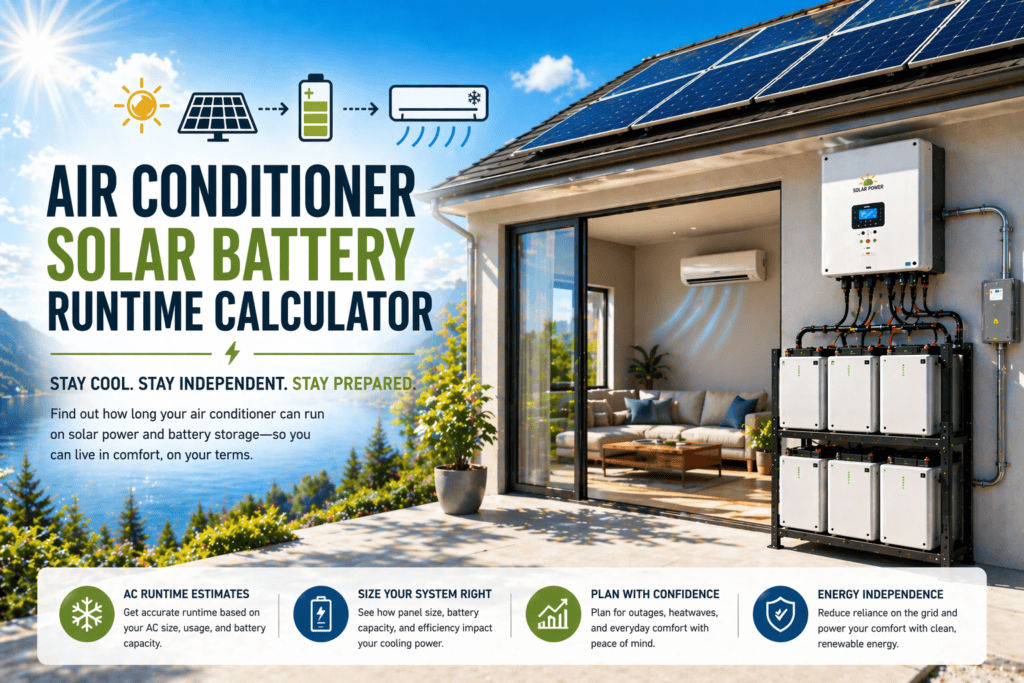
This Air Conditioner Solar Runtime Calculator helps you estimate realistic runtime based on your battery capacity and your air conditioner’s power usage. It considers both continuous operation and real-world efficiency losses so you can avoid undersizing your system.
Use simple mode for a quick estimate, or switch to advanced mode to include duty cycle, inverter efficiency, and system losses for a true off-grid planning calculation.
How the Calculation Works
This calculator estimates how long your battery can power an air conditioner by comparing usable battery energy to the AC unit’s average power draw. Because air conditioners cycle on and off depending on room temperature, insulation, and outside heat, actual runtime depends on more than just rated wattage.
In simple mode, the calculator uses battery capacity and air conditioner wattage to give you a fast runtime estimate. In advanced mode, it applies duty cycle, inverter efficiency, battery depth of discharge, and system loss to produce a much more realistic off-grid result.
Basic Runtime Formula
Runtime (hours) = Usable Battery Capacity (Wh) ÷ Average Air Conditioner Load (W)
For air conditioners, average load is often lower than maximum running wattage because the compressor cycles instead of running at full output all the time.
Battery Capacity
The total stored energy available in your battery before discharge limits and losses are applied.
AC Duty Cycle
The percentage of time the compressor actively runs. Higher heat and poor insulation increase duty cycle and reduce runtime.
System Losses
Inverter losses, battery limitations, and wiring inefficiencies reduce how much of your stored energy actually reaches the AC unit.
How long will your battery keep the AC running?
Factor in duty cycle, outdoor heat, inverter vs rotary compressor, surge watts, and BTU sizing — get a practical cooling estimate for blackouts, RVs, and off-grid homes. Results are planning estimates, not guaranteed runtime.
| Battery System | Capacity | Usable Wh | Runtime | Typical Price Range* |
|---|---|---|---|---|
| Jackery 1000 / EcoFlow River 2 | 1.0 kWh | 900 Wh | 2.0 hrs | $700–$1,100 |
| EcoFlow Delta 2 / Bluetti AC180 | 1.5–2 kWh | 1.6 kWh | 3.5 hrs | $900–$1,500 |
| Your system (5 kWh LiFePO4) | 5.0 kWh | 4.5 kWh | 4.8 hrs | $1,800–$3,000 |
| EG4 Rack / Pylontech stack | 10 kWh | 9.0 kWh | 9.6 hrs | $3,500–$5,500 |
| Tesla Powerwall 3 | 13.5 kWh | 12.2 kWh | 13.0 hrs | $9,000–$13,000 |
| Whole-home 20 kWh bank | 20 kWh | 18 kWh | 19.2 hrs | $7,000–$12,000 |
Starting with 5,000 Wh battery × LiFePO4 DoD 0.90 × inverter efficiency 0.92 × (1 − system loss 0.08) = 3,802 Wh usable.
AC running wattage 750 W × duty cycle 0.60 at 95°F outdoor = 450 W average draw, plus other loads 120 W = 570 W total average.
Runtime = 3,802 Wh ÷ 570 W = 6.67 hours of continuous cooling. Warmer weather increases duty cycle and reduces this — see the heat impact bars above.
Next step to double your AC runtime
Switch to an inverter compressor mini-split — they cut duty cycle from 60% to 30% while delivering the same BTU. A 12,000 BTU inverter unit uses about 400 W average versus 750 W for a rotary window unit, giving you ~8 hours runtime on the same 5 kWh battery.
Continue Planning After AC Runtime Estimation
Air conditioners are one of the highest power loads in an off-grid system. Use this Air Conditioner Solar Runtime Calculator to estimate the runtime, the next step is verifying battery capacity, checking full battery runtime, confirming recharge time, and validating your complete system design.
Battery Bank Size Calculator
Ensure your battery bank is large enough to support high-demand AC loads.
Solar Battery Runtime Calculator
Move beyond a single appliance to calculate total battery runtime across all loads.
Solar Battery Charge Time Calculator
Estimate how long it will take to recharge after running your AC.
Complete Solar System Calculator
Validate AC usage within your full off-grid system design.
Did You Know
Air conditioners are one of the fastest ways to drain an off-grid battery system. Even efficient mini split units can consume a large amount of energy over several hours, especially during hot weather when compressor runtime increases dramatically.
AC Units Rarely Run at One Fixed Load
Air conditioners cycle based on room temperature, insulation, humidity, and thermostat settings, so real-world usage often varies throughout the day.
Mini Splits Are Usually More Efficient
Compared to many portable or window units, mini split air conditioners often deliver better cooling efficiency with lower average energy use.
Heat and Insulation Matter
A poorly insulated space or very hot outdoor temperatures can raise duty cycle sharply, cutting battery runtime much faster than expected.
Results Interpretation
After using the Air Conditioner Solar Runtime Calculator. Your result shows how long your solar battery can realistically power your air conditioner based on your inputs. Because AC units cycle based on temperature and demand, this estimate reflects average usage rather than constant full-power operation.
8+ Hours Runtime
Your system is strong enough for extended cooling periods. This setup can support evening and overnight use in many cases.
3–8 Hours Runtime
Your system can handle cooling during peak heat hours, but may not support full-day or overnight operation without recharging.
Under 3 Hours
Your battery capacity is likely too small for sustained air conditioning. Consider increasing storage or reducing AC load.
Air conditioning is one of the most demanding off-grid loads. Even efficient systems can drain batteries quickly, so always plan with conservative assumptions.
Example Calculation
This example shows how long a typical air conditioner can run on a solar battery using realistic off-grid assumptions.
Scenario: 2000Wh Battery + Mini Split AC
- Battery Capacity: 2000 Wh
- Depth of Discharge: 80%
- Inverter Efficiency: 90%
- System Loss: 10%
- AC Running Wattage: 1000W
- Duty Cycle: 50%
Step 1: Calculate average load
1000W × 0.50 = 500W average load
Step 2: Calculate usable battery energy
2000 × 0.80 × 0.90 × 0.90 = 1296Wh usable
Step 3: Calculate runtime
1296Wh ÷ 500W ≈ 2.6 hours
Estimated runtime: approximately 2.6 hours. This shows why air conditioning requires significantly larger battery systems for extended off-grid use.
How To Use This Air Conditioner Runtime Calculator
Step 1: Enter Battery Capacity
Input your battery size in watt-hours. This determines how much total energy is available for cooling.
Step 2: Enter AC Wattage
Input the running wattage of your air conditioner. Mini splits often use 500–1200W depending on size and load.
Step 3: Adjust Duty Cycle (Advanced)
In advanced mode, set the duty cycle to reflect how often your AC runs. Higher heat increases compressor runtime.
Step 4: Include System Losses
Apply inverter efficiency, depth of discharge, and system loss values to get realistic off-grid runtime estimates.
For accurate planning, always use conservative values. Air conditioners are highly variable loads, and real-world performance depends heavily on environment and system design.
Expert Tips for Running Air Conditioning Off-Grid
Use High-Efficiency AC Systems
Inverter-based mini splits are far more efficient than traditional units and can significantly reduce battery drain.
Improve Insulation First
Better insulation reduces how often your AC needs to run, which directly extends battery runtime.
Pre-Cool During Peak Solar Hours
Run your AC when solar production is highest to reduce battery usage later in the day.
Reduce Cooling Area
Cooling smaller, enclosed spaces instead of entire homes can drastically improve off-grid efficiency.
Air conditioning is achievable off-grid, but only with careful system design. Efficiency upgrades often provide better results than simply adding more battery capacity.
Air Conditioner Runtime Comparison Table
Use this table to compare how long different battery sizes can power an air conditioner under typical off-grid conditions.
| Battery Size | AC Type | Avg Load | Estimated Runtime |
|---|---|---|---|
| 1000 Wh | Portable AC | 500W | 1.5–2.5 hours |
| 2000 Wh | Window Unit | 600–800W | 2–4 hours |
| 3000 Wh | Mini Split | 500–1000W | 3–6 hours |
| 5000 Wh+ | Efficient Mini Split | 400–800W | 6–12+ hours |
Visual Insight: Temperature vs AC Runtime
Outdoor temperature and insulation quality have a direct impact on how long your air conditioner can run on battery power. As temperatures rise, the AC runs more frequently, reducing available runtime.
Mild Weather (20–25°C)
Low duty cycle
Long runtime
Efficient cooling
Warm Weather (25–32°C)
Moderate duty cycle
Average runtime
Hot Weather (32°C+)
High duty cycle
Short runtime
Heavy battery usage
Reducing heat load through insulation, shading, and airflow improvements can significantly extend runtime without increasing battery size.
Planning Advice for Running Air Conditioning Off-Grid
Air conditioning requires careful planning in off-grid systems due to its high energy demand. Proper system design ensures comfort without draining your battery too quickly.
Prioritize Solar Production
Ensure your solar panels can generate enough energy during the day to recharge your battery after AC usage.
Use Zoned Cooling
Cooling smaller areas instead of entire homes reduces load and significantly improves battery runtime.
Increase Battery Storage
Air conditioning often requires larger battery banks. Increasing storage capacity improves runtime and system stability.
Combine with Passive Cooling
Use shading, ventilation, and insulation to reduce reliance on AC and extend your battery’s available energy.
Off-grid air conditioning is possible, but it requires balancing energy production, storage, and efficiency. Smart planning delivers the best results without overspending on oversized systems.
Key Expansion Insights
How long can a solar battery run an air conditioner?
Most solar battery systems can run an air conditioner for 2 to 8 hours depending on battery size, AC efficiency, and environmental conditions. Larger systems can extend this significantly.
Can solar power run air conditioning?
Yes, solar can run air conditioning, but it requires a properly sized system with sufficient solar production and battery storage to handle high energy demand.
What size battery is needed for AC?
Most setups require at least 2000Wh to 5000Wh for meaningful air conditioning runtime. Smaller systems typically only support short cooling periods.
Why does AC drain batteries so fast?
Air conditioners consume high wattage and run frequently in hot conditions, which quickly depletes available battery energy compared to most other appliances.
Everything about powering an AC from a solar battery
Twenty answers on duty cycle, BTU sizing, inverter vs rotary compressors, surge watts, climate penalties, and the real-world math behind running air conditioning off-grid.
AC Runtime Basics
Q1How long will an air conditioner run on a solar battery?+
Runtime depends on four variables: usable battery Wh, AC running watts, duty cycle, and inverter efficiency. The core formula:
Typical real-world ranges for a 5 kWh LiFePO4 battery in 90°F weather:
| AC Type | BTU | Runtime |
|---|---|---|
| Mini-split (inverter) | 12,000 | 9–12 hrs |
| Window AC (rotary) | 8,000 | 4–6 hrs |
| Portable AC | 10,000 | 3–5 hrs |
| RV rooftop | 13,500 | 2.5–4 hrs |
| Central AC | 24,000+ | 1.5–3 hrs |
The same battery delivers 4× more cooling time with a well-matched mini-split versus an oversized window unit — because duty cycle and efficiency dominate the math.
Q2Why is AC so much harder to run off-grid than other appliances?+
Three reasons compound:
- High continuous draw — AC compressors pull 400–3,500 W average, 10–100× more than electronics or lights
- Long runtime demand — nobody wants AC for 20 minutes; they want it for 8+ hours
- Massive startup surge — compressors spike 3-5× running watts at startup, forcing you to oversize the inverter
Compare daily Wh for common loads powering an 8-hour day:
| Appliance | Avg W | 8 hrs Wh |
|---|---|---|
| LED lighting (whole house) | 60 | 480 |
| WiFi router + modem | 12 | 96 |
| Full-size fridge | 50 | 400 |
| Window AC 8,000 BTU | 450 | 3,600 |
| Central AC | 2,500 | 20,000 |
A central AC alone consumes as much as 40+ other appliances combined. That’s why off-grid sizing starts with AC strategy, not battery math.
Q3Can a portable solar generator run a home air conditioner?+
Yes — but only small ACs for limited periods. Modern 1-2 kWh solar generators (Jackery 1000, EcoFlow Delta, Bluetti AC180) can run:
- 5,000 BTU window unit (~450 W running): 2–3 hours
- 8,000 BTU window unit (~750 W running): 1.5–2 hours
- Portable 10,000 BTU: 1–1.5 hours
- Mini-split 9,000 BTU: 3–4 hours (most efficient option)
Q4What’s the difference between running watts and average watts for an AC?+
Every AC with a thermostat cycles on and off. Running watts is the draw when the compressor is actively cooling. Average watts is running watts × duty cycle — the hourly rate that determines battery consumption.
Daily Wh = Average Watts × 24
Example: 750 W window AC at 60% duty cycle = 450 W average = 10,800 Wh per day. At 30% duty on a cool morning, the same unit drops to 225 W avg = 5,400 Wh/day. Duty cycle is the single biggest lever for AC runtime — more than battery size, more than efficiency ratings.
BTU, Sizing & Compressor Types
Q5How do I convert BTU to watts for my AC unit?+
BTU measures cooling output; watts measure electrical input. The ratio is the unit’s EER (Energy Efficiency Ratio).
| AC Type | Typical EER | W per 1,000 BTU |
|---|---|---|
| Budget window unit | 8.5 | 118 W |
| Standard window unit | 10.0 | 100 W |
| Portable AC | 8.0 | 125 W |
| Mini-split (inverter) | 14.0+ | 72 W |
| Central AC (SEER ~14) | 12.0 | 83 W |
An 8,000 BTU window AC with EER 10 draws 800 W running. A 9,000 BTU mini-split at EER 14 draws just 643 W — 20% less power for more cooling. Higher EER pays you back in runtime every hour.
Q6What size AC do I need for my room?+
The standard rule is 20 BTU per square foot, adjusted for ceiling height, insulation, and sun exposure.
| Room Size | BTU Needed | Common AC |
|---|---|---|
| 100–150 sq ft | 5,000 | Small window unit |
| 150–250 sq ft | 6,000–7,000 | Bedroom window |
| 250–350 sq ft | 8,000–9,000 | Standard window / mini |
| 350–550 sq ft | 10,000–12,000 | Mini-split / portable |
| 550–875 sq ft | 14,000–18,000 | Large mini-split |
| Whole home 1,200+ sq ft | 24,000+ | Central AC |
Q7Why do inverter-compressor AC units run longer on battery?+
Traditional rotary (single-speed) compressors are either 100% on or 0% off — they cool hard, overshoot the setpoint, shut down, then restart with a 2,500+ W surge. Typical duty cycle: 55–70%.
Inverter compressors use variable-speed DC motors that modulate from 20–100% output. Once the room reaches setpoint, they throttle down to just enough power to maintain it — often 20–30% of rated watts. No restart surges. No overshooting.
Rotary compressor duty ≈ 60% average
For the same BTU output, an inverter mini-split uses 40–50% less battery over 8 hours. On a 5 kWh LiFePO4 battery: ~6 hrs with rotary window AC, ~10 hrs with inverter mini-split. That alone justifies the higher upfront cost for any off-grid application.
Q8Should I pick 12 V DC AC, a rooftop RV unit, or a 120 V inverter-fed AC?+
Depends on your system architecture:
- 12/24/48 V DC AC (like Nomadic Cooling, Mabru): skips inverter losses entirely — 8–12% more efficient. Best for vans, campers, and small off-grid cabins. Limited to ~9,000–12,000 BTU models. Expensive but the most battery-friendly option.
- RV rooftop 13,500–15,000 BTU (Dometic, Coleman Mach): rotary compressors with hard on/off cycling, 2,500+ W surge. Cheap but hungry. Fine if you run them off shore power and only occasionally off battery.
- 120 V mini-split inverter AC: best overall for homes and larger systems. Requires a 2,000+ W pure sine inverter but delivers the highest efficiency and longest runtime.
Rule of thumb for off-grid: inverter compressor wins on efficiency, DC direct wins on tiny systems, rotary/RV wins only on upfront cost.
Heat, Climate & Duty Cycle
Q9How does outdoor temperature change my AC runtime?+
Hotter outdoor air means bigger temperature differential (ΔT) the AC must overcome, so the compressor runs more hours per hour. This is non-linear — efficiency also drops when the outdoor coil is hot.
| Outdoor °F | Duty Cycle | Runtime on 5 kWh |
|---|---|---|
| 78°F (mild) | 35% | 13.7 hrs |
| 85°F (warm) | 50% | 9.6 hrs |
| 95°F (hot) | 65% | 7.4 hrs |
| 105°F (extreme) | 85% | 5.6 hrs |
| 115°F (desert) | 95%+ | 5.0 hrs |
Every 10°F hotter cuts runtime by roughly 25%. Plan your battery around the hottest week of the year, not the average — that’s when blackouts and grid strain hit hardest.
Q10What’s the ideal indoor temperature setting for maximum battery runtime?+
Every 1°F warmer you can tolerate indoors cuts AC energy use by ~6–8%. The sweet spot for most people during outages:
- 78°F — DOE recommended; 30% less runtime demand than 72°F
- 80°F with ceiling fan — feels like 76°F, roughly 45% less AC demand
- 72°F — only if you have excess battery; doubles your AC runtime cost
Q11Does insulation quality really change how long my AC runs?+
Enormously. A well-sealed, well-insulated room keeps cold air in and reduces how often the compressor restarts. Estimated duty cycle multipliers:
| Room Type | Duty Multiplier | Runtime Impact |
|---|---|---|
| Poor (RV, old house, single-pane) | 1.25× | −20% |
| Average home | 1.00× | baseline |
| Good (sealed, double-pane) | 0.85× | +15% |
| Passive / super-insulated | 0.65× | +50% |
The cheapest AC upgrade is weather-stripping and window film — $30–$80 can shift your room from “average” to “good,” adding 1–2 hours of runtime for every battery full with zero battery cost.
Q12How does humidity affect AC energy consumption?+
AC units do two jobs simultaneously: lower air temperature (sensible cooling) and remove moisture (latent cooling). In humid climates, 30–50% of the AC’s work is wringing water out of the air before it can lower temperature.
Practical consequences:
- Same BTU unit runs 15–25% longer duty cycle in 80%+ humidity vs dry air
- Oversized ACs leave rooms cool but clammy because they short-cycle before moisture extraction completes
- A dedicated dehumidifier at 300–500 W can reduce AC load dramatically in wet climates
Inverter Sizing & Surge Watts
Q13What size inverter do I need to start my AC?+
Your inverter must handle surge watts, not just running watts. Compressor startup spikes 3-5× running power for 1-3 seconds as the motor overcomes static rotor friction and internal pressure.
Min Inverter Surge W ≥ AC Running W × 4
| AC Rating | Running W | Surge W | Min Inverter |
|---|---|---|---|
| 5,000 BTU window | 450 | 1,350 | 1,000 W / 2,000 surge |
| 8,000 BTU window | 750 | 2,250 | 1,500 W / 3,000 surge |
| 10,000 BTU portable | 1,100 | 3,000 | 2,000 W / 4,000 surge |
| 13,500 BTU RV | 1,400 | 3,500 | 2,500 W / 5,000 surge |
| 24,000 BTU central | 2,500 | 8,000+ | 5,000 W / 10,000 surge |
Q14Do I need a pure sine wave inverter for an AC unit?+
Yes — always. Modified sine wave (MSW) inverters will physically power most ACs, but cause three problems:
- Compressor buzzing and overheating — motor runs hotter on stepped waveform, shortening lifespan
- Inverter-compressor ACs won’t work at all — the variable-speed electronics require clean sine
- 15–20% efficiency loss — extra waveform losses in the motor windings
The price delta between quality MSW and quality pure sine is now small ($100–$300) and the runtime + longevity savings pay it back in weeks for any AC application. Pure sine is non-negotiable.
Q15Why does my AC trip my inverter even though the watts match on paper?+
Nine times out of ten, it’s the surge window. The AC pulls 3,000 W for 1-2 seconds at compressor startup; your 2,000 W inverter reads the overcurrent and faults out for safety.
Diagnostic checklist:
- Check inverter’s surge rating (usually listed as “peak” — must be 2× continuous minimum)
- Measure AC startup current with a clamp meter — actual surge often exceeds label spec
- Check DC battery-to-inverter cable size — undersized cables cause voltage sag that triggers low-voltage cutoff
- Verify battery BMS discharge current limit — some LiFePO4 BMS units limit 100A / 1,280 W on 12V systems
- Add a soft-start kit to the AC to cut surge watts by 65–75%
Q16Does inverter idle current really affect my AC runtime?+
More than most people realize. A typical 3,000 W inverter consumes 20–40 W just being on, 24/7. Over a full day that’s 480–960 Wh — equivalent to an hour of AC runtime burned on nothing but “readiness.”
Mitigation strategies:
- Right-size the inverter — a 1,500 W inverter idles at ~12 W vs a 3,000 W at ~30 W
- Use power-save / search mode — most modern inverters can drop to 2–4 W and auto-wake when load is detected
- Turn inverter off when AC isn’t needed at night — easily saves 300–500 Wh per sleep cycle
- High-efficiency models (Victron MultiPlus, Schneider XW) idle at 10–15 W regardless of rating
Extending Runtime & Solar Strategy
Q17How many solar panels do I need to run an AC all day?+
Depends on AC load, sun hours, and whether you’re powering directly from solar or through battery. Daytime direct-powering math:
For off-grid with battery reserve, plan for 2–3× the daytime direct requirement to charge batteries for nighttime use:
| AC Type | Daily Wh | Solar @ 5 Peak Sun Hrs |
|---|---|---|
| 8,000 BTU window (8hr run) | 3,600 | 900 W array |
| 12,000 BTU mini-split (10hr) | 4,000 | 1,000 W array |
| 24,000 BTU central (8hr) | 20,000 | 4,500 W array |
| Whole home all-day AC | 30,000+ | 6,500–8,000 W |
Rule of thumb: each 1,000 BTU of efficient cooling needs ~100 W of panel for all-day off-grid operation in a sunny climate.
Q18Should I run my AC directly from solar during the day?+
Absolutely yes. Solar peak production (10am–3pm) lines up almost perfectly with peak AC demand. Running the compressor directly from panels means:
- Zero battery cycle wear during peak hours
- No round-trip efficiency loss (battery charging + inverter is ~85%; direct AC is ~98%)
- Night battery reserved for the hours when AC actually matters for sleep
Q19What’s the #1 upgrade to extend AC runtime on battery?+
Ranked by dollars per additional hour gained:
- Switch to an inverter-compressor mini-split ($800–$1,500) — cuts duty cycle ~40%, effectively doubles runtime. Best ROI by far.
- Add a soft-start kit ($300) — doesn’t extend runtime directly, but lets a smaller inverter run the AC, cutting idle losses.
- Seal windows / add reflective film ($50–$150) — 15–20% duty cycle reduction.
- Raise thermostat 3°F + ceiling fan ($50) — 18–24% runtime gain.
- Add LiFePO4 capacity ($300–$400 per kWh) — linear runtime extension but most expensive per hour gained.
- Add solar panels ($0.80/W) — runs AC directly during sun hours, extending effective runtime to 24hrs/day.
Most people default to #5 (more battery) because it’s the most visible. Start with #1–4 for 3-5× better return on dollars spent.
Q20How should I plan battery sizing for AC during a multi-day blackout?+
Assume worst case: heatwave with overcast skies reducing solar to 40% of normal. Design around essential AC runtime per day × days of autonomy ÷ usable DoD.
| Scenario | Hrs/Day | Days | Min Battery (LiFePO4) |
|---|---|---|---|
| Mini-split 9,000 BTU · bedroom cool overnight | 8 | 2 | ~7 kWh |
| Window 8,000 BTU · living room day + bedroom night | 12 | 2 | ~12 kWh |
| Whole-home central · essential cooling | 10 | 2 | ~60 kWh (impractical — use mini-splits instead) |
| Medical-dependent (cooling-critical) | 24 | 3 | ~35 kWh + full solar |
For extended blackouts, most people are better served by a single efficient mini-split in one room plus a reasonable battery, than by trying to keep a whole house cool on storage alone. Picking one “retreat room” to cool extends runtime 3-5× versus whole-home conditioning.
Still running the numbers?
Plug your AC size, battery, and outdoor climate into the calculator above — it auto-computes duty cycle, surge watts, inverter sizing, and shows your runtime against 6 battery-size tiers.
Open the calculator →Related Appliance and System Tools
Compare different appliance loads and refine your system performance without repeating the main next-step links above.
Refrigerator Solar Runtime Calculator
Compare AC runtime with a more typical continuous appliance load.
TV Solar Runtime Calculator
See how lower-power devices compare against high-load AC usage.
Solar Inverter Size Calculator
Ensure your inverter can handle AC startup surge and running loads.
Solar Panel Output Calculator
Verify your solar system can keep up with high-demand cooling loads.