
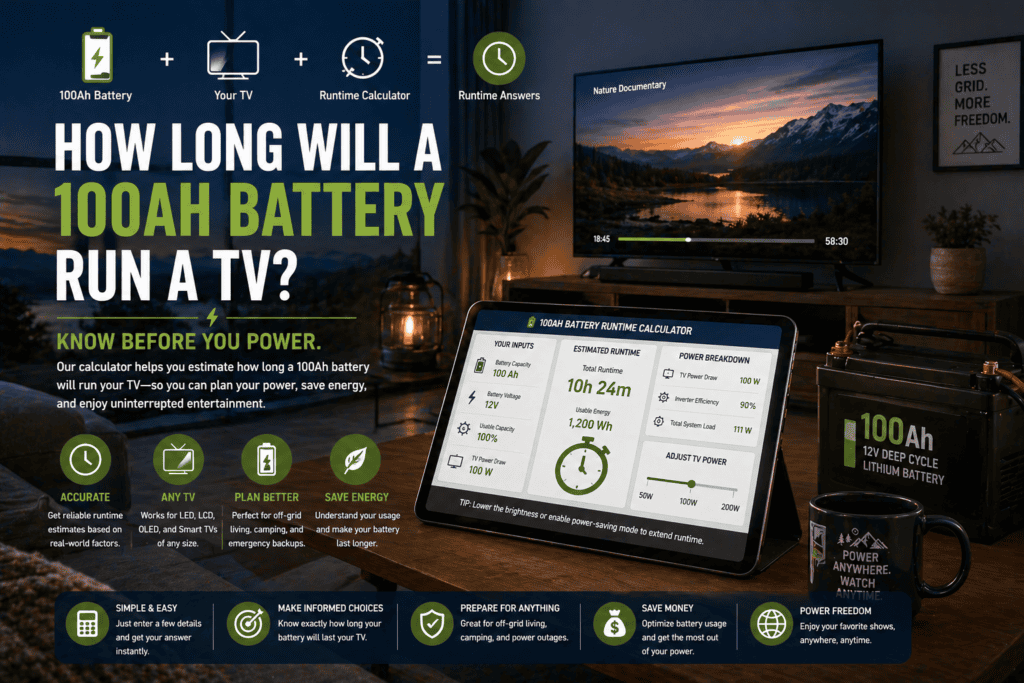
If you’re asking how long will a 100Ah battery run a TV, the answer depends on more than just battery size. A 100Ah 12V battery provides roughly 1200 watt-hours of power, but real-world usable energy is lower due to inverter losses, battery type, and depth of discharge limits. For example, a lithium (LiFePO₄) battery can safely use up to 90% of its capacity, while a lead-acid battery may only use 50%, cutting your runtime significantly.
This means a small energy-efficient LED TV (30W–60W) can run for many hours, while larger 4K TVs (100W–150W+) will drain a 100Ah battery much faster. If you’re building an off-grid TV setup for an RV, cabin, camper, or backup power system, understanding these variables is critical. Use the calculator below to get an accurate runtime based on your exact setup, including battery voltage, inverter efficiency, and additional loads.
Quick Answer
A 100Ah 12V battery can run a typical LED TV for about 8 to 15 hours, depending on TV wattage, battery type, usable depth of discharge, and inverter efficiency.
Best-case range for efficient 30W–50W TVs.
Most common estimate for 50W–80W TVs.
Lower range for 100W–150W screens.
Gives more usable energy than AGM or lead-acid.
How to Use the TV Runtime Calculator
Use the simple mode for a quick estimate or switch to advanced mode for a more accurate runtime based on your actual off-grid system setup.
Enter your TV wattage. Most LED TVs use between 40W and 100W. Check the label or manual for accuracy.
Choose simple mode for fast results, or advanced mode to include battery type, voltage, and inverter efficiency.
In advanced mode, add other loads like routers, lights, or fans to get a real-world runtime estimate.
Review the runtime result and decision output to determine if your battery size is sufficient.
Pro Tip: Always plan with a buffer. Real-world conditions like temperature, inverter losses, and battery aging will reduce runtime. If your result is borderline, increase your battery capacity or reduce load.
TV Runtime Calculator for a 100Ah Battery
Estimate how long a 100Ah battery can run a TV using battery voltage, battery chemistry, inverter efficiency, screen size, viewing hours, reserve capacity, and extra loads such as streaming boxes or speakers.
Runtime Inputs
Planning Tip
A 100Ah battery can run a TV for a surprisingly long time, but battery chemistry and inverter efficiency change the result dramatically. Lead-acid batteries may deliver roughly half the usable runtime of LiFePO4.
Decision Output
Calculate estimated runtime from your 100Ah battery.
Complete active fields. Volts, TV watts, goal, usable fraction and efficiency must be positive. Efficiency cannot exceed 100%; reserve must be below 100%; extra watts cannot be negative; sessions must be a positive whole number.
Battery-only estimate for exactly 100Ah. Simple mode assumes 12V. Advanced capacity is voltage × 100Ah, with the selected usable fraction, efficiency and additional reserve applied multiplicatively. All loads share that conversion efficiency. Session counts use viewing hours only: no charging or standby between sessions, battery aging, discharge-rate curves or inverter startup checks are included.
Results will show whether the battery is enough for your target viewing time.
- Enter the actual TV wattage from the label or power meter if possible.
- Use Advanced Mode if you also run speakers, router, streaming box, or lights.
- Choose the correct battery type because usable capacity changes the result.
What Your TV Runtime Result Means
Your result shows the estimated number of hours a 100Ah battery can run your TV before the usable battery capacity is depleted. Longer runtime usually means your TV uses fewer watts, your battery has more usable capacity, or your inverter is operating efficiently.
Strong result. Your TV is efficient, and a 100Ah battery is likely enough for regular viewing.
Good result. This is realistic for many LED TVs in RV, cabin, and backup power setups.
Limited runtime. Consider lowering TV brightness, using a smaller TV, or improving inverter efficiency.
Weak result. A 100Ah battery is probably too small for this TV or total load.
Example: 100Ah Battery Running a 60W TV
A common off-grid setup is a 100Ah 12V LiFePO₄ battery running a 60W LED TV through a 90% efficient inverter. In this case, the usable battery energy is about 1,080 watt-hours before inverter losses are fully accounted for.
Approx. 1,200Wh before usable capacity limits.
Typical efficient LED TV power draw.
Real-world result may be lower with extra loads.
Decision: This is a good setup for evening TV use, RV entertainment, small cabin backup power, or emergency viewing. If you plan to run a TV plus a router, lights, fan, or game console, move up to a 200Ah battery or use the advanced calculator to include the extra loads.
TV Battery Runtime FAQ: 100Ah, 200Ah, Solar & Off-Grid TV Use
This FAQ explains how long batteries can run a TV, what affects runtime, why real-world results differ from basic estimates, and how to size a battery, inverter, or solar setup for off-grid entertainment.
TV Runtime Basics
How long will a 100Ah battery run a TV?
A 100Ah battery can usually run a TV for about 6 to 20+ hours depending on TV wattage, battery voltage, battery type, inverter efficiency, and any extra loads. A small LED TV may run much longer than a large OLED or high-brightness TV.
How do you calculate TV battery runtime?
Calculate usable battery watt-hours, then divide by the total TV load in watts. For example, a 12V 100Ah battery stores about 1,200Wh before losses. After usable capacity and inverter efficiency, the real available energy may be much lower.
What affects TV runtime the most?
The biggest factors are TV wattage, battery chemistry, battery voltage, usable depth of discharge, inverter efficiency, and extra devices like speakers, routers, streaming sticks, or game consoles.
Battery Size & Battery Type
Is a 100Ah battery enough for daily TV use?
For moderate viewing, a 100Ah battery is usually enough, especially if it is LiFePO4. For long daily viewing, large TVs, or extra devices, a 200Ah battery or solar charging may be a better setup.
How long will a 200Ah battery run a TV?
A 200Ah battery can run a TV roughly twice as long as a 100Ah battery of the same voltage and chemistry. If a 100Ah battery gives 10 hours, a similar 200Ah battery may give around 20 hours under the same load.
Which battery type is best for running a TV?
LiFePO4 is usually the best battery type because it provides high usable capacity, stable voltage, long cycle life, and better performance under repeated use. Lead-acid batteries are cheaper upfront but have much less usable capacity.
Inverters, DC TVs & Extra Loads
Can I run a TV directly from a battery without an inverter?
Yes, if the TV supports DC input and matches your system voltage or uses a proper DC adapter. Running a TV directly from DC can improve runtime because it avoids inverter conversion losses.
Does inverter efficiency affect TV runtime?
Yes. If your inverter is 90% efficient, about 10% of the battery energy is lost during DC-to-AC conversion. Lower-quality inverters or oversized inverters may waste even more power.
Do streaming devices, speakers, and routers reduce runtime?
Yes. Extra devices can noticeably reduce runtime. A streaming stick may only add a few watts, but speakers, routers, gaming consoles, or soundbars can add enough load to shorten runtime significantly.
Solar Charging & Off-Grid TV Use
Can solar panels recharge the battery while running a TV?
Yes, if your charge controller and battery setup support solar charging while loads are connected. The battery will gain charge only if solar input is higher than the TV and other loads.
How much solar do I need to run a TV off-grid?
For light TV use, a small solar panel setup may be enough. For example, a 60W TV used for 5 hours needs about 300Wh before losses. A 100W–200W panel may recover that energy in good sun, depending on location and weather.
Why is my real TV runtime lower than expected?
Runtime may be lower because of inverter losses, battery age, cold temperatures, higher screen brightness, extra connected devices, battery reserve settings, or using lead-acid batteries beyond their practical discharge limit.
Recommended Runtime Calculators
Related Off-Grid Power Tools
Expand your system planning with these essential off-grid calculators.