Solar Generator Runtime Calculator
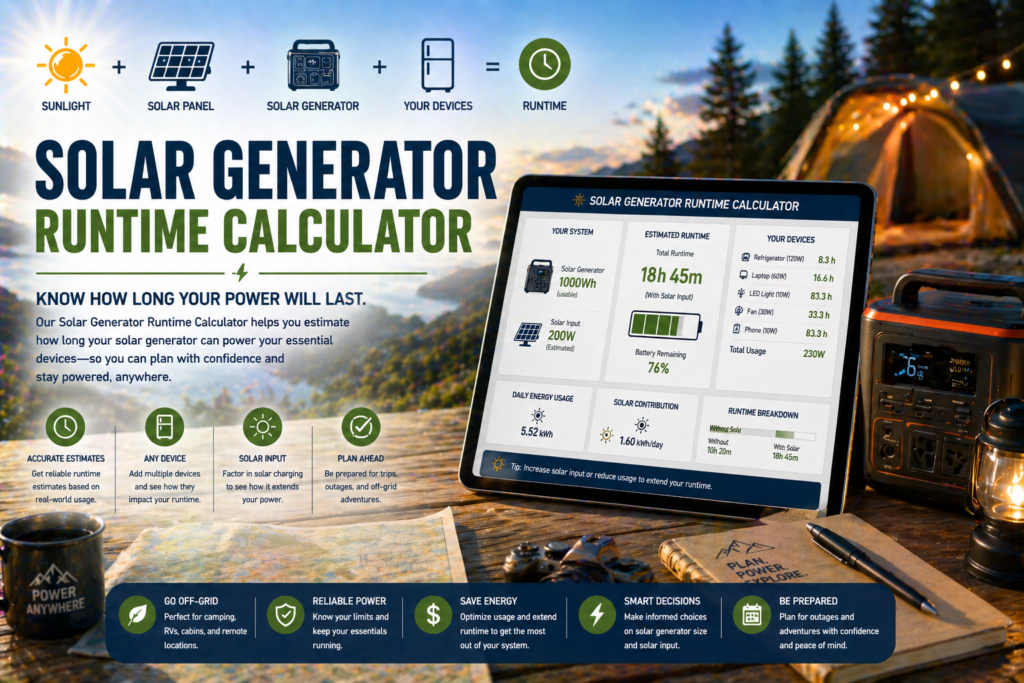
A solar generator runtime calculator helps estimate how long a portable power station or solar generator can run electrical devices before the battery is depleted. By comparing generator battery capacity with appliance wattage, you can determine how long your power source will last during camping trips, outages, off-grid setups, or emergency situations.
This calculator estimates runtime using generator battery capacity, appliance power consumption, and inverter efficiency. Understanding runtime helps ensure your solar generator is properly sized for refrigerators, laptops, lights, medical devices, and other critical equipment.
- How long a solar generator can power specific appliances
- Estimated runtime for multiple devices
- Realistic runtime after inverter efficiency losses
- Whether your generator capacity is sufficient for your needs
How to Use the Solar Generator Runtime Calculator
This calculator estimates how long a portable solar generator or power station can run appliances before the battery is depleted. Use simple mode for quick estimates or advanced mode for more realistic planning.
Enter Generator Battery Capacity
Start by entering the battery capacity of your solar generator in watt-hours (Wh). This number represents the total stored energy available in the power station.
Add Appliance Wattage
Enter the power consumption of the device you want to run. If several appliances are used together, add their wattages to get the total load.
Use Advanced Mode for Realistic Estimates
Advanced mode accounts for inverter efficiency and safety margins. These factors reflect real-world energy losses and help produce more reliable runtime estimates.
Review Estimated Runtime
The result will show the approximate number of hours the solar generator can power your devices before the battery needs to be recharged.
Solar Generator Runtime Calculator
Estimate ideal runtime, realistic runtime, inverter fit, surge risk, solar recharge impact, and whether your generator is large enough for your actual use case.
Runtime Planner
Simple Mode gives a fast estimate. Advanced Mode adds duty cycle, reserve, inverter efficiency, surge, standby loads, runtime goals, and solar recharge.
Generator Inputs
Load + Goal Inputs
Decision Output
Runtime estimate, inverter pass/fail, recharge impact, and next-step guidance.
Add your generator and appliance data to calculate runtime.
Advanced Mode compares your runtime target against realistic usable energy.
- Use the real device wattage, not just the generator brand or model.
- Check inverter output separately from battery capacity.
- Use Advanced Mode for fridges, CPAP, routers, pumps, and overnight loads.
Continue Planning After Generator Runtime Estimation
Once you estimate how long your solar generator will run, the next step is checking battery capacity, validating solar input, confirming inverter sizing, and making sure your full backup or off-grid setup is properly balanced.
Battery Bank Size Calculator
Check whether your storage capacity is enough for your runtime goals and backup needs.
Solar Panel Output Calculator
Verify whether your solar input can realistically recharge and support the generator system.
Solar Inverter Size Calculator
Confirm that your inverter can safely handle the loads connected to your solar generator setup.
Complete Solar System Calculator
Bring generator runtime into a full system check to validate your complete power setup.
How Solar Generator Runtime Is Calculated
Solar generator runtime is calculated by comparing the total stored energy in the generator’s battery with the electrical load of the devices being powered. As appliances draw electricity, the stored energy gradually decreases until the generator battery is depleted.
The most important factors affecting runtime include generator battery capacity, appliance wattage, inverter efficiency, and how many devices are running simultaneously. These variables determine how long a solar generator can realistically power your equipment.
Solar Generator Runtime Formula
Runtime (hours) = Generator Battery Capacity (Wh) ÷ Total Appliance Load (W)
Real-world runtime is often slightly lower than the theoretical value because inverter losses and internal system consumption reduce the usable battery energy.
Factors That Affect Solar Generator Runtime
- Generator battery capacity in watt-hours
- Total power consumption of connected appliances
- Inverter efficiency losses
- Standby power used by the generator itself
- Battery health and system temperature
Understanding Your Solar Generator Runtime Results
The Solar Generator Runtime Calculator estimates how long a portable power station or solar generator can power connected appliances before the battery is depleted. The result helps determine whether your generator has enough capacity for your planned usage.
Estimated Runtime
This value shows how long your solar generator can power the selected appliances. Runtime assumes constant power usage and does not include additional charging from solar panels during operation.
Usable Generator Capacity
Real generator runtime is often lower than the advertised battery capacity because inverter losses and internal system electronics consume some of the stored energy.
Appliance Power Matters
High-wattage appliances dramatically reduce runtime. Devices such as microwaves, heaters, and coffee makers can drain a generator much faster than lights, laptops, or phones.
Typical Solar Generator Runtime Examples
- 1,000Wh generator running a 100W load: ~10 hours
- 1,000Wh generator running a 300W load: ~3 hours
- 2,000Wh generator running a 200W load: ~10 hours
- 2,000Wh generator running a refrigerator (~150W average): ~12 hours
Did You Know?
Small Appliances Can Run Much Longer Than Expected
A solar generator may only run a microwave for a short time, but the same unit can often power lights, laptops, phones, routers, and small fans for many hours.
AC Power Always Uses More Battery Than the Label Suggests
When a solar generator converts stored battery power into household AC electricity, inverter losses reduce the total usable energy. Real runtime is usually lower than a simple battery-capacity-only estimate.
Refrigerators and CPAP Machines Are Common Runtime Searches
Many buyers check solar generator runtime for refrigerators, CPAP machines, TVs, laptops, and mini fridges before purchasing because these are among the most common real-world backup power needs.
Higher Wattage Does Not Always Mean Better Value
A solar generator with a high inverter rating can run powerful appliances, but if the battery capacity is small, runtime may still be short. Capacity in watt-hours often matters more than inverter wattage for extended use.
Example Solar Generator Runtime Calculation
The following example shows how to estimate how long a solar generator can run appliances. Understanding this calculation helps you determine whether a portable power station has enough battery capacity for your needs.
Example Solar Generator Setup
- Solar generator capacity: 1,500Wh
- Appliance load: 150 watts
- Inverter efficiency: 90%
- Safety margin: 10%
Step-by-Step Runtime Calculation
1. Calculate usable generator energy:
1,500Wh × 90% inverter efficiency × 90% usable margin
Usable energy ≈ 1,215Wh
2. Estimate runtime:
1,215Wh ÷ 150W ≈ 8.1 hours
Estimated Result
- Usable energy: 1,215Wh
- Appliance load: 150W
- Estimated runtime: about 8 hours
This example shows how inverter efficiency and safety margin adjustments produce a more realistic estimate of how long a solar generator can power appliances.
Expert Tips for Extending Solar Generator Runtime
Solar generators are popular for backup power, camping, RV use, and off-grid setups. Managing appliance loads and system efficiency can significantly extend runtime and help your generator last longer between recharges.
Use Energy-Efficient Devices
LED lights, efficient laptops, and modern electronics consume far less power than older devices. Switching to efficient appliances can dramatically increase runtime.
Limit High-Wattage Appliances
Appliances such as microwaves, kettles, heaters, and coffee makers can quickly drain a solar generator. Using these devices sparingly helps extend battery life.
Run Devices One at a Time
Running several appliances simultaneously increases total wattage and shortens runtime. Sequential use of appliances can make a generator last much longer.
Recharge With Solar During Use
Connecting solar panels allows the generator to recharge while powering devices. This can slow battery depletion and extend usable runtime during daylight hours.
Practical Generator Planning Tip
When selecting a solar generator, battery capacity (Wh) usually matters more than inverter power (W). A large battery bank allows longer runtime even if the inverter rating is moderate.
Solar Generator Runtime Comparison Guide
Solar generator runtime varies depending on battery capacity and appliance load. Larger power stations can run appliances for much longer, especially when powering low-wattage devices.
| Generator Capacity | Appliance Load | Estimated Runtime | Typical Use Case |
|---|---|---|---|
| 500Wh | 50W | ≈ 10 hours | Phones, lights, routers |
| 1,000Wh | 100W | ≈ 10 hours | Laptops and electronics |
| 1,500Wh | 150W | ≈ 8 hours | Small refrigerators |
| 2,000Wh | 200W | ≈ 10 hours | Camping or RV power |
| 3,000Wh | 300W | ≈ 10 hours | Home backup devices |
Why Generator Capacity Matters
The larger the battery capacity of the solar generator, the longer it can power appliances. However, appliance wattage is equally important. High-power devices quickly reduce runtime even with large battery banks.
Planning Advice for Solar Generator Runtime
Choosing the right solar generator involves balancing battery capacity, appliance demand, and expected runtime. Planning ahead ensures your generator can handle real-world power needs during outages, travel, or off-grid use.
Choose Battery Capacity Based on Runtime Needs
Larger battery capacity provides longer runtime. For example, a 2,000Wh generator can run small appliances for many hours, while smaller 500Wh units are better suited for phones, lights, and laptops.
Understand Your Appliance Wattage
Before selecting a generator, add the wattage of the devices you plan to run. Knowing the total load helps determine whether the generator can handle both runtime and peak power requirements.
Plan for Overnight or Emergency Use
If the generator is intended for overnight power or emergency backup, select a system that can run essential appliances such as refrigerators, CPAP machines, or communication devices.
Combine Solar Charging With Battery Storage
Pairing a solar generator with solar panels allows the battery to recharge during daylight hours. This extends runtime and reduces the risk of completely draining the generator.
Related Solar Planning Tools
- Solar Battery Runtime Calculator – estimate runtime for battery banks
- Solar Battery Size Calculator – determine required battery storage
- Solar Panel Output Calculator – estimate daily solar energy production
Visual Insight: Solar Generator Runtime by Appliance Load
The runtime of a solar generator depends heavily on the wattage of the appliance being powered. Lower wattage devices allow generators to run much longer, while high-wattage appliances quickly drain stored energy.
Key Takeaway
Solar generators are ideal for running low-power electronics for long periods. High-power appliances such as heaters, kettles, and microwaves drastically reduce runtime and should be used sparingly if you need extended backup power.
Solar Generator Runtime Questions People Also Ask
Clear answers about solar generator runtime, refrigerator use, inverter limits, battery capacity, solar recharging, and why real-world runtime is usually lower than advertised numbers.
How long will a solar generator run a refrigerator?
A solar generator may run a refrigerator for a few hours to more than a full day depending on generator capacity, fridge wattage, duty cycle, inverter efficiency, and battery chemistry. A 1,000Wh solar generator may run an efficient refrigerator for roughly 6–10 hours if the fridge averages 100–150 watts after cycling and losses.
Can a solar generator power a house?
A small solar generator can power essentials such as lights, a router, phones, laptops, CPAP machines, small fans, and sometimes a refrigerator. It cannot realistically power a whole house with air conditioning, electric heating, water heating, dryers, ovens, and multiple large appliances unless it is part of a much larger battery and solar system.
What size solar generator do I need?
The right solar generator size depends on the total watts you want to run and how many hours you need runtime. A 300–700Wh unit is usually best for phones, lights, laptops, and small electronics. A 1,000–2,000Wh unit is better for refrigerators, CPAP machines, routers, and longer backup use. A 3,000Wh+ system is usually needed for heavier emergency backup or multiple appliances.
Can solar panels recharge a generator while it is running?
Yes, many modern solar generators support pass-through charging, meaning they can accept solar input while also powering devices. However, the generator will only gain charge if the solar input is higher than the load being used. If your appliances draw more power than the solar panels produce, the battery will still drain.
Why does solar generator runtime differ from advertised battery capacity?
Advertised capacity is usually the battery’s rated watt-hour storage under ideal conditions. Real runtime is lower because of inverter losses, battery management limits, reserve capacity, standby draw, temperature, cable losses, and appliance power fluctuations. AC loads often lose 10–20% through inverter conversion alone.
How do I calculate solar generator runtime?
Divide usable generator watt-hours by the appliance’s average watt draw. For example, if a generator has 900Wh of usable energy and the appliance averages 100 watts, estimated runtime is about 9 hours. For AC loads, reduce capacity for inverter losses before calculating.
What is the difference between running watts and surge watts?
Running watts are the power an appliance uses while operating normally. Surge watts are the short burst of power needed when motors or compressors start. Refrigerators, pumps, freezers, and power tools can have surge loads much higher than their normal running watts.
Is LiFePO4 better for solar generators?
LiFePO4 batteries are usually better for solar generators because they offer longer cycle life, better thermal stability, and strong usable capacity. Lithium NMC batteries can be lighter and more compact, but LiFePO4 is usually the better long-term choice for frequent backup, RV, cabin, or off-grid use.
Related Tools for Backup Power and Runtime Planning
These tools help refine runtime behavior, appliance usage, wiring, and broader backup system planning without duplicating the main next-step links above.
Solar Battery Runtime Calculator
Compare dedicated battery runtime estimates against your solar generator runtime scenario.
Appliance Runtime Calculator
Test how long specific appliances can run when powered from stored energy.
Solar Wire Size Calculator
Make sure wiring is sized safely for the currents and loads in your generator-based setup.
Alternative Power Systems Planner
Compare solar generator setups against other backup and hybrid power system approaches.