
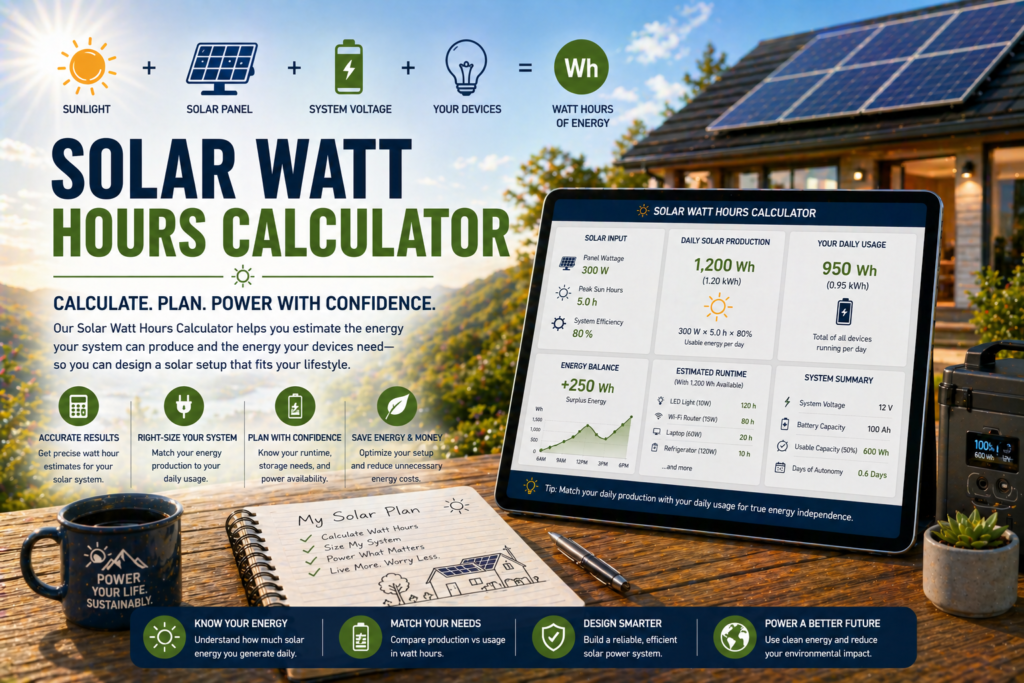
Solar Watt Hours Calculator
The Solar Watt Hours Calculator helps estimate how much energy an appliance uses over time. By converting appliance wattage and runtime into watt-hours (Wh), you can determine how much electricity your solar system must generate each day.
Watt-hours are one of the most important measurements in solar power design. This value determines the size of your solar panels, battery storage capacity, and inverter requirements for reliable off-grid or backup power systems.
- Total watt-hours consumed by an appliance
- Daily energy usage for solar system planning
- Estimated energy requirements for batteries
- Solar panel production needed to power devices
How Watt Hours Are Calculated
Watt-hours measure the total amount of electricity an appliance uses over time. This value is calculated by multiplying the power rating of a device (in watts) by the number of hours the device runs.
Understanding watt-hours is critical when planning solar systems because solar panels generate energy over time, not instantly. By estimating watt-hour usage, you can determine how much energy must be generated during the day and stored in batteries for nighttime use.
Watt-Hour Calculation Formula
Watt Hours (Wh) = Appliance Watts × Hours Used
For example, if a device uses 100 watts and runs for 5 hours:
100W × 5 hours = 500Wh
Why Watt Hours Matter in Solar Systems
- Solar panels generate electricity measured in watt-hours per day
- Batteries store energy in watt-hours or kilowatt-hours
- Daily energy demand determines the total solar system size
- Accurate watt-hour estimates prevent undersized solar systems
Solar Watt Hours Calculator
Calculate daily watt-hours, weekly and monthly energy use, estimated solar panel size, battery storage, system voltage impact, and whether the load is realistic for off-grid use.
Simple Inputs
Decision Output
Advanced System Inputs
Appliance List
Decision Output
Continue Planning After Daily Energy Calculation
After calculating your daily energy usage, the next step is sizing your battery bank, determining solar panel requirements, confirming inverter capacity, and validating your full off-grid system.
Battery Bank Size Calculator
Convert your daily consumption into the correct battery storage size.
Solar Array Planner
Determine how many solar panels you need to meet your daily energy demand.
Solar Inverter Size Calculator
Ensure your inverter can handle your full daily load.
Complete Solar System Calculator
Validate your energy usage within a full system planning tool.
How to Use the Solar Watt Hours Calculator
This calculator helps you convert appliance wattage and runtime into total energy usage measured in watt-hours. That number is essential for sizing solar panels, batteries, and backup power systems correctly.
1. Enter Appliance Wattage
Start by entering the power draw of the appliance in watts. This is usually shown on the product label, adapter, or specification sheet.
2. Add Runtime
Enter how many hours the appliance runs. The calculator multiplies watts by hours to estimate total energy usage in watt-hours.
3. Use Advanced Mode for Real Planning
Advanced mode lets you include multiple devices and efficiency adjustments. This is the better option when planning a full solar system instead of checking one appliance.
4. Review the Watt-Hour Result
The final watt-hour number shows how much energy the appliance uses over the selected time period. Use that result to estimate solar panel output and battery storage requirements.
Understanding Your Watt Hour Results
The result from the Solar Watt Hours Calculator shows the total amount of energy an appliance consumes over a specific period of time. This number is measured in watt-hours (Wh), which represents the amount of electricity required to power a device for a given number of hours.
Solar systems must generate enough watt-hours during daylight hours to match or exceed the energy consumed by appliances throughout the day. If the system does not produce enough watt-hours, the battery bank will gradually drain and the system may run out of power.
Daily Energy Demand
The watt-hour result represents how much electricity a device uses in a day or during a specified period. This value helps determine the total energy your solar system must generate.
Solar Panel Production
Solar panels produce a specific number of watt-hours per day based on sunlight conditions and panel size. The system must produce enough energy to cover daily usage.
Battery Storage Needs
Batteries store excess solar energy produced during the day so it can be used at night. Battery capacity is usually measured in watt-hours or kilowatt-hours.
Example Calculation
If a laptop uses 60 watts and runs for 6 hours per day, the total energy consumption would be:
60W × 6 hours = 360Wh per day
Your solar panels must generate at least 360 watt-hours of electricity each day to power this device.
Example Watt Hour Calculation
Understanding watt-hours becomes easier when looking at real appliance examples. The following example demonstrates how different devices contribute to total daily energy usage in a solar power system.
Example Appliances
- Refrigerator – 150 watts running for 10 hours
- Laptop – 60 watts running for 6 hours
- LED lighting – 40 watts running for 5 hours
- Television – 120 watts running for 4 hours
Step-by-Step Energy Calculation
Refrigerator energy use:
150W × 10 hours = 1,500Wh
Laptop energy use:
60W × 6 hours = 360Wh
LED lighting energy use:
40W × 5 hours = 200Wh
Television energy use:
120W × 4 hours = 480Wh
Total Daily Energy Consumption
Adding these values together gives the total daily energy demand:
1,500Wh + 360Wh + 200Wh + 480Wh = 2,540Wh per day
A solar system designed to power these appliances would need to generate at least 2,540 watt-hours of electricity per day, plus additional capacity to account for system losses and cloudy weather.
Expert Tips for Estimating Watt Hours
Accurately estimating watt-hour usage is critical for designing reliable solar systems. Even small mistakes in energy estimates can result in undersized solar panels or insufficient battery storage.
Measure Actual Usage
Use a power meter or smart plug to measure real appliance consumption. Many devices draw less or more power than their label indicates.
Add a System Loss Buffer
Solar systems typically lose 10–20% of energy through inverter losses, wiring resistance, and battery charging inefficiencies.
Identify High Consumption Devices
Refrigerators, air conditioners, heaters, and cooking appliances usually dominate daily energy usage in solar systems.
Plan for Future Expansion
If you plan to add appliances later, design your solar system with extra capacity to avoid expensive upgrades in the future.
Planning Tip
Reducing energy consumption often costs far less than expanding a solar system. Efficient appliances and LED lighting can dramatically reduce watt-hour demand.
Watt Hour Energy Comparison
Different appliances consume very different amounts of electricity depending on both wattage and runtime. Comparing typical watt-hour usage helps identify which devices have the biggest impact on solar system sizing.
| Appliance | Average Power | Runtime | Energy Used |
|---|---|---|---|
| LED Light | 10W | 5 hours | 50Wh |
| Laptop | 60W | 6 hours | 360Wh |
| Television | 120W | 4 hours | 480Wh |
| Refrigerator | 150W | 10 hours | 1,500Wh |
| Microwave | 1,000W | 15 minutes | 250Wh |
| Air Conditioner | 1,500W | 4 hours | 6,000Wh |
Key Insight
A small number of high-power appliances usually account for the majority of daily energy usage. Identifying and optimizing these loads can significantly reduce the size and cost of a solar power system.
Visual Insight: Appliance Energy Consumption
Some appliances use dramatically more energy than others. Visualizing watt-hour consumption helps identify which devices will have the largest impact on your solar system design.
Air Conditioner
≈ 6,000Wh / day
Refrigerator
≈ 1,500Wh / day
Television
≈ 480Wh / day
Laptop
≈ 360Wh / day
Key Insight
Heating, cooling, and refrigeration appliances dominate daily energy consumption in most homes. Managing these loads is the most effective way to reduce total solar system size.
Planning Advice for Watt-Hour Energy Usage
Watt-hours determine the total energy a solar system must generate each day. Accurately estimating energy usage allows you to design a solar system that reliably powers your appliances without overspending on unnecessary equipment.
Calculate Daily Energy Demand First
Before selecting solar panels or batteries, determine total daily energy usage in watt-hours. This number is the foundation of solar system design.
Account for System Efficiency
Real solar systems lose energy through inverters, wiring, and batteries. Adding a 10–20% buffer helps ensure reliable performance.
Reduce Large Power Loads
Large appliances such as air conditioners, heaters, and electric cooking devices dramatically increase solar system size requirements.
Design Systems With Expansion in Mind
Future appliances and additional loads may increase energy demand. Planning for expansion avoids costly upgrades later.
Recommended Next Calculators
- Solar Panel Output Calculator – estimate daily solar production
- Solar Battery Size Calculator – determine battery capacity requirements
- Solar Inverter Size Calculator – size your inverter for appliance loads
Solar Watt Hours Calculator — Expert FAQ
What is a watt-hour?
A watt-hour (Wh) measures total energy used over time. It is calculated by multiplying watts by hours.
Example: 100W × 10 hours = 1,000Wh, or 1kWh.
How many watt-hours are in a kilowatt-hour?
1 kilowatt-hour (kWh) equals exactly 1,000 watt-hours.
Most utility bills and solar systems use kWh because it is easier to read at scale.
Why are watt-hours critical for solar systems?
Watt-hours determine how much energy your solar panels must generate and how much your batteries must store.
If this number is wrong, your system may run out of power or fail to recharge properly.
How accurate should watt-hour estimates be?
Estimates should be as accurate as possible, with a 20–30% safety margin added.
Real-world usage is often different from manufacturer ratings.
What appliances use the most energy?
The biggest energy users are air conditioners, water heaters, dryers, ovens, and refrigerators.
These can account for most of a household’s total energy use.
How do I calculate total daily watt-hours?
Add up all appliances using this formula: watts × hours = Wh per device.
Then multiply the total by 1.25 to account for system losses.
Watt-hours vs amp-hours — what’s the difference?
Watt-hours measure energy. Amp-hours measure electrical charge.
The conversion is: Wh = Ah × Voltage.
How do I size a solar battery using watt-hours?
Multiply your daily Wh by the number of backup days you want.
Then divide by usable battery capacity, such as 0.9 for lithium batteries.
Related Tools for Energy and System Optimization
These tools help refine production, runtime behavior, wiring, and cost planning without duplicating the main next-step links above.
Solar Energy Consumption Calculator
Break down your total energy usage beyond watt-hour estimates.
Solar Panel Output Calculator
Check how much energy your solar system can realistically produce.
Solar Wire Size Calculator
Ensure your system wiring safely supports your calculated load.
Solar Panel Cost Calculator
Estimate system cost based on your calculated energy requirements.