Solar Power Daily Consumption Calculator
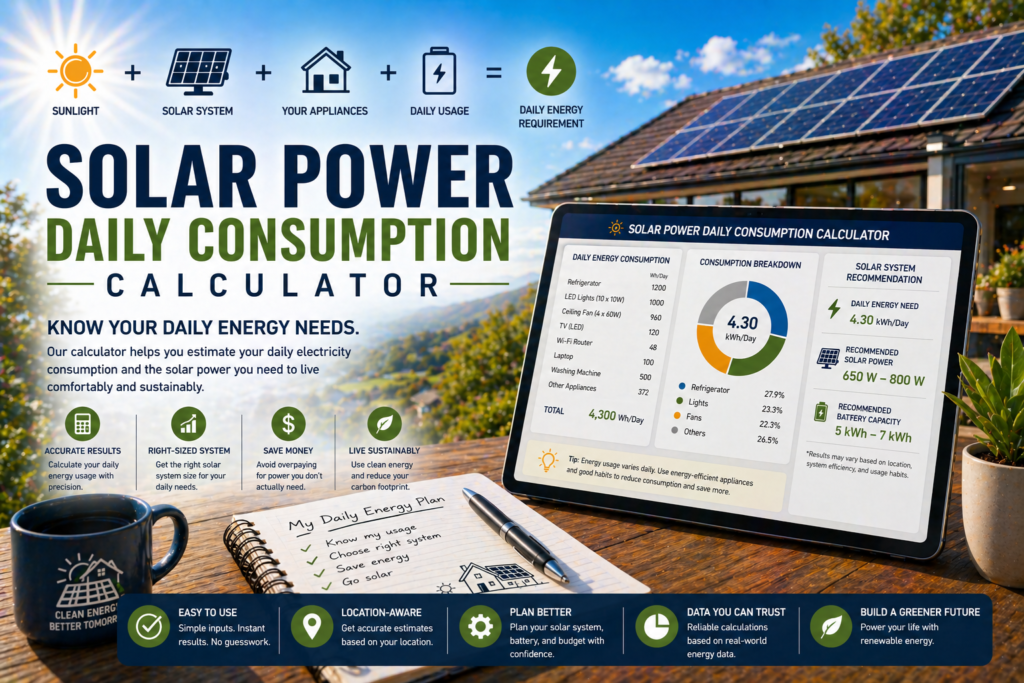
The Solar Power Consumption Calculator helps estimate how much electricity your appliances and devices use each day. Understanding total energy consumption is one of the most important steps when designing a solar system, off-grid power setup, RV solar installation, or backup battery system.
By calculating total watt-hours used per day, you can determine how large your solar panel array and battery storage must be. This tool helps homeowners, RV travelers, cabin owners, and off-grid planners accurately estimate daily energy demand.
- Total daily electricity consumption in watt-hours (Wh)
- Estimated energy usage of multiple appliances
- Power requirements for solar battery systems
- Whether your solar system can meet your daily energy demand
How Solar Power Consumption Is Calculated
Ourt Solar Power Daily Consumption Calculator works by multiplying the power rating of each appliance by the number of hours it operates per day. This produces the total energy used in watt-hours (Wh). Once the energy usage of each device is calculated, all appliances are added together to determine total daily energy consumption.
Understanding this number is essential when designing solar systems because it determines how large your solar panel array and battery storage must be. If daily energy demand is underestimated, the system may not generate enough electricity to meet real-world usage.
Solar Power Consumption Formula
Daily Energy Consumption (Wh) = Appliance Power (Watts) × Hours Used Per Day
For multiple appliances, simply repeat the calculation for each device and add the results together to determine total daily energy usage.
Factors That Affect Solar Energy Consumption
- Number of appliances being used
- Power rating (wattage) of each appliance
- Number of hours appliances run per day
- Energy efficiency of devices
- Seasonal changes in usage patterns
Solar Power Consumption Calculator
Calculate daily watt-hours, average load, peak load, battery pressure, solar recharge coverage, inverter fit, and whether your off-grid power plan is actually viable.
Power Consumption Planner
Use Simple Mode for one device, or Advanced Planner Mode for a full appliance list with battery, solar, inverter, and reliability margin checks.
System Inputs
Appliance List
Decision Output
Real-world power demand, system pressure, and recommended next step.
Add your appliance data to calculate daily demand and system fit.
Advanced Mode compares demand against usable battery capacity, daily solar recharge, and inverter size.
- Use real measured appliance loads whenever possible.
- Do not confuse peak watts with daily watt-hours.
- Use Advanced Mode before sizing batteries, solar panels, or an inverter.
Continue Planning After Daily Energy Calculation
After calculating your daily energy usage, the next step is sizing your battery bank, determining solar panel requirements, confirming inverter capacity, and validating your full off-grid system.
Battery Bank Size Calculator
Convert your daily consumption into the correct battery storage size.
Solar Array Planner
Determine how many solar panels you need to meet your daily energy demand.
Solar Inverter Size Calculator
Ensure your inverter can handle your full daily load.
Complete Solar System Calculator
Validate your energy usage within a full system planning tool.
How to Use the Solar Power Consumption Calculator
This calculator helps estimate the total electricity your appliances use each day. The result can be used to size solar panels, battery storage, and backup power systems accurately.
Enter Appliance Wattage
Start by entering the power rating of the appliance in watts. This information can usually be found on the appliance label or manufacturer specifications.
Add Daily Usage Hours
Enter the number of hours the appliance runs per day. Devices that run continuously, such as refrigerators, may average several hours of runtime throughout the day.
Include Multiple Devices
In advanced mode you can include several devices and system efficiency adjustments to estimate real-world solar energy demand.
Review Total Daily Energy Use
The calculator will estimate your total daily electricity consumption in watt-hours. This number is the foundation for sizing solar panels and battery storage.
Understanding Your Solar Power Consumption Results
The Solar Power Consumption Calculator estimates how much electricity your appliances use each day. The result shows the total watt-hours (Wh) required to power your devices and helps determine whether your solar panels and battery storage are large enough to meet your energy needs.
Total Daily Energy Use
This value represents the total electricity your appliances consume each day. Solar systems must generate at least this much energy to fully power your setup.
Solar Panel Requirements
Once daily energy consumption is known, you can estimate the number of solar panels needed to produce enough electricity during daylight hours.
Battery Storage Needs
Batteries must store enough energy to power appliances when solar panels are not producing electricity, such as at night or during cloudy weather.
Example Daily Energy Usage
- Refrigerator: 150W × 10 hours = 1,500Wh
- Laptop: 60W × 6 hours = 360Wh
- LED Lights: 40W × 5 hours = 200Wh
- Phone Charging: 10W × 3 hours = 30Wh
Total daily energy consumption in this example is approximately 2,090Wh per day. This value helps determine the size of both the solar array and battery bank needed for reliable power.
Example Solar Power Consumption Calculation
The following example shows how to estimate the total electricity consumption of several appliances. Understanding this process helps determine the size of solar panels and battery storage required for reliable power.
Example Appliance Setup
- Refrigerator: 150W used for 10 hours
- Laptop: 60W used for 6 hours
- LED Lighting: 40W used for 5 hours
- Phone Charging: 10W used for 3 hours
Step-by-Step Energy Calculation
Refrigerator energy use:
150W × 10 hours = 1,500Wh
Laptop energy use:
60W × 6 hours = 360Wh
LED lighting energy use:
40W × 5 hours = 200Wh
Phone charging energy use:
10W × 3 hours = 30Wh
Total Daily Energy Use
- Refrigerator: 1,500Wh
- Laptop: 360Wh
- Lighting: 200Wh
- Phone charging: 30Wh
Total estimated daily consumption: 2,090Wh per day. This number helps determine how large your solar panel array and battery storage must be.
Solar Power Consumption Comparison Guide
Different appliances consume electricity at very different rates. Understanding typical energy consumption helps estimate how large your solar system must be to support daily usage.
| Appliance | Average Power (Watts) | Hours Used Daily | Daily Energy Use (Wh) |
|---|---|---|---|
| Refrigerator | 150W | 10 hours | 1,500Wh |
| Laptop | 60W | 6 hours | 360Wh |
| LED Lighting | 40W | 5 hours | 200Wh |
| Television | 120W | 4 hours | 480Wh |
| Phone Charging | 10W | 3 hours | 30Wh |
Why Appliance Energy Use Matters
A few high-energy appliances often account for the majority of daily electricity usage. Identifying these devices allows you to reduce consumption, improve solar efficiency, and reduce system size requirements.
Did You Know?
A Few Appliances Can Use Most of Your Power
In many homes, a small number of devices such as refrigerators, air conditioners, heaters, pumps, and cooking appliances account for most daily electricity use.
Runtime Matters as Much as Wattage
A low-wattage device used all day can consume more energy than a high-wattage appliance used for only a few minutes. Hours of use are a major part of total consumption.
Daily Watt-Hours Drive Solar System Size
Solar panel size, battery storage, inverter capacity, and backup runtime all depend on how many watt-hours your appliances use each day.
Efficient Appliances Shrink Solar Costs
Lowering electricity demand often reduces the required size of your solar array and battery bank, which can cut total system cost significantly.
Expert Tips for Managing Solar Power Consumption
Lowering electricity demand is one of the fastest ways to improve solar system performance. The less energy your appliances use each day, the smaller and more affordable your solar panels, batteries, and inverter can be.
Reduce High-Consumption Appliances First
Focus first on appliances that use the most electricity, such as refrigerators, heaters, pumps, air conditioners, and cooking devices. Small efficiency improvements in these areas can have a major impact on total daily energy use.
Use Efficient Appliances
LED lights, efficient fridges, modern laptops, and low-draw electronics can dramatically lower solar system requirements. In many cases, upgrading devices is cheaper than adding more solar hardware.
Track Real Usage Instead of Guessing
Many people underestimate how long appliances actually run. Using realistic hours per day gives much better solar sizing results than rough guesses or ideal assumptions.
Design Around Daily Watt-Hours
Solar systems should be planned around daily energy consumption in watt-hours, not just appliance wattage. Daily Wh is the number that determines how much solar production and battery storage you actually need.
Practical Planning Tip
The cheapest solar upgrade is often lower consumption, not more equipment. Cutting daily energy demand first usually leads to a smaller battery bank, fewer solar panels, and a lower total system cost.
Planning Advice for Solar Power Consumption
Power consumption is the foundation of every solar design. If your daily energy use is wrong, your solar panels, batteries, and inverter will all be sized incorrectly. Good planning starts with realistic daily watt-hour estimates, not guesswork or optimistic assumptions.
Build Around Daily Watt-Hours First
Before looking at solar panel count or battery size, total your daily energy demand in watt-hours. This single number drives the rest of the system design more than any other input.
Use Real Appliance Patterns
A fridge does not run at full power all day, and some devices are only used briefly. Accurate solar planning depends on realistic hours of use, duty cycles, and actual daily habits.
Reduce Demand Before Adding Hardware
Lowering energy use is often cheaper than buying more panels and batteries. Efficient appliances, LED lighting, and smarter usage patterns can shrink total system cost fast.
Add Margin for Real Life
Real systems need some buffer for extra usage, seasonal changes, cloudy weather, and expansion. A solar plan that only works under perfect conditions is too tight.
Smart Next Steps
Once daily power consumption is known, the next step is to size the rest of the solar system around that number. These related tools help turn energy demand into a full working system plan:
- Solar Panel Output Calculator to estimate how much daily energy your array can produce
- Solar Battery Size Calculator to estimate how much storage capacity you need
- Solar Inverter Size Calculator to size the inverter around your real appliance loads
Visual Insight: Daily Energy Use by Appliance Type
Some appliances consume far more electricity than others. Understanding which devices use the most energy helps prioritize efficiency improvements and properly size solar systems.
Key Insight
In most homes and off-grid setups, refrigerators and climate control systems dominate daily energy use. Identifying these high-demand appliances helps optimize solar system design and reduce unnecessary power consumption.
Solar Power Consumption Questions People Also Ask
Clear answers about daily watt-hour usage, high-consumption appliances, solar panel sizing, battery planning, and how to reduce energy demand before building an off-grid solar system.
How many watt-hours does a house use per day?
A typical home may use about 10,000Wh to 30,000Wh per day, or 10–30kWh daily. Smaller off-grid homes, cabins, RVs, and low-energy households often use far less, sometimes between 2,000Wh and 8,000Wh per day.
What appliance uses the most electricity?
The biggest electricity users are usually heating systems, air conditioners, electric water heaters, dryers, ovens, pumps, and refrigerators. Anything that creates heat, cooling, or runs for many hours can quickly dominate daily energy consumption.
Why is daily energy consumption important for solar systems?
Daily energy consumption tells you how much electricity your solar system must replace each day. Without this number, solar panel size, battery bank size, inverter size, and backup power planning are just guesses.
How can I reduce solar power consumption?
Reduce solar power consumption by switching to LED lighting, using efficient appliances, lowering standby loads, improving insulation, avoiding electric resistance heating, and reducing the runtime of high-wattage devices.
How do I estimate solar panel requirements from power consumption?
First calculate your daily watt-hour use. Then divide that number by the realistic daily output of one solar panel. For example, if you use 4,000Wh per day and each panel produces 1,200Wh per day, you need about 3.4 panels, which should be rounded up to at least 4 panels.
What is the difference between watts and watt-hours?
Watts measure instant power draw. Watt-hours measure total energy used over time. A 100W device running for 5 hours uses 500Wh. This distinction matters because solar panels, batteries, and inverters are sized using different parts of the equation.
How much battery storage do I need for daily power consumption?
Battery storage depends on your daily energy use, battery type, desired backup time, and safe depth of discharge. A system using 5,000Wh per day usually needs more than 5,000Wh of rated battery capacity because not all battery energy is safely usable.
Related Tools for Energy and System Optimization
These tools help refine production, runtime behavior, wiring, and cost planning without duplicating the main next-step links above.
Solar Panel Output Calculator
Check how much energy your solar system can realistically generate.
Solar Battery Runtime Calculator
Estimate how long your battery will last based on your daily usage.
Solar Wire Size Calculator
Ensure your wiring supports your system load safely.
Solar Panel Cost Calculator
Estimate the cost of building a system that meets your energy demand.