
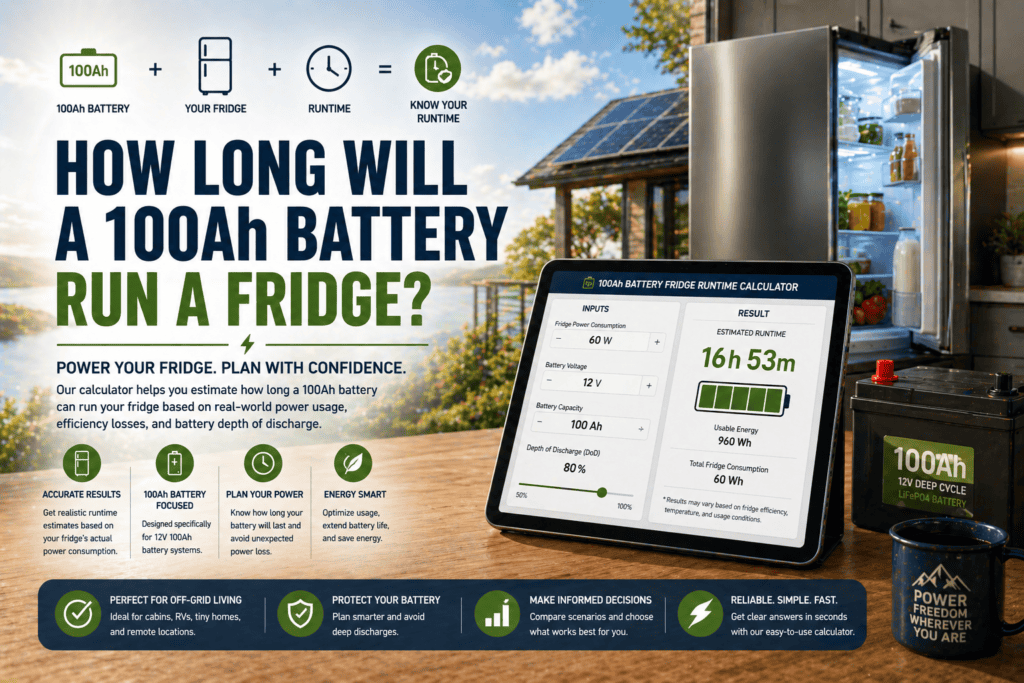
How Long Will a 100Ah Battery Run a Fridge?
A common off-grid question is how long a 100Ah battery can run a refrigerator. The answer depends on the fridge’s average power draw, battery voltage, battery chemistry, inverter losses, and how much of the rated capacity is actually usable. A 100Ah battery may sound large, but real runtime can vary dramatically depending on these factors.
This page gives you a real-world answer, not a vague guess. Use the calculator below to estimate fridge runtime with any battery type, see a worked example, understand what affects the result, compare battery chemistries, and decide whether one 100Ah battery is actually enough for your setup.
Quick Answer
A 100Ah battery will usually run a fridge for about 8 to 24 hours
A typical 100Ah battery fridge runtime is around 8 to 24 hours, depending on battery voltage, fridge wattage, battery chemistry, inverter efficiency, and real-world fridge cycling. Lithium LiFePO4 batteries and efficient refrigerators usually perform better, while older fridges and flooded lead-acid batteries reduce runtime significantly.
100Ah Battery Fridge Runtime Calculator
Use Simple Mode for a fast answer, or switch to Advanced Mode for a more realistic estimate using battery chemistry, inverter losses, and fridge duty cycle.
Battery Chemistry Comparison (same Ah & Watts)
How Battery Runtime for a Fridge Is Calculated
To estimate the 100Ah Battery Fridge Runtime, you convert battery capacity into watt-hours, apply the usable battery percentage for your chemistry, subtract inverter losses, and divide by the fridge’s average running wattage.
In real life, refrigerators cycle on and off. Advanced calculations also use duty cycle to produce a more realistic runtime estimate than assuming the fridge runs flat-out continuously.
Battery Capacity
Amp-hours × voltage = total stored energy in watt-hours
Usable Capacity
Apply usable battery % based on chemistry (Li 90%, AGM 80%, LA 50%)
Inverter Losses
Subtract energy lost during DC-to-AC conversion (typically 5–15%)
Fridge Power Draw
Divide usable energy by average fridge wattage (or watts × duty cycle)
Runtime Result
The result is your estimated runtime in hours
Important to Know
Refrigerators do not run continuously. They cycle on and off to maintain temperature, meaning real-world runtime is often longer than a constant-load estimate suggests.
Startup surge, room temperature, battery age, inverter quality, and fridge efficiency all affect actual performance. Use the Advanced Mode calculator above for a more realistic estimate.
100Ah Battery Fridge Runtime Example
Here is a realistic example using a 12V 100Ah lithium LiFePO4 battery powering a standard refrigerator with an average running draw of 120 watts and a 10% inverter loss.
Step 1
Battery Capacity
100 Ah × 12V = 1,200 Wh total energy
Step 2
Usable Energy
1,200 Wh × 90% = 1,080 Wh usable
Step 3
After Inverter Loss
1,080 Wh × 0.90 = 972 Wh available
Step 4
Runtime Estimate
972 Wh ÷ 120 W = 8.1 hours
✅ Example Final Result
In this example, a 12V 100Ah lithium battery can run a 120W refrigerator (constant draw) for about 8.1 hours before recharge is needed.
If the fridge cycles at a 35% duty cycle rather than running flat-out, the effective average load drops to 42W (120W × 35%) and the runtime extends to roughly 23 hours — a much more realistic result for a typical refrigerator.
⚠ Important Note
This is a planning estimate, not a guaranteed result. Actual runtime changes with thermostat cycling, startup surge, ambient temperature, battery age, and inverter quality. The calculator above uses these same formulas and adjusts results automatically as you change inputs.
Fridge Type Runtime Reference Table
This table shows estimated runtimes for a 12V 100Ah lithium LiFePO4 battery (972 Wh usable after 10% inverter loss) with common refrigerator types. Simple runtime assumes constant load; realistic runtime uses a 35% duty cycle.
| Fridge Type | Running Watts | Avg Watts (35% duty) |
Simple Runtime | Realistic Runtime | Verdict |
|---|---|---|---|---|---|
| DC Camping Fridge | 45W | 45W (DC direct) | 21.6 hrs | 21.6 hrs | ✓ Excellent match |
| Mini Fridge (AC) | 60W | 21W | 16.2 hrs | 46+ hrs | ✓ Very good |
| Energy Star Fridge | 80W | 28W | 12.2 hrs | 34.7 hrs | ✓ Good |
| Standard Fridge | 120W | 42W | 8.1 hrs | 23.1 hrs | • Marginal overnight |
| Large Fridge (20 cu ft) | 180W | 63W | 5.4 hrs | 15.4 hrs | • Needs solar top-up |
| Old / Inefficient Fridge | 250W | 88W | 3.9 hrs | 11.0 hrs | ✗ Undersized |
* DC camping fridges (e.g. Dometic, ARB) connect directly to the battery with no inverter loss, which is why they are the most efficient choice for battery-powered setups. All AC fridge estimates assume a 10% inverter loss.
Which Battery Type Gives the Best Fridge Runtime?
Not all 100Ah batteries deliver the same usable energy. The chemistry determines how deep you can safely discharge, how many cycles you get, and how the voltage behaves under load — all of which affect real runtime.
Lithium LiFePO4
Best for fridge runtime RecommendedAGM (Sealed Lead-Acid)
Good middle-ground option CompromiseFlooded Lead-Acid
Budget option, lower runtime BudgetBottom Line on Chemistry
A 100Ah LiFePO4 battery delivers roughly 1.8× the usable runtime of a same-rated flooded lead-acid battery. Over its lifespan, lithium typically costs less per usable kilowatt-hour despite the higher upfront price.
What Your Runtime Result Actually Means
A runtime number tells you whether your battery setup is realistic, marginal, or undersized for the refrigerator you want to run.
Under 6 hours
Usually too tight for dependable fridge use unless you only need very short-term emergency backup.
6 to 10 hours
Can work for partial-day use, but leaves limited safety margin for real off-grid or overnight use.
10 to 18 hours
Better for practical use, especially with an efficient fridge and daytime solar charging to top up.
18+ hours
Strong result. Good resilience, flexibility, and less recharging pressure on cloudy days.
A higher runtime generally means less stress on your system, more room for inverter losses and temperature swings, and a better chance that the fridge will keep running reliably through changing conditions or a day of poor solar generation.
What Affects Fridge Runtime on a 100Ah Battery?
Real-world runtime depends on far more than battery size alone. These factors can easily change results by 30% to 70% compared to a simple calculation.
Fridge Efficiency
Efficient refrigerators use less power. An Energy Star fridge can use 40–60% less energy than an old or oversized model of the same volume.
Battery Chemistry
Lithium batteries provide ~1.8× more usable energy than same-rated flooded lead-acid batteries, drastically improving runtime.
Inverter Efficiency
Low-quality or oversized inverters waste more energy, especially at light loads. A good pure-sine inverter runs at 90–95% efficiency.
Ambient Temperature
Hot rooms make the compressor work harder, increasing duty cycle and average power draw significantly.
Compressor Cycling
Most fridges cycle at 30–50% duty cycle. Assuming constant load dramatically underestimates real runtime.
Battery Age & Condition
Older batteries lose effective capacity. A 5-year-old lead-acid battery may deliver only 60–70% of its rated capacity.
Tips to Maximise Fridge Runtime on a 100Ah Battery
These practical steps can meaningfully extend how long your battery keeps the fridge running without adding more capacity.
Use a DC Compressor Fridge
A DC camping fridge (e.g. Dometic, ARB, BougeRV) connects directly to 12V or 24V and skips the inverter entirely, eliminating 10–15% inverter loss and usually drawing 40–55W vs 120W+ for AC fridges.
Pre-Cool Before Switching to Battery
Cool the fridge fully on mains or solar before relying on battery alone. A well-chilled fridge maintains temperature longer, reducing compressor run time and extending battery life significantly.
Keep the Fridge in a Cool Location
Every 10°C rise in ambient temperature increases compressor duty cycle by roughly 10–15%. Shading the fridge or keeping it out of direct sun reduces its average power draw meaningfully.
Use an MPPT Solar Charge Controller
An MPPT controller extracts 20–30% more energy from your solar panels than a PWM controller, effectively giving you a free panel upgrade and keeping the battery topped up during the day.
Minimise Door Openings
Each time you open the fridge, warm air rushes in and the compressor has to work harder. Organising contents so you can find things quickly can noticeably reduce duty cycle over a full day.
Right-Size Your Inverter
An oversized inverter draws more idle power. Size your inverter to at least 3× the fridge running watts for surge handling, but avoid a massively oversized unit that wastes power at light load.
Should You Use a 100Ah Battery for a Fridge?
In most off-grid setups, one 100Ah battery is usually not enough for dependable full-day refrigerator use. It can work for short-term use, partial-day use, emergency backup, or lighter-duty systems using DC fridges, but it is usually too small for comfortable full-time AC fridge operation without solar charging.
A better setup is usually more battery capacity plus properly sized solar charging and the right inverter. If you want to size the full system more accurately, use the Battery Bank Size Calculator, Solar Panel Output Calculator, and Solar Inverter Size Calculator.
Usually Not Enough
One 100Ah battery is generally too limited for full-time, dependable AC refrigerator use without frequent recharging.
Can Work for Short Use
A 100Ah battery can still work for backup, daytime support, short camping trips, or lightweight DC fridge setups.
Better Practical Setup
Most reliable systems use 200–400Ah of lithium storage plus solar charging for comfortable, stress-free fridge operation.
Bottom Line
The goal is not to build the smallest possible battery system. The goal is to build a system that works reliably every day without constant stress, recharging pressure, or performance surprises. Size for comfort, not the theoretical minimum.
100Ah Battery Fridge Runtime FAQs
Common questions about running a refrigerator on battery power.
-
Sometimes — but it depends heavily on battery type and fridge efficiency. A 100Ah lithium LiFePO4 battery at 12V stores 1,200 Wh with 1,080 Wh usable. After a 10% inverter loss, that’s about 972 Wh available. An efficient fridge drawing 80W average lasts roughly 12 hours, which covers a full night. A standard 120W fridge (constant draw) only lasts about 8 hours — enough for a short night but risky for longer ones.
Lead-acid batteries are far less forgiving. A 100Ah flooded lead-acid battery at 12V safely delivers only 600 Wh (50% usable) — barely enough for 4–5 hours of fridge runtime before the battery reaches its recommended discharge limit. For overnight fridge use, lithium is almost always the practical choice with a single 100Ah battery.
-
Most household refrigerators use 100–200 watts while the compressor is running. However, the compressor does not run continuously — it cycles on and off to maintain temperature. The average actual power draw across a full 24-hour period is typically 30–80 watts for a modern Energy Star fridge, and 80–150 watts for an older or less-efficient model.
The startup surge is a separate consideration: when the compressor kicks on, the initial current spike can be 3–7× the running wattage for a fraction of a second. This surge requires an inverter with an adequate peak surge rating — typically 2–3× the fridge’s running wattage — to avoid tripping protections or damaging the inverter at startup.
-
No. A refrigerator’s compressor cycles on and off to maintain the set internal temperature. In a typical household environment, a standard fridge runs its compressor about 30–50% of the time — this percentage is called the duty cycle. When ambient temperature is high or the door is opened frequently, the duty cycle increases; in a cool room with a well-insulated fridge, it decreases.
This cycling behaviour is why the Advanced Mode in the calculator above uses duty cycle as an input. If you enter a running wattage of 150W and a 35% duty cycle, the calculator computes an average load of 52.5W — much lower than the 150W compressor draw — which produces a more realistic runtime estimate than assuming the fridge runs flat-out continuously.
-
Lithium LiFePO4 (lithium iron phosphate) is the best choice for fridge runtime in off-grid systems. It offers 90–95% usable capacity versus 50% for flooded lead-acid and 80% for AGM, meaning a 100Ah lithium battery effectively delivers nearly double the usable energy of a same-rated lead-acid battery. Lithium also maintains a flatter voltage curve under load, which keeps the inverter running more efficiently throughout the discharge cycle.
AGM batteries are a practical middle-ground option: better than flooded lead-acid for usable depth, lower maintenance, and no risk of spilling electrolyte. They cost more than flooded lead-acid but significantly less than lithium. For a permanent installation where budget allows, lithium is consistently the better long-term investment; for a temporary or budget-constrained setup, AGM is a reasonable compromise.
-
It depends on panel size and daily sun hours. A 12V 100Ah lithium battery needs roughly 1,200 Wh to fully charge from empty. A standard fridge uses 1,920–2,400 Wh per day on average (80–100W × 24h). In a location with 5 peak sun hours per day, a 300W panel generates about 1,500 Wh/day — not quite enough to keep up with fridge consumption. A more comfortable setup would use 400–600W of solar for a single-fridge system.
The solar charge controller also matters — an MPPT controller extracts 20–30% more energy from panels than a PWM controller in the same conditions, effectively giving you a free panel upgrade. For reliable solar fridge operation, the standard rule of thumb is to size your solar array to generate 1.5–2× the fridge’s daily energy consumption, accounting for weather, panel angle, and seasonal variation.
-
The simple formula is: (Battery Ah × Voltage × Usable %) × (1 − Inverter Loss %) ÷ Fridge Average Watts = Runtime in hours. For a 12V 100Ah lithium battery (90% usable) with 10% inverter loss running a 120W fridge: (100 × 12 × 0.90 × 0.90) ÷ 120 = 8.1 hours.
For a more realistic estimate, replace fridge average watts with the compressor running wattage multiplied by the duty cycle percentage. If the fridge compressor draws 150W and cycles 35% of the time, the average load is 52.5W. Running the same formula: (972 Wh) ÷ 52.5W = 18.5 hours — a much longer runtime that better reflects real-world cycling behaviour. The calculator above does this automatically in Advanced Mode.
-
A general rule is to size the inverter at 2–3× the fridge’s running wattage to handle the compressor startup surge. A standard 120W fridge has a startup surge of roughly 360–720W, so a 600–1000W pure-sine inverter is the minimum practical choice. Most off-grid users choose a 1000–1500W pure-sine inverter for a standard fridge, which gives enough headroom for surge and lets you run other light loads simultaneously.
Always choose a pure-sine wave inverter for refrigerators. Modified sine wave inverters can cause the compressor motor to run hotter, consume more energy, and wear out faster. The slightly higher cost of a pure-sine unit is easily justified by fridge longevity and efficiency. Idle draw also matters: a good 1000W pure-sine inverter idles at about 10–15W, but a cheap modified-sine unit may idle at 25–40W, which adds up over 24 hours.
-
The highest-impact changes are: switch to a DC compressor fridge (bypasses the inverter entirely, reducing consumption by 50–70%); upgrade from lead-acid to lithium (nearly doubles usable energy from the same Ah rating); and add solar charging so the battery is topped up during daylight hours rather than relying entirely on stored energy overnight.
Operational tips also help: pre-cool the fridge before switching to battery, keep it out of direct sun, minimise door openings, and set the temperature no colder than needed. For longer trips, a second 100Ah battery in parallel doubles your capacity at a fraction of the cost of a larger single battery and improves system resilience if one battery degrades.
Continue Planning With These Related Calculators
These tools help you move from a single runtime estimate to a complete, correctly sized off-grid power plan.