
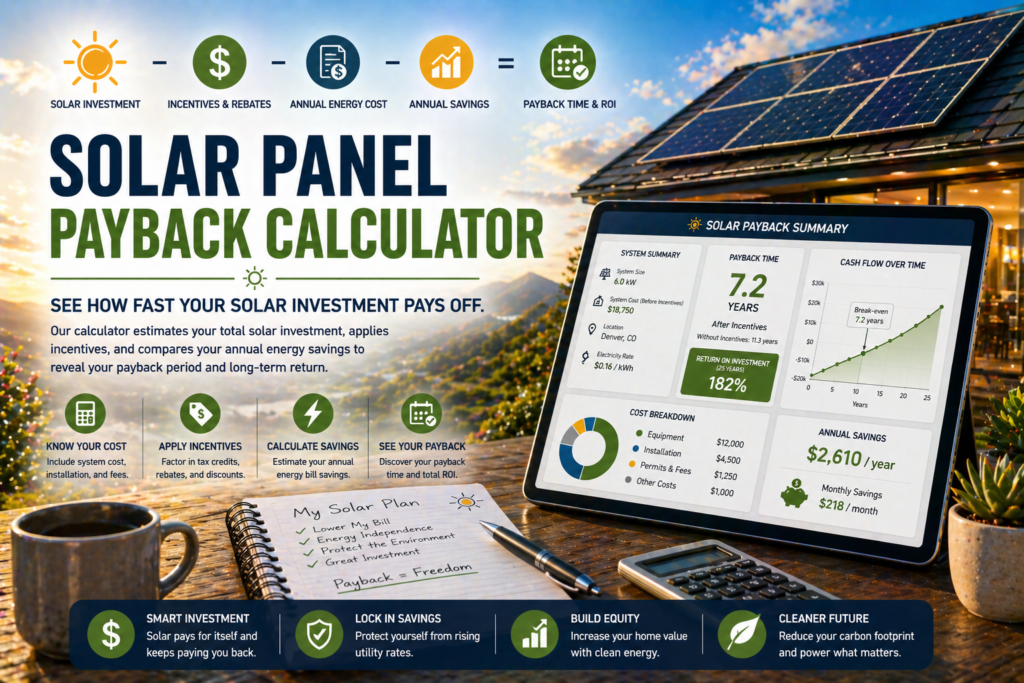
Solar Panel Payback cost Calculator
Calculate how long it will take for your solar system to pay for itself. This tool estimates your break-even point based on system cost, energy savings, electricity rates, and real-world conditions.
Use Simple Mode for a quick estimate or Advanced Mode to factor in utility rates, system degradation, maintenance costs, and energy production for a true ROI and financial analysis.
How the Calculation Works
The solar panel payback cost calculator will help you to figure out the amount of time it takes for your energy savings to equal the total cost of your solar system. The calculation compares your upfront investment against the annual savings generated by reducing or eliminating your electricity bill.
In basic form, the payback period is calculated by dividing total system cost by annual energy savings. Advanced calculations refine this by including electricity rate increases, system degradation, maintenance costs, and real-world performance factors.
Step 1
Enter the total cost of your solar system including equipment and installation.
Step 2
Estimate your annual electricity savings based on your current energy usage and utility rates.
Step 3
Divide total cost by yearly savings to determine your break-even period.
Step 4
Advanced mode adjusts for inflation, system degradation, and ongoing costs for a more accurate result.
Core formula: Payback Period = Total System Cost ÷ Annual Savings. Faster payback means higher return on investment.
Solar Payback Calculator
Estimate solar break-even, long-term ROI, financing cash flow, replacement costs, incentives, and 25-year net return.
Continue Planning After Payback Analysis
Once you estimate your solar payback period, the next step is validating panel costs, checking real-world energy production, confirming system size, and making sure your solar investment is built on realistic performance assumptions.
Solar Panel Cost Calculator
Refine your equipment cost assumptions to improve payback accuracy.
Solar Panel Output Calculator
Check real-world solar production so your savings assumptions are grounded in reality.
Solar Array Planner
Confirm your panel count and system size before relying on payback results.
Off-Grid Power Planner
Bring financial planning into a broader off-grid system strategy and design decision.
How To Use
Use this calculator to determine how long it will take for your solar system to pay for itself. Follow these steps to get accurate results.
Step 1: Enter Total System Cost
Input the full cost of your solar system, including panels, inverter, installation, and additional components.
Step 2: Enter Annual Savings
Estimate your yearly savings based on reduced electricity bills or total energy offset.
Step 3: Use Advanced Mode
Include electricity rate increases, system degradation, and maintenance costs for more accurate ROI analysis.
Step 4: Calculate Payback
The calculator will show your break-even point and overall savings timeline.
Using Advanced Mode (Recommended)
Advanced Mode allows you to simulate real-world financial conditions and get a more realistic payback estimate.
- Adjust electricity rate increases
- Factor in panel degradation
- Include maintenance costs
- Model long-term financial performance
Simple Mode
Best for quick break-even estimates.
Advanced Mode
Best for detailed financial planning and ROI analysis.
Best Practice: Always use conservative estimates for savings to ensure your investment meets expectations.
Results Interpretation
Your results show how long it will take for your solar system to pay for itself through energy savings. This is known as the payback period or break-even point.
Payback Period
The number of years required for your savings to equal your total system cost. Shorter payback means better financial return.
Total Savings
The total amount saved by the time your system reaches break-even.
Return on Investment (ROI)
After payback, all energy savings become profit, increasing your overall return on investment.
Payback Guide:
• 0–5 years: Excellent investment
• 5–10 years: Strong return
• 10–15 years: Moderate return
• 15+ years: Long-term investment
Faster payback typically means higher electricity costs, better system efficiency, or lower installation costs.
Example Calculation
This example shows how to calculate the payback period of a solar system based on total cost and annual savings.
System Inputs
System Cost: $18,000
Annual Savings: $3,000
Formula
Payback = Total Cost ÷ Annual Savings
Goal
Determine how many years it takes to recover your investment.
Step-by-Step Breakdown
Step 1: Identify total cost
$18,000 investment
Step 2: Identify annual savings
$3,000 per year
Step 3: Calculate payback
$18,000 ÷ $3,000 = 6 years payback period
Payback Period
Annual Savings
Investment Rating
Real-World Tip: Faster payback periods are typically achieved in areas with high electricity costs or strong solar incentives.
Did You Know
Most Systems Pay Back in 5–10 Years
Depending on energy costs and system size, many solar installations recover their cost within a decade.
Electricity Rates Impact ROI
Higher utility rates mean greater savings, which shortens your payback period significantly.
Solar Panels Last 25+ Years
Even after payback, your system continues generating free energy for decades.
Incentives Can Speed Payback
Tax credits, rebates, and incentives can significantly reduce upfront cost and improve ROI.
Key Insight: The faster your system pays itself off, the higher your long-term return on investment.
Expert Tips
Understanding solar payback requires more than just simple math. These expert insights help you evaluate your investment accurately and avoid common mistakes.
Use Conservative Savings Estimates
Overestimating savings can make payback look better than reality. Always use realistic or slightly conservative numbers.
Factor in Electricity Rate Increases
Rising utility rates can significantly improve your payback period over time.
Consider System Degradation
Solar panels gradually lose efficiency over time, which slightly reduces annual savings.
Incentives Improve ROI
Tax credits, rebates, and incentives can reduce upfront cost and shorten your payback period.
Advanced Considerations
- Include maintenance and replacement costs
- Evaluate long-term energy savings trends
- Consider battery lifecycle and replacement
- Factor in financing or loan costs
- Analyze net savings beyond payback period
Typical Payback
System Lifespan
Long-Term Value
Expert Insight: The real value of solar is not just reaching payback, but the years of free energy and savings that follow.
Comparison Table
This table compares solar payback periods based on system cost, annual savings, and overall investment quality.
Key Insight: Systems with higher annual savings relative to cost achieve faster payback and better investment performance.
Visual Insight
Solar payback improves as annual savings increase relative to system cost. This visual illustrates how different scenarios impact your return timeline.
Payback Speed by Savings Ratio
Low Savings vs Cost
Moderate Savings
High Savings
Very High ROI
Savings Impact
Higher annual savings significantly reduce payback time and increase return on investment.
Cost Impact
Higher upfront costs extend payback unless offset by strong energy savings or incentives.
Planning Insight: The best solar investments balance system cost with high energy savings to achieve faster payback and long-term profitability.
Planning Advice
Planning your solar investment correctly ensures faster payback and stronger long-term returns. Use these strategies to maximize your ROI.
Maximize Energy Savings
The more energy your system offsets, the faster your payback. Match system size to your energy usage for optimal results.
Reduce Upfront Costs
Take advantage of incentives, rebates, and competitive installation quotes to lower your initial investment.
Choose Efficient Equipment
Higher efficiency panels and components can increase energy production and improve long-term returns.
Plan for Long-Term Value
Focus on total savings over the system lifespan, not just the payback period.
Common Payback Mistakes
- Overestimating annual savings
- Ignoring maintenance and replacement costs
- Not factoring in system degradation
- Focusing only on upfront cost
- Failing to consider long-term ROI
Ideal Payback
Faster ROI
Profit Growth
Final Advice: A well-planned solar system should not only pay for itself quickly but also deliver decades of financial and energy benefits.
Key Expansion Insights
How long does it take for solar panels to pay for themselves?
Most solar systems pay for themselves within 5 to 10 years depending on system cost, energy savings, and electricity rates.
What is a good solar payback period?
A good solar payback period is typically under 10 years. Faster payback indicates a stronger return on investment.
How do you calculate solar ROI?
Solar ROI is calculated by comparing total savings over time to the initial investment cost, including factors like electricity rates and system performance.
Does solar increase home value?
Yes, solar installations can increase property value by reducing energy costs and improving energy efficiency.
What affects solar payback the most?
Key factors include system cost, annual savings, electricity rates, incentives, and system efficiency.
Solar Payback Calculator — Frequently Asked Questions
Understand solar payback periods, ROI, incentives, financing, battery costs, resale value, and long-term return assumptions.
Most residential solar systems pay for themselves in roughly 6 to 12 years, depending on system cost, local electricity rates, incentives, sunlight, system size, and whether the system is purchased with cash or financed.
A shorter payback usually happens when electricity rates are high, incentives are strong, the system is well-sized, and installation cost is reasonable. A longer payback often means low utility rates, poor net metering, high system cost, or unnecessary oversizing.
Under 7 years is excellent. Seven to 10 years is strong. Ten to 14 years can still be worthwhile if the system has a long lifespan, good warranty coverage, and positive 25-year savings.
Anything beyond 15 years deserves a closer look. It may still make sense for energy independence, backup power, or environmental reasons, but the financial return is weaker unless incentives, rates, or resale value improve the numbers.
The simple formula is net system cost divided by annual electricity savings.
For example, if a system costs $20,000 after incentives and saves $2,500 per year, the simple payback is 8 years. Advanced calculations also include rate increases, maintenance, panel degradation, replacement costs, resale value, and financing costs.
Yes. Incentives reduce the net cost of the system, which directly shortens payback. A tax credit, rebate, or utility incentive can remove thousands of dollars from the effective project cost.
Because incentive programs vary by country, province, state, city, utility, and year, the calculator should be treated as a scenario planner. Always confirm current incentive rules before making a purchase decision.
Financing changes the analysis because the system may be profitable long term while still producing weak cash flow in the early years. If the monthly loan payment is higher than the monthly utility savings, the homeowner may save money over 25 years but pay more out of pocket at first.
The best financed solar projects usually have loan payments close to or below the monthly bill savings. If the loan payment is far higher than expected savings, the project may still work, but it should be treated as a long-term investment rather than immediate bill relief.
After payback, the system has recovered its net cost. Future utility savings become the financial return, minus maintenance, repairs, inverter replacement, battery replacement if applicable, and any remaining loan costs.
This is why a system with an 8-year payback and a 25-year useful life can still be attractive. The strongest returns usually come during the years after break-even.
When electricity rates rise, each kilowatt-hour produced by your solar system becomes more valuable. This can improve long-term ROI because avoided utility costs increase over time.
However, rate escalation should not be exaggerated. A conservative calculator should let users test different annual rate increase assumptions instead of assuming aggressive future utility increases.
Solar panels gradually lose output over time. Many planning models use an annual degradation assumption, often around a fraction of a percent per year, to estimate reduced production over a 25-year period.
Panel degradation usually does not ruin the economics of a good system, but it should be included in long-term projections so ROI is not overstated.
Batteries usually make simple financial payback longer because they add significant upfront cost and may need replacement before the panels reach end of life.
They can still be worth it for backup power, time-of-use savings, weak net metering, off-grid systems, and energy independence. For pure ROI, solar without batteries often pays back faster unless the utility rate structure heavily rewards stored energy.
Yes. Long-term ROI is more realistic when inverter and battery replacement costs are included. Panels may last 25 years or longer, but inverters and batteries often have shorter useful lives.
For a clean estimate, include at least one inverter replacement in a 25-year model. If the system includes batteries, include a battery replacement assumption or run a separate scenario with and without replacement cost.
Solar can increase resale value, especially when the system is owned outright, well-installed, permitted, and has transferable warranties. The value impact depends on the local market, buyer awareness, electricity costs, system age, and whether the system is leased or financed.
Owned systems usually add more value than leased systems. If resale value matters, keep documentation for permits, warranties, production history, and equipment specifications.
No. Payback is useful, but it does not tell the full story. A better decision looks at 25-year net return, monthly cash flow, financing cost, maintenance, replacement costs, resale value, backup value, and utility policy risk.
The best system is not always the biggest system. The best system is the one that balances cost, savings, reliability, and the homeowner’s real energy goals.
Related Tools for Solar Value and System Planning
These tools help refine energy usage, system design, component sizing, and efficiency without duplicating the main next-step links above.
Solar Energy Consumption Calculator
Measure your real energy usage to improve savings and payback estimates.
Solar Inverter Size Calculator
Ensure inverter sizing does not distort overall system cost and value assumptions.
Battery Bank Size Calculator
Estimate battery storage requirements that can significantly affect total project cost.
Solar Panel Efficiency Calculator
See how panel efficiency can improve production and shorten your payback period.