Off-Grid Solar System Size Calculator
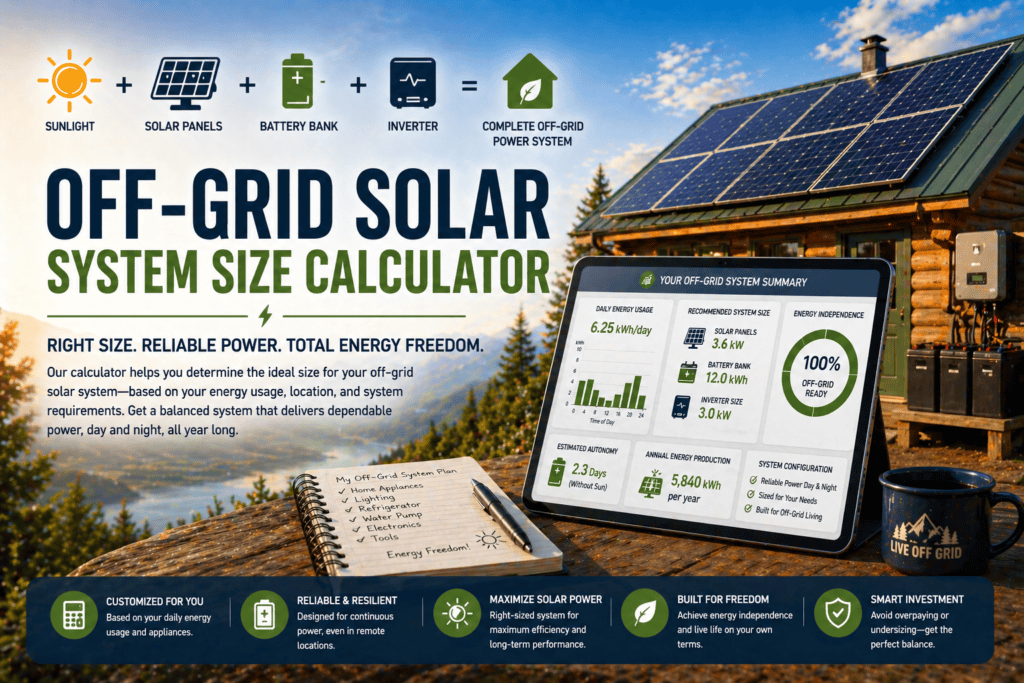
Accurately size your off-grid solar system based on real energy usage, efficiency losses, and backup requirements. This calculator helps determine the exact solar panel capacity, battery storage, and system requirements needed to power your home, cabin, RV, or off-grid setup.
Whether you’re planning a full off-grid lifestyle or a backup system, this tool gives you a precise, real-world system size estimate using both simple inputs and advanced customizable calculations for maximum accuracy.
How This Off Grid Solar System Size Calculator Works
An off-grid solar system size calculator works by starting with your total daily energy consumption, usually measured in watt-hours or kilowatt-hours per day. The system then adjusts that load to account for real-world inefficiencies such as inverter losses, battery losses, wiring loss, system derating, and reserve capacity. This gives a more accurate estimate of how much usable solar production and battery storage you actually need.
From there, the calculator estimates the required solar array size based on your available peak sun hours, and it calculates battery bank size based on how many days of autonomy or backup you want. In advanced mode, the calculation becomes much more precise by allowing multiple appliances, custom duty cycles, device counts, efficiency settings, and safety margins. This turns the result from a rough guess into a planning-grade off-grid system estimate.
Step 1
Add up your daily energy use from appliances, tools, lights, pumps, refrigeration, and electronics.
Step 2
Apply efficiency losses and reserve margin so the system is sized for real use, not lab conditions.
Step 3
Divide adjusted daily energy needs by peak sun hours to estimate the minimum solar array size.
Step 4
Calculate battery storage based on backup days, usable depth of discharge, and system voltage.
Core formula concept: Daily Load × Loss Adjustments × Reserve Margin ÷ Peak Sun Hours = Recommended Solar Array Size. Battery storage is then sized separately using adjusted daily load, autonomy days, and usable battery capacity.
Solar System Size Calculator
Estimate the solar array, battery bank, inverter size, and charge controller size needed for your daily energy use. Simple Mode gives a fast estimate, while Advanced Mode builds a real load profile from appliances.
Quick System Presets
Start with a common use case, then adjust the values.
Solar Resource & System Settings
Use realistic sun hours and losses for your location and system type.
Sizing Preferences
Add safety margin and choose a common panel wattage for panel count.
Recommended System Size
Results update automatically as you change inputs.
Solar Production Coverage
How well the recommended array covers your daily energy need.
—
System Component Summary
Planning-level component sizes based on your inputs.
| Component | Recommendation | Why It Matters |
|---|
How This Was Calculated
Solar kW = daily kWh ÷ peak sun hours ÷ efficiency, then margin is added.
Refine Your System After Initial Planning
After generating your off-grid system plan, the next step is validating energy production, checking inverter sizing, ensuring battery capacity is sufficient, and confirming your system performs in real-world conditions.
Solar Panel Output Calculator
Verify your system can generate enough energy based on your location and setup.
Solar Inverter Size Calculator
Confirm your inverter can handle your expected load and surge requirements.
Battery Bank Size Calculator
Ensure your battery capacity supports your planned energy usage.
Complete Solar System Calculator
Run a full system validation to confirm your entire setup works together.
How To Use
Use this calculator to accurately size your off-grid solar system based on your real energy needs. Follow the steps below to get a reliable system estimate that you can use for planning or building your setup.
Step 1: Enter Daily Usage
In Simple Mode, enter your total daily energy usage in kWh. In Advanced Mode, add each appliance with watts, usage hours, and quantity for a detailed calculation.
Step 2: Input Sun Hours
Enter your average daily peak sun hours. This is critical for determining how much solar energy your system can realistically generate.
Step 3: Set Efficiency
Adjust system efficiency to account for inverter losses, battery losses, and wiring. Typical real-world systems operate between 75%–85%.
Step 4: Configure Backup (Advanced)
In Advanced Mode, set your desired battery backup days. This determines how long your system can run without solar input.
Using Advanced Mode (Recommended)
Advanced Mode allows you to build a true real-world energy model. Add multiple appliances, adjust usage patterns, and customize system variables to get a highly accurate system size.
- Add multiple appliances using the “Add Another” button
- Enter exact wattage and usage time
- Adjust system efficiency and backup days
- Model real usage instead of estimates
Simple Mode
Best for quick estimates when you already know your total daily energy usage.
Advanced Mode
Best for accurate planning using real appliance data and full system customization.
Best Practice: Always use Advanced Mode when designing a real off-grid system. It provides a far more accurate result and helps prevent undersizing or costly system mistakes.
Results Interpretation
Your results provide a realistic estimate of the solar system size and battery storage required to reliably operate off-grid. These values are not just theoretical—they include efficiency loss, real-world usage patterns, and system buffer to ensure dependable performance.
Solar System Size (kW)
This represents the minimum solar array capacity required to generate enough energy daily. A higher value means more panels are needed to meet your energy demand.
Battery Storage (kWh)
This shows how much energy storage is required to keep your system running when solar production is unavailable, such as during the night or cloudy days.
Daily Energy Usage
This is your total daily consumption after factoring in appliance usage, run time, and quantity. It is the foundation of all system sizing calculations.
System Classification:
• Low Demand (1–3 kWh/day): Small cabins, minimal off-grid setups, or backup systems.
• Moderate Demand (3–10 kWh/day): Typical off-grid homes with efficient appliances.
• High Demand (10+ kWh/day): Full-size homes, heavy appliance usage, or high-energy systems.
If your system falls into a higher demand category, you will need a larger solar array, increased battery capacity, and potentially additional system components such as higher-capacity inverters or backup power sources.
Example Calculation
This example shows how to calculate a properly sized off-grid solar system using real-world inputs. It includes energy usage, system efficiency, and battery backup requirements to produce a reliable system estimate.
System Inputs
Daily Energy Use: 8 kWh/day
Peak Sun Hours: 5 hours
System Efficiency: 80%
Battery Backup: 2 days
Solar Sizing Formula
Solar Size = Daily Usage ÷ (Sun Hours × Efficiency)
Battery Sizing Formula
Battery Storage = Daily Usage × Backup Days
Step-by-Step Breakdown
Step 1: Adjust efficiency
Convert 80% efficiency to decimal → 0.80
Step 2: Calculate solar system size
8 ÷ (5 × 0.80) = 8 ÷ 4 = 2.0 kW
Step 3: Calculate battery storage
8 × 2 = 16 kWh
Step 4: Final system output
Minimum system requirement is 2.0 kW solar and 16 kWh battery storage
Solar Array Size
Battery Capacity
Energy Demand Level
Real-World Adjustment: Most systems are sized 10–25% higher than calculated values to handle cloudy days, seasonal changes, battery degradation, and future energy expansion.
Did You Know
Most Systems Are Undersized
The majority of off-grid solar systems fail because they are designed without accounting for real-world losses and energy spikes. Undersizing leads to constant power shortages.
Efficiency Loss Is Significant
Between inverter loss, battery inefficiency, and wiring resistance, you can lose 15%–30% of your total system output if not properly calculated.
Peak Sun Hours Matter More Than Location
Solar production depends more on daily peak sun hours than your geographic location alone. Even sunny regions can have poor production during certain seasons.
Battery Storage Is the Real Limiter
Solar panels generate energy during the day, but your battery determines how long you can actually live off-grid. Undersized storage is the #1 failure point.
Key Insight: A properly sized off-grid system is not just about matching your usage — it must exceed it to account for inefficiencies, seasonal variation, and unexpected demand.
Expert Tips
Designing an off-grid solar system requires more than just matching your energy usage. These expert-level strategies ensure your system performs reliably, efficiently, and is built to handle real-world conditions.
Oversize Your System
Always size your solar array 10–25% above calculated needs. This compensates for cloudy days, seasonal changes, and long-term performance degradation.
Focus on Battery Capacity
Your battery bank determines how long you can operate without sunlight. Prioritize storage capacity over panel count for true off-grid reliability.
Reduce Energy Consumption First
Upgrading to energy-efficient appliances can significantly reduce system size requirements, lowering total system cost and complexity.
Plan for Future Expansion
Leave room in your system design for additional panels or batteries. Energy needs typically increase over time.
Advanced Planning Considerations
- Account for inverter efficiency (typically 90–95%)
- Factor in battery depth of discharge limits
- Include seasonal variation in sun hours
- Plan for backup generation if needed
- Use real appliance data instead of estimates
Recommended Oversizing Range
Real-World System Efficiency
Ideal Battery Backup Range
Expert Insight: The most reliable off-grid systems are designed with margin, flexibility, and real-world conditions in mind—not just theoretical calculations.
Comparison Table
Use this comparison to understand how different energy usage levels translate into solar system size and battery requirements. This helps quickly benchmark your setup against typical off-grid scenarios.
Key Insight: As energy demand increases, both solar panel size and battery capacity must scale together. Increasing one without the other leads to system imbalance and unreliable performance.
Visual Insight
Understanding how energy demand scales your solar system helps you plan more effectively. As usage increases, both solar panel capacity and battery storage grow rapidly, especially when factoring in inefficiencies and backup requirements.
System Size Growth by Daily Energy Usage
Low Demand (1–3 kWh/day)
Moderate Demand (3–10 kWh/day)
High Demand (10–20 kWh/day)
Very High Demand (20+ kWh/day)
Linear vs Real Growth
Solar systems do not scale perfectly linearly. As demand increases, inefficiencies and backup requirements cause system size to grow faster than expected.
Battery Scaling Impact
Higher energy demand requires disproportionately larger battery storage to maintain the same level of autonomy and reliability.
Planning Insight: The biggest jump in system cost and complexity occurs when moving from moderate to high demand. Reducing consumption slightly can significantly reduce total system size and cost.
Key Expansion Insights
How many solar panels do I need to live off-grid?
The number of solar panels needed depends on your daily energy usage, available sunlight, and system efficiency. Most off-grid systems range from 1 kW to 10+ kW, which typically translates to 3 to 30+ panels depending on panel wattage. A properly sized system must account for real-world losses and include a safety margin to ensure reliable performance year-round.
What size solar system is needed for an off-grid home?
A typical off-grid home requires between 3 kW and 10 kW of solar capacity depending on energy consumption. Smaller setups for cabins or minimal living may require less than 3 kW, while full-size homes with appliances and heating systems often require 8 kW or more. Battery storage must also be sized accordingly to ensure consistent power availability.
How much battery storage do I need for off-grid solar?
Battery storage is typically sized based on daily energy usage and the number of backup days required. Most off-grid systems use 2–3 days of autonomy, meaning your battery capacity should be 2 to 3 times your daily usage. Larger systems or areas with limited sunlight may require even more storage for reliability.
How do I calculate off-grid solar system size accurately?
Accurate system sizing requires calculating total daily energy consumption, adjusting for system efficiency losses, and factoring in peak sun hours. Advanced calculations also include appliance-level inputs, usage patterns, and reserve margins to produce a reliable system design rather than a basic estimate.
What happens if my off-grid solar system is too small?
An undersized system will lead to frequent power shortages, battery depletion, and system stress. This often results in reduced battery lifespan and unreliable performance. Proper sizing with additional margin ensures consistent operation and protects your investment.
Off-Grid Solar System — Frequently Asked Questions
Practical answers on sizing solar panels, battery banks, inverters, charge controllers, autonomy days, peak sun hours, system voltage, generator backup, and real-world off-grid planning.
Planning note: These answers are planning guidance only. Final electrical design should follow manufacturer specifications, local electrical code, and qualified installer guidance.
1How do I calculate the size of an off-grid solar system?+
Start with your daily energy use in kilowatt-hours, then divide by your site’s peak sun hours and system efficiency. After that, add a design margin for weather, temperature, wiring loss, panel aging, and future load growth. For batteries, multiply daily kWh by autonomy days, then divide by the battery’s usable depth of discharge.
2What is a good solar system size for off-grid living?+
Most full-time off-grid homes land somewhere between 3 kW and 10 kW of solar, but that range is only a starting point. A small cabin may run on 1–2 kW, while a home with refrigeration, pumps, laundry, electronics, and cooling can need 5–10 kW or more. The correct size depends on daily kWh use, not square footage.
3What happens if my solar system is undersized?+
An undersized system creates chronic battery stress, frequent generator use, load-shedding, and poor winter reliability. The biggest hidden cost is usually battery replacement. Batteries that are repeatedly over-discharged can fail years earlier than expected, especially lead-acid batteries.
4Should I size my system for average sun or winter sun?+
For grid-tied savings, annual average sun hours may be acceptable. For off-grid living, winter or worst-month sun hours are safer because the system must work when solar production is lowest. If you size only for the annual average, your system may look fine on paper but fail during winter or cloudy stretches.
5How many solar panels do I need for an off-grid system?+
Divide the recommended solar array size by the wattage of the panels you plan to use, then round up. For example, a 4.8 kW target using 400W panels needs 12 panels. Always round up, because panel ratings are based on ideal lab conditions and real-world output is lower.
6How many peak sun hours does my location get?+
Peak sun hours measure the equivalent number of full-strength sunlight hours at 1,000 W/m². Sunny regions may average 5–7 peak sun hours, while northern or cloudy regions may average 2.5–4. Winter values can be much lower than annual averages, which is why off-grid systems should be sized conservatively.
7Should I oversize my solar panel array?+
Moderate oversizing is usually smart for off-grid systems. Extra solar helps recover batteries faster after cloudy weather, supports winter production, and reduces generator use. However, too much array can exceed charge controller limits or waste roof/ground space if the battery and loads cannot use the energy.
8What affects real-world solar panel output?+
Real-world output is reduced by heat, clouds, panel angle, direction, shading, dust, wiring loss, charge controller loss, inverter loss, and panel aging. This is why calculators should include an efficiency or derating factor instead of assuming panels produce their full rated watts all day.
9How many batteries do I need for off-grid solar?+
Battery count depends on daily energy use, autonomy days, battery voltage, usable depth of discharge, and each battery’s amp-hour rating. First calculate required storage in kWh. Then convert to amp-hours at your system voltage and divide by the capacity of each battery.
10What is depth of discharge and why does it matter?+
Depth of discharge is the percentage of battery capacity you can safely use before recharging. AGM and flooded lead-acid are commonly planned around 50% usable capacity, while LiFePO4 is often planned around 80–90%. Ignoring DoD makes the battery bank look larger on paper than it actually is in daily use.
11Is LiFePO4 better than AGM for off-grid solar?+
For most serious off-grid systems, yes. LiFePO4 usually gives more usable capacity, longer cycle life, faster charging, less voltage sag, and better partial-state-of-charge performance. AGM can still work for low-budget or occasional-use systems, but it usually becomes more expensive over time if cycled heavily.
12How many days of battery autonomy do I need?+
Most off-grid homes use 2–3 days of autonomy. A cabin with a generator may only need 1–2 days. A remote home in a cloudy or snowy climate may need 3–5 days. More autonomy improves resilience, but battery cost rises quickly, so load reduction is often cheaper than adding storage.
13What inverter size do I need for an off-grid solar system?+
Your inverter should handle the largest simultaneous running load plus surge loads from motors, pumps, refrigerators, compressors, and power tools. A simple planning estimate is peak running watts × 1.25, but high-surge appliances may need more headroom.
14Should I build a 12V, 24V, or 48V off-grid system?+
12V is best for small RV and very small systems. 24V is better for cabins and medium systems. 48V is strongly preferred for larger homes, high inverter loads, and systems above roughly 3–4 kW because it reduces current, cable size, voltage drop, and heat.
15Why does system voltage matter so much?+
Higher voltage reduces current for the same power. A 3,000W inverter at 12V can pull over 275A after losses, which requires very large cables and careful protection. At 48V, the same load pulls roughly one-quarter of the current, making the system safer, cleaner, and more efficient.
16What size charge controller do I need?+
Charge controller size depends on solar array watts and battery voltage. Divide array watts by battery voltage, then add a safety margin, commonly 125%. For example, a 3,000W array on a 24V battery bank can require around 156A of charge controller capacity, often split across multiple controllers.
17How much does an off-grid solar system cost?+
A small cabin system may cost a few thousand dollars. A full-time off-grid home with lithium batteries, inverter-charger, charge controllers, wiring, racking, protection, and professional installation can cost tens of thousands. Battery capacity, inverter quality, installation complexity, and backup generator needs drive the final price.
18Do I need a backup generator for off-grid solar?+
Most practical off-grid systems benefit from a backup generator, especially in winter climates or during extended cloudy weather. A well-sized system may only need the generator occasionally, but having one protects the battery bank from deep discharge and prevents complete power loss during poor solar weeks.
19What should I do before buying solar equipment?+
Build a load list first. Measure or estimate appliance wattage, hours per day, surge loads, seasonal changes, and backup needs. Then size solar, batteries, inverter, charge controller, and wiring together. Buying panels or batteries first often leads to mismatched systems.
20What is the biggest mistake people make sizing off-grid solar?+
The biggest mistake is sizing from guesses instead of loads. People often underestimate refrigerator duty cycles, water pumps, heating/cooling loads, inverter idle draw, cloudy weather, and winter sun reduction. The result is a system that works in good weather but struggles when it matters most.
Size your complete off-grid solar system
Use the Solar System Size Calculator to estimate solar array size, panel count, battery bank capacity, inverter size, and charge controller requirements.
Open the Solar System Size Calculator →Related Tools for System Optimization and Planning
These tools help refine energy usage, wiring safety, array layout, and cost planning without duplicating the main next-step links above.
Solar Energy Consumption Calculator
Break down your daily energy usage to improve system planning accuracy.
Solar Wire Size Calculator
Ensure safe and efficient wiring across your full system.
Solar Array Planner
Refine panel count and layout to match your energy goals.
Solar Panel Cost Calculator
Estimate total system cost and budget requirements.