
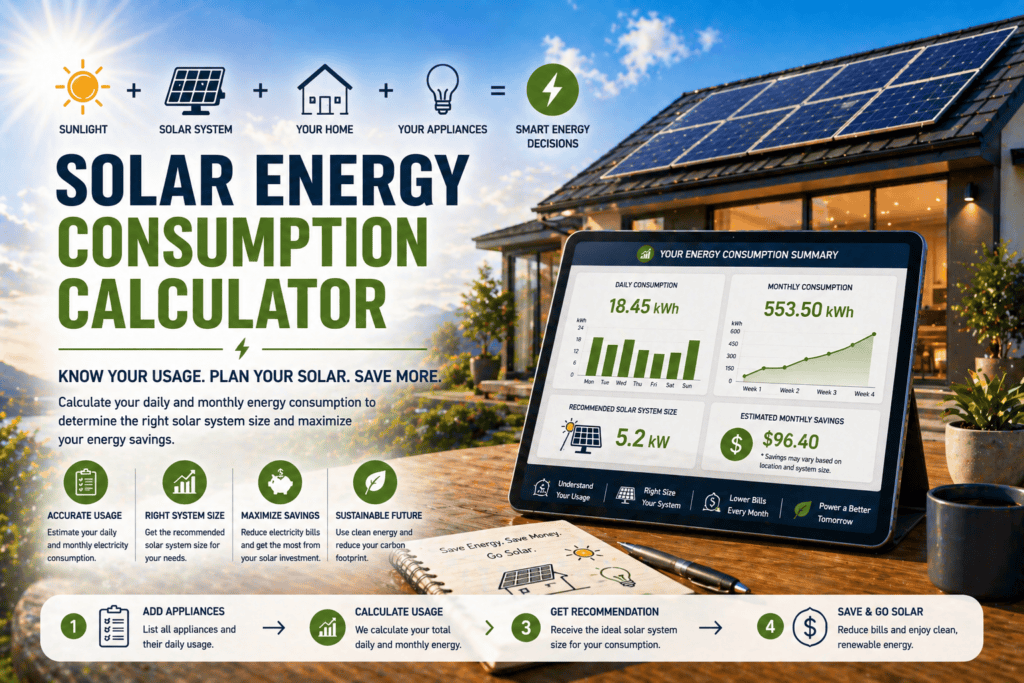
Solar Energy Consumption Calculator (Daily Power Usage & Appliance Load)
Use this Solar Energy Consumption Calculator to determine how much energy your appliances use each day and calculate your total daily power consumption in watt-hours (Wh) or kilowatt-hours (kWh). Whether you’re trying to figure out how much energy your home, cabin, RV, or off-grid system requires, this tool helps you accurately estimate your real-world electricity usage.
Knowing your daily energy consumption is the first and most important step in designing a solar system. Once you understand how much power your appliances use, you can properly size your solar panels, battery bank, and inverter to avoid underbuilding your system or wasting money on unnecessary capacity.
How the Calculation Works
Solar energy consumption is calculated by multiplying the power rating of each device in watts by the number of hours it runs each day. This gives you the daily energy use in watt-hours. Once you total all devices, you can convert that value into kilowatt-hours by dividing by 1,000.
Basic Formula:
Energy Consumption (Wh/day) = Device Watts × Hours Used Per Day × Number of Devices
In real-world solar planning, the raw device load is only part of the picture. System losses from inverter inefficiency, wiring losses, battery conversion losses, and a safety margin should also be considered. That is why advanced calculations apply efficiency adjustments so your system sizing reflects actual usable power needs instead of ideal lab conditions.
Solar Energy Consumption Calculator
Estimate daily, monthly, and yearly energy use for solar planning. Use Simple Mode for one device or Advanced Mode to build a full appliance profile with duty cycle, standby load, system losses, reserve margin, solar panel estimate, battery estimate, and planning verdict.
Simple Daily Energy Use
Use this when you only need a fast estimate for one device or one appliance type.
Simple Results
Advanced Energy Load Planner
Build a full appliance profile. Duty cycle lets you model devices that cycle on and off, such as refrigerators, freezers, pumps, fans, and compressors.
System Assumptions
Use 3–5 for many planning estimates, or local sun-hour data if known.
Advanced Results
Appliance Breakdown
Adjustment Breakdown
Continue Planning After Energy Usage Calculation
Once you calculate your daily energy consumption, the next step is sizing your battery bank, determining how many solar panels you need, confirming inverter capacity, and validating your full system design.
Battery Bank Size Calculator
Convert your daily energy usage into the correct battery storage capacity.
Solar Array Planner
Determine how many panels you need to generate enough daily energy.
Solar Inverter Size Calculator
Ensure your inverter can handle your total load requirements.
Complete Solar System Calculator
Bring your energy usage into a full system validation and planning tool.
How To Use
Use the Solar Energy Consumption Calculator to estimate how much electricity your system needs to supply each day. The simple mode is best for a fast single-device calculation, while the advanced mode is designed for a full real-world appliance load plan with customizable assumptions and detailed adjustment controls.
Simple Mode
Enter one device’s wattage, how many hours it runs each day, and how many of that device you use. The calculator will return daily, monthly, and yearly energy consumption.
Advanced Mode
Build a complete appliance profile, customize every row, model duty cycle behavior, apply system losses, and create a more accurate planning result for solar panel, battery, and inverter sizing.
Step-by-Step Instructions
1. Choose your mode.
Select Simple Mode for a quick estimate or Advanced Mode for a full customizable energy plan.
2. Enter appliance details.
In advanced mode, add each appliance you want to include. You can customize the name, watts, hours per day, quantity, and duty cycle percentage for each item.
3. Add or remove appliances as needed.
Use the Add Another Appliance button to create a fully personalized load profile. Remove rows that do not apply to your setup.
4. Adjust system assumptions.
Enter your inverter efficiency, system efficiency, safety margin, reserve percentage, peak-use buffer, standby allowance, seasonal adjustment, and simultaneous load factor to reflect how your system actually performs.
5. Review the results.
The calculator will show your raw load, adjusted daily energy demand, monthly and annual totals, appliance-by-appliance breakdown, and the final planning number you should use for system sizing.
Best Practice: In advanced mode, enter realistic values instead of ideal ones. Appliances like fridges, pumps, freezers, air conditioners, and compressors should usually use a duty cycle below 100% so your result better reflects actual daily energy use.
Did You Know
Most people underestimate their actual energy consumption by 20% to 40% because they forget standby power, inverter losses, and real-world inefficiencies.
A typical off-grid home uses anywhere from 3 kWh to 10 kWh per day, depending on appliance usage, climate, and lifestyle habits.
Devices like refrigerators, water pumps, and heaters consume power in cycles, meaning their real daily usage is often higher than their listed wattage suggests.
Adding a 15%–25% safety margin to your energy calculations helps prevent system overloads and ensures consistent performance during cloudy days or peak demand periods.
Example Calculation
Here is a realistic example showing how the Solar Energy Consumption Calculator can estimate daily energy demand for a small off-grid setup. In this example, the user wants to calculate the adjusted load for a fridge, LED lights, a laptop, and a water pump using real-world duty cycles, efficiency losses, and a safety margin.
Example Appliance Inputs
System: 85%
Safety Margin: 20%
Step-by-Step
1. Add all appliance loads together:
1,260 + 480 + 600 + 300 = 2,640 Wh/day
2. Adjust for inverter and system efficiency:
2,640 ÷ 0.90 ÷ 0.85 = 3,450.98 Wh/day
3. Add a 20% safety margin:
3,450.98 × 1.20 = 4,141.18 Wh/day
4. Convert to kilowatt-hours:
4,141.18 Wh/day ÷ 1,000 = 4.14 kWh/day
Results Interpretation
Your calculated energy consumption represents the total electricity your system must supply each day. This value is the foundation for sizing your solar panels, battery storage, and inverter capacity. The higher your daily kilowatt-hour (kWh) usage, the larger and more expensive your system will be.
Key Insight: Always design your system based on the adjusted load (after efficiency losses and safety margin), not just the raw appliance total.
If your calculated consumption is higher than expected, focus on reducing high-wattage appliances or limiting usage hours. Small adjustments—like switching to LED lighting or reducing runtime—can significantly lower system size and cost.
Expert Tips
Use duty cycle properly. High-draw appliances such as refrigerators, freezers, pumps, and air conditioners do not usually run at full power continuously. In advanced mode, adjusting duty cycle is one of the fastest ways to get a more realistic result instead of an inflated load estimate.
Do not size from raw watt-hours alone. A basic appliance total is not enough for serious planning. Always account for inverter losses, overall system efficiency, and reserve margin so your solar setup performs in real conditions rather than only on paper.
Add a standby allowance when in doubt. Routers, chargers, control boards, monitors, and idle electronics can quietly add up over a full day. If you are not tracking every background load individually, use the standby allowance field to avoid underestimating your system demand.
Use seasonal adjustment for real-world planning. Winter loads, summer cooling, and changing daylight hours can shift your energy needs significantly. A seasonal adjustment helps reflect higher-usage months so your final number is not based on an overly optimistic average day.
Build around the final adjusted kWh/day value. The most important output in advanced mode is the fully adjusted daily energy demand. That number is the one to use when sizing battery bank capacity, solar array production, backup autonomy, and inverter suitability.
Comparison Table
This table shows how different energy consumption levels typically translate into solar system scale. It helps you quickly understand whether your result points to a small backup setup, a moderate off-grid system, or a larger full-time solar installation.
Visual Insight
Your daily energy consumption directly determines how large your solar system needs to be. As your energy use increases, every component of your system must scale — including battery storage, solar panel capacity, and inverter size.
Key Takeaway: Even small increases in daily energy usage can significantly increase system size and cost. Optimizing your consumption is one of the most effective ways to reduce overall solar system requirements.
Planning Advice
Your total daily energy consumption is the single most important number when designing a solar power system. Every major component—solar panels, batteries, and inverters—must be sized based on this value to ensure consistent and reliable performance.
Start with accurate inputs. The more realistic your appliance data, the more accurate your system design will be. Use actual wattage ratings and estimate usage hours honestly instead of guessing low values.
Design for worst-case scenarios. Your system should be able to handle peak usage days, not just average conditions. Use safety margins, reserve percentages, and seasonal adjustments to prevent power shortages during heavy demand or low sunlight periods.
Balance system size and efficiency. Reducing consumption through efficient appliances and smarter usage patterns can dramatically lower system cost. Often, cutting energy use is cheaper than increasing solar capacity.
Use the final adjusted number for sizing. Always base your system design on the fully adjusted energy demand from advanced mode. This includes losses, reserve capacity, and real-world conditions, making it far more reliable than raw appliance totals.
Plan for future expansion. If you expect to add appliances later—such as air conditioning, additional lighting, or electric cooking—account for that now. Designing with expansion in mind prevents costly system upgrades down the road.
Final Strategy: Treat your calculated daily kWh value as your baseline requirement, then build your solar system with enough capacity to consistently exceed that number. This ensures reliability, system longevity, and a buffer for unexpected demand.
Key Expansion
How do I calculate my daily solar energy consumption?
To calculate your daily solar energy consumption, multiply each appliance’s wattage by the number of hours it runs per day and the quantity used. Then add all devices together to get total watt-hours per day. For more accurate results, include system losses, duty cycles, and a safety margin to reflect real-world conditions.
What is a good daily kWh usage for an off-grid solar system?
A typical off-grid solar system uses between 2 kWh and 10 kWh per day, depending on the size of the home and appliance usage. Smaller setups like cabins or RVs may use under 3 kWh per day, while full-time homes with refrigerators, pumps, and electronics often require 5 kWh or more.
Why is my solar energy usage calculation higher than expected?
Your calculation may be higher because of system inefficiencies, standby loads, or peak usage factors. Inverter losses, battery inefficiency, and real-world appliance behavior can increase total energy demand by 20% or more compared to basic calculations that only use rated wattage.
How can I reduce my solar energy consumption?
You can reduce solar energy consumption by switching to energy-efficient appliances, minimizing usage time, and eliminating unnecessary standby loads. Using LED lighting, efficient refrigeration, and optimizing appliance run times can significantly lower your daily energy demand and reduce system size.
How accurate are solar consumption calculators?
Solar consumption calculators are highly accurate when realistic inputs are used. Advanced calculators that include duty cycles, efficiency losses, reserve margins, and seasonal adjustments provide significantly more reliable estimates than simple wattage-based calculations.
Solar Energy Consumption — Common Questions
Clear answers about daily kWh use, appliance loads, duty cycle, system losses, battery sizing, and solar planning assumptions.
Solar energy consumption is the amount of electricity your appliances and devices use over time, usually measured in watt-hours or kilowatt-hours per day. For solar design, daily kWh is the key number because it determines how large your solar array and battery bank need to be.
Multiply watts by hours used per day, then divide by 1,000.
For example, a 100W device running 5 hours per day uses 500Wh, or 0.5kWh per day.
Simple mode gives a fast estimate. Advanced mode is better for real solar planning because it includes duty cycle, inverter efficiency, system losses, standby loads, reserve margin, solar panel estimate, and battery storage estimate.
Duty cycle is the percentage of time a device actually runs at its rated wattage. A fridge may be plugged in 24 hours per day but only run its compressor 30–40% of the time. Using duty cycle avoids overestimating or underestimating daily consumption.
A small cabin may use 1–2kWh per day. A modest off-grid home often uses 3–10kWh per day. A larger home with pumps, washing machines, refrigeration, air conditioning, or electric cooking can exceed 15kWh per day.
Use the final adjusted daily load from advanced mode. That number includes efficiency losses, reserve margin, standby allowance, and weather/seasonal buffer. Raw appliance totals are useful, but they are not enough for reliable solar sizing.
The biggest loads are usually air conditioners, electric heaters, water heaters, electric ovens, dryers, large pumps, and full-size refrigeration. Reducing or replacing these loads can shrink the solar array and battery bank dramatically.
Solar systems lose energy through inverter conversion, battery charge/discharge, wiring resistance, temperature, and charge controller losses. A 15–25% total loss allowance is common for planning. That means a 5kWh appliance load may require roughly 5.9–6.7kWh of solar production.
Divide your adjusted daily Wh by peak sun hours and system efficiency. For example, 5,000Wh per day ÷ 4.5 sun hours ÷ 0.80 system efficiency = about 1,389W of solar panels. With 400W panels, that rounds up to 4 panels.
Battery storage depends on daily energy use, desired backup days, and usable depth of discharge. A 5kWh/day load with 1 day of autonomy and 90% usable LiFePO4 capacity needs about 5.56kWh of nominal battery storage.
Use adjusted average daily energy for panel and battery sizing, but check peak running load and surge load for inverter sizing. Energy consumption determines how long the system runs. Peak watts determine whether the inverter can safely power everything at once.
Yes. Reducing high-draw appliances is often cheaper than buying more panels and batteries. Efficient refrigeration, LED lighting, propane cooking, solar water heating, and avoiding electric resistance heating can cut required system size dramatically.
Related Tools for Energy and System Optimization
These tools help refine production, runtime behavior, wiring, and cost planning without duplicating the main next-step links above.
Solar Panel Output Calculator
Check how much energy your solar system can realistically produce.
Solar Battery Runtime Calculator
Estimate how long your battery bank will run based on your energy usage.
Solar Wire Size Calculator
Ensure your wiring is properly sized for your system load.
Solar Panel Cost Calculator
Estimate the cost of building a system that matches your energy usage.