
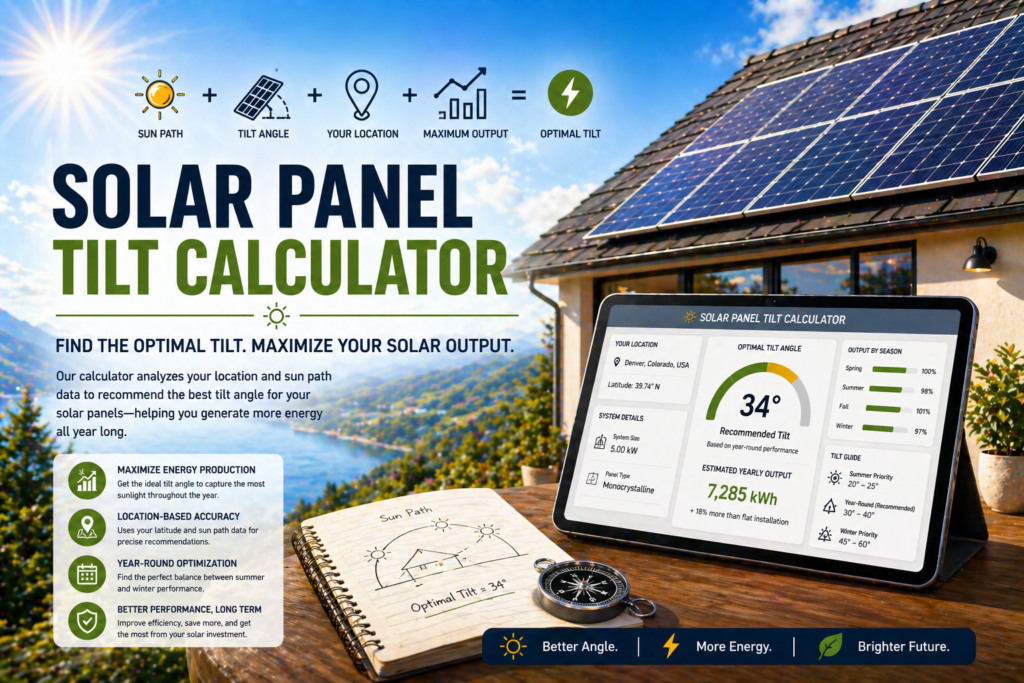
Solar Panel Tilt Calculator
The Solar Panel Tilt Calculator helps determine the ideal tilt angle for your solar panels based on your geographic location and seasonal sunlight patterns. Panel tilt plays a major role in how efficiently solar panels capture sunlight throughout the year.
When solar panels are positioned at the correct angle, they receive more direct sunlight during peak hours, which improves overall electricity production. The correct tilt angle depends largely on your latitude, the time of year, and whether the system is designed for year-round production or seasonal optimization.
This calculator estimates the recommended tilt angle for your solar array so you can maximize energy production, improve system efficiency, and get better performance from your solar panels.
What Is the Best Solar Panel Tilt Angle?
The best tilt angle for solar panels is usually close to your geographic latitude. This angle allows the panels to face the sun more directly throughout the year, maximizing solar energy production.
General rule of thumb:
Optimal Solar Panel Tilt ≈ Your Latitude
For example, if you live at a latitude of 40°, setting your solar panels at approximately a 40° tilt will usually provide strong year-round energy production.
Seasonal Adjustments (Optional)
- Winter tilt ≈ Latitude + 10–15°
- Summer tilt ≈ Latitude − 10–15°
- Year-round fixed tilt ≈ Latitude
Solar Panel Tilt Calculator
Find the best solar panel tilt angle for your location, season, and system type. Use live city search, browser location, or manual latitude to calculate annual, summer, winter, and off-grid tilt recommendations.
Location & Latitude
Search by city or adjust latitude manually.
System Type
The best tilt recommendation changes depending on whether your panels are fixed, adjustable, portable, or flat-mounted.
Recommended Tilt Results
Results update automatically as you change inputs.
Seasonal Tilt Comparison
Use this to decide whether seasonal adjustment is worth it.
| Season | Recommended Tilt | Best For |
|---|
How This Was Calculated
Annual tilt ≈ latitude. Winter tilt ≈ latitude + 15°. Summer tilt ≈ latitude – 15°.
Related Tools for Panel Layout and Performance
These tools help refine spacing, wiring, efficiency, and long-term solar value without duplicating the main next-step links above.
Solar Panel Spacing Calculator
Prevent self-shading and improve panel layout after choosing your tilt angle.
Solar Wire Size Calculator
Make sure your wiring supports the current flow from your optimized solar setup.
Solar Panel Efficiency Calculator
Estimate how panel efficiency affects the energy gain from better tilt and positioning.
Solar Payback Period Calculator
See how better solar performance may improve the financial return of your system.
How to Use the Solar Panel Tilt Calculator
This calculator helps you estimate the best solar panel tilt angle for year-round use or seasonal adjustment. To get a useful result, enter your location’s latitude as accurately as possible and use the recommendation that best matches how your solar system will be installed.
Enter Your Latitude
Start by entering your geographic latitude in degrees. This is the main number used to estimate the best fixed and seasonal solar panel tilt angles.
Review the Fixed Tilt Recommendation
The year-round fixed tilt is usually the best choice for rooftop solar systems or any installation where the panel angle will stay the same all year.
Compare Seasonal Tilt Angles
If your mounting system is adjustable, use the winter and summer tilt suggestions to improve solar production during different times of the year.
Match the Angle to Your Real Setup
Use the recommendation as a planning target, but also consider roof pitch, mounting hardware, shading, wind, and snow conditions before finalizing the installation angle.
How Solar Panel Tilt Is Calculated
Solar panel tilt is the angle between the panel surface and the ground. This angle matters because it affects how directly sunlight hits the panels throughout the day and across different seasons. When the tilt is close to the sun’s average path for your location, the panels can capture more solar energy and produce more electricity.
The most common starting point for finding the best fixed tilt angle is your geographic latitude. In many cases, setting the panel tilt close to your latitude gives strong year-round performance. From there, you can make seasonal adjustments if your goal is to increase winter production or improve summer output.
Solar Panel Tilt Formula
Year-Round Fixed Tilt ≈ Latitude
Winter Tilt ≈ Latitude + 10° to 15°
Summer Tilt ≈ Latitude − 10° to 15°
For example, if your location is at 35° latitude, a fixed tilt of about 35° is a strong general choice. If you want better winter solar production, you may increase the angle to around 45° to 50°. If you want stronger summer output, you may lower the angle to around 20° to 25°.
Key Factors That Affect the Best Tilt Angle
- Your geographic latitude
- Whether the system is fixed or adjustable
- Year-round use versus seasonal optimization
- Roof pitch or mounting structure limitations
- Snow shedding, shading, and site conditions
Understanding Your Solar Panel Tilt Results
The tilt angle shown in the calculator results represents the recommended angle between your solar panels and the ground. This angle helps your panels receive sunlight more directly throughout the day, which improves solar energy production.
Year-Round Fixed Tilt
The fixed tilt angle is the best compromise for solar production across the entire year. Most rooftop solar systems use this approach because the panels remain in the same position all year.
Winter Tilt Adjustment
Increasing the tilt angle during winter allows solar panels to capture lower sun angles. This can improve winter production when the sun sits lower on the horizon.
Summer Tilt Adjustment
Lowering the tilt angle during summer helps panels face the higher sun path more directly. This often improves energy production during long summer days.
Typical Solar Panel Tilt Ranges
- Low-latitude regions: 10° – 25° tilt
- Mid-latitude regions: 25° – 40° tilt
- Higher-latitude regions: 40° – 55° tilt
- Adjustable ground mounts may vary seasonally
Solar Panel Tilt Comparison Guide
Different solar panel tilt angles can significantly affect annual solar energy production. The table below shows how different tilt strategies are commonly used depending on installation type, climate, and system goals.
| Tilt Strategy | Typical Angle | Best For | Advantages |
|---|---|---|---|
| Latitude-Based Fixed Tilt | ≈ Latitude | Most residential systems | Simple installation and good year-round performance |
| Summer-Optimized Tilt | Latitude − 10° to 15° | Warm climates with strong summer demand | Higher summer solar production |
| Winter-Optimized Tilt | Latitude + 10° to 15° | Off-grid systems needing strong winter output | Improves solar capture when the sun is lower |
| Adjustable Seasonal Tilt | Varies seasonally | Ground-mounted solar systems | Can increase total yearly solar output |
| Roof Pitch Alignment | Matches roof slope | Most rooftop installations | Lower installation cost and easier mounting |
Why Tilt Optimization Matters
Even small tilt adjustments can improve solar energy production by helping panels face the sun more directly. While the difference may be modest for grid-tied systems, tilt optimization becomes much more important for off-grid systems where every watt of energy matters.
Did You Know?
Panel Angle Can Change Output by 10–25%
If solar panels are installed at a poor tilt angle, they can lose a significant amount of potential energy production. Proper tilt optimization can improve total annual output by 10% or more in some locations.
Latitude Is the Most Important Factor
The Earth’s curvature determines the sun’s path across the sky. Because of this, your geographic latitude is the primary factor used to estimate the ideal tilt angle for solar panels.
Adjustable Mounts Can Increase Annual Production
Some solar systems use adjustable mounting systems that allow panels to change tilt seasonally. This can increase annual solar production compared with fixed-angle installations.
Steeper Angles Help Snow Slide Off Panels
In colder climates, installing solar panels at a steeper tilt can help snow slide off the panels faster, which helps restore solar production after winter storms.
Expert Tips for Optimizing Solar Panel Tilt
While the latitude rule is a strong starting point, several practical considerations can affect the best tilt angle for your solar installation. These tips can help you fine-tune your solar panel position to maximize energy production and system reliability.
Match Tilt to Roof Pitch
Many residential systems follow the natural roof pitch instead of adjusting tilt angles. Fortunately, roof slopes often fall within a reasonable range for solar production.
Steeper Angles Help in Snowy Regions
In colder climates, steeper solar panel angles allow snow to slide off faster. This helps restore solar production more quickly after winter storms.
Avoid Very Low Angles When Possible
Extremely flat solar panels may collect dust, leaves, or debris more easily. A moderate tilt helps panels stay cleaner and maintain better efficiency over time.
Ground Mounts Allow Better Optimization
Ground-mounted solar systems often allow more flexibility for choosing the best tilt angle and orientation compared with rooftop installations.
Practical Rule of Thumb
For most residential solar systems, a fixed tilt angle close to your latitude provides strong year-round performance. Seasonal adjustments can improve production slightly, but many systems operate efficiently with a single fixed tilt angle.
Visual Insight: How Solar Panel Tilt Affects Energy Production
Solar panel tilt influences how directly sunlight reaches the panel surface. When panels are angled correctly, they receive stronger sunlight throughout the day. The illustration below shows how solar output can change when panels are installed at different tilt angles.
What This Visual Shows
Panels installed at extremely low angles may miss optimal sunlight during large parts of the year. Panels installed close to the local latitude usually deliver the best overall yearly production.
Steeper angles can be helpful in colder regions because they capture more winter sunlight and help snow slide off the panels faster.
Planning Advice for Choosing the Best Solar Panel Tilt
The best solar panel tilt angle is not always the most mathematically perfect angle. Real-world system design also depends on roof slope, mounting limitations, local weather, shading, snow conditions, and whether your goal is year-round balance or stronger seasonal performance. Good solar planning uses tilt as part of a complete system strategy, not as a stand-alone decision.
Choose a Practical Fixed Angle First
For most rooftop systems, a fixed angle close to your latitude is the best practical choice. It gives strong annual performance without adding the cost or complexity of seasonal adjustments.
Design for Winter if Energy Is Critical
If you rely on solar for off-grid living or winter backup power, a steeper tilt is often smarter. Winter is usually when sunlight is weakest, so systems should be planned around the hardest months, not the easiest ones.
Match Tilt to Total System Performance
Panel tilt affects solar production, but production still needs to match your loads and battery storage. After estimating the best angle, compare your system with the Solar Panel Output Calculator and Solar System Size Calculator.
Work With Site Limitations
The ideal calculated angle may not be possible on every roof or structure. Wind exposure, roof design, mounting hardware, and nearby obstructions can all affect the final installation angle.
Smart Next Steps
Once you estimate the best tilt angle, the next step is to confirm how that angle affects real production and total system sizing. These related tools help connect tilt planning to the rest of your solar design:
- Solar Panel Output Calculator to estimate daily energy production
- Solar Panel Angle Calculator to compare positioning and sun-facing setup considerations
- Solar Panel Production Calculator to estimate expected energy generation under real conditions
Solar Panel Tilt — Frequently Asked Questions
Practical answers on fixed tilt, seasonal adjustment, winter angle, roof pitch, RV panels, off-grid cabins, snow shedding, and how tilt affects real-world solar output.
Planning note: Tilt recommendations are estimates. Final output depends on latitude, season, azimuth, shading, roof pitch, snow, weather, and local solar resource.
1What is the best tilt angle for solar panels?+
The best fixed tilt angle is usually close to your geographic latitude. This gives a balanced year-round result for most roof, ground-mount, cabin, and RV solar systems.
2Should solar panels be tilted or flat?+
Tilted panels usually perform better than flat panels because they face the sun more directly and shed rain, dust, leaves, and snow more easily. Flat panels can work, but they often lose production and get dirty faster.
3Does solar panel tilt affect energy production?+
Yes. Tilt changes the angle at which sunlight hits the glass. A good angle increases direct sunlight capture, especially in winter when the sun is lower in the sky.
4What is the difference between tilt and azimuth?+
Tilt is the up-and-down panel angle from horizontal. Azimuth is the compass direction the panels face. Tilt controls sun height alignment; azimuth controls whether panels face south, east, west, or north.
5What tilt angle works best in winter?+
Winter tilt is usually steeper than your latitude because the sun sits lower in the sky. A common winter rule is latitude plus 10–15 degrees.
6What tilt angle works best in summer?+
Summer tilt is usually flatter than your latitude because the sun is higher in the sky. A common summer rule is latitude minus 10–15 degrees.
7Can solar panels be adjusted seasonally?+
Yes. Adjustable mounts let you set a steeper winter angle and flatter summer angle. This can improve production, but the gain must be worth the extra effort and mounting complexity.
8Is seasonal tilt adjustment worth it?+
It depends on your system. For off-grid cabins, RVs, and winter-heavy loads, seasonal adjustment can be worthwhile. For grid-tied homes, a fixed angle is often good enough because simplicity matters more.
9How do I calculate solar panel tilt from latitude?+
Use latitude as your starting point, then adjust based on season and goal. For balanced year-round output, use latitude. For winter output, go steeper. For summer output, go flatter.
10What is the best solar panel tilt in Canada or northern climates?+
Northern climates usually benefit from steeper tilt, especially for winter performance and snow shedding. If winter power matters, using latitude plus 10–15 degrees is often better than a flat or low-angle mount.
11What is the best solar panel tilt for RVs?+
For RVs, flat panels are convenient while driving and parking briefly, but adjustable tilt can improve output when camping for several days. A portable or adjustable mount is often better than permanently steep panels.
12What is the best solar panel tilt for off-grid cabins?+
For off-grid cabins, the best tilt depends on when the cabin is used. Summer cabins can use a lower angle. Year-round cabins should use latitude or slightly steeper. Winter-use cabins should prioritize a steep winter angle.
13Can solar panels be mounted vertically?+
Yes, but vertical panels produce less annual energy in most locations. They can make sense for snowy regions, walls, fences, winter-focused systems, and places where snow buildup is a bigger issue than summer production.
14Does roof pitch matter for solar panel tilt?+
Yes. Roof pitch may force the panel angle unless you use tilt racks. Many roofs are close enough for acceptable performance, but very flat or very steep roofs can reduce output depending on latitude and season.
15What happens if solar panels are tilted too steep?+
Too-steep panels may lose summer production because the sun passes high overhead. They can still perform well in winter and shed snow better, but annual output may drop if the tilt is extreme.
16What happens if solar panels are tilted too low?+
Low-tilt panels can perform well in summer but often underperform in winter. They also hold more dirt, snow, leaves, and standing water, which reduces real-world output.
17Why did changing tilt not improve output much?+
Tilt helps, but it may not fix bigger issues like shading, dirty panels, poor azimuth, heat, wiring losses, or battery/controller limits. If output barely changes after adjusting tilt, another bottleneck may be controlling the system.
18Should I tilt panels for maximum daily output or annual output?+
For a grid-tied home, annual output is usually the main goal. For off-grid systems, the best tilt should support the hardest season, often winter or cloudy months.
19Does tilt help with snow on solar panels?+
Yes. Steeper tilt helps snow slide off faster, especially on smooth glass panels. In snowy regions, a low tilt can leave panels covered for days, cutting output to nearly zero until cleared.
20How do I know if my solar panel tilt is wrong?+
Signs include weak winter output, persistent snow buildup, frequent dirty panels, lower-than-expected kWh, or strong production only during a short part of the day. Compare your setup with a tilt calculator and local sun-hour estimates.
Find the best tilt for your exact location
Estimate year-round, summer, and winter tilt angles for your solar panels.
Open the Solar Panel Tilt Calculator →