
Off Grid Living Tools · Panel comparison
Solar Panel Efficiency Calculator
Calculate one panel’s rated efficiency, or compare three panels by efficiency, estimated energy and optional price.
Separate what the module can convert at standard test conditions from the energy your system might deliver under your chosen sunlight and loss assumptions.
Open the calculator ↓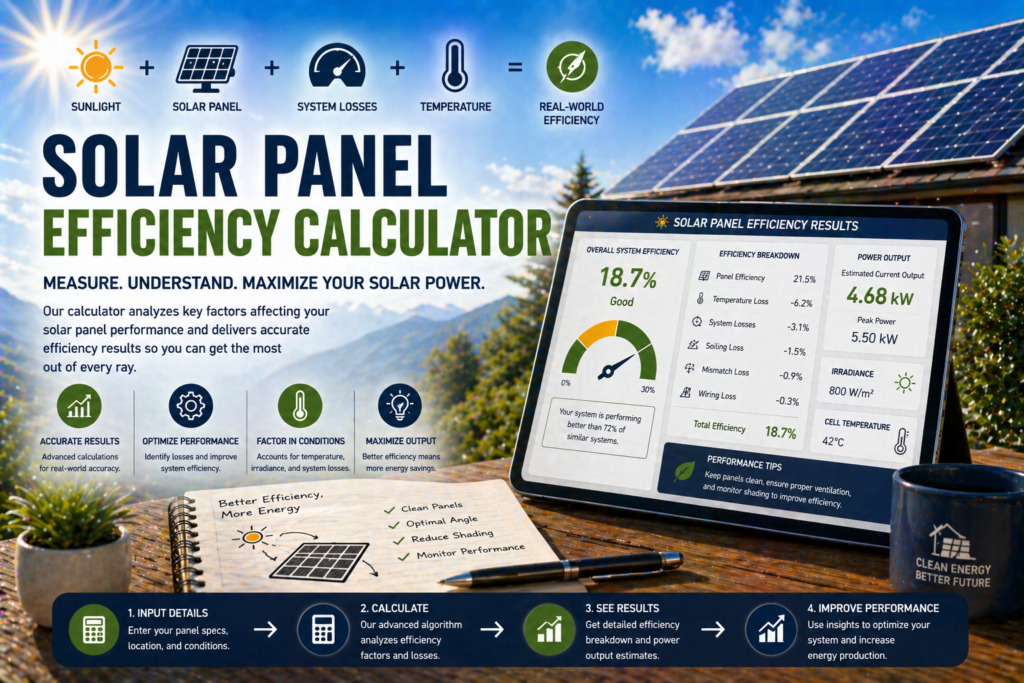
Three different measurements
Efficiency is only part of the comparison
Rated efficiency
How much incident sunlight power the panel converts under STC. Calculated from its rated watts and total panel area.
Loss assumptions
Temperature, electrical delivery, and shade/dirt/snow factors reduce modeled output. They do not change the panel’s STC rating.
Daily energy
Whole-panel count, rated power, losses and peak sun hours determine the energy comparison. The highest-efficiency panel is not always the cheapest choice.
Solar Panel Efficiency Calculator
Compare rated STC panel efficiency, estimated delivered energy, mounting area and optional panel prices. Peak sun hours are user-entered or approximate, not live solar data.
Calculate one panel’s rated efficiency
Enter the panel’s STC rated power and its full external dimensions. This calculates module efficiency only, without making assumptions about sunshine, shade, losses, or installation area.
Uses 1,000 W/m² STC irradiance. Enter physical panel dimensions, including the frame. It is not a field measurement or a prediction of daily energy.
Sunlight & mounting area
The default peak sun hours are illustrative. Optional latitude estimates are rough placeholders, not live irradiance data. Enter verified local values for planning.
Delivery-loss assumptions
Compare three panel options
| Panel | Watts | Area m² | Price |
|---|---|---|---|
| Panel A | |||
| Panel B | |||
| Panel C |
Helpful equipment
Solar Panels to Compare
Use the calculator to compare rated power and area. These example listings are not automatically matched to your results. Check the latest panel dimensions, test conditions and mounting specifications before purchasing.
Renogy 100W N-Type Solar Panel
Compare module dimensions and rated efficiency with the calculator.
Click for the latest price.Jackery SolarSaga 100 Prime Bifacial
Compare rigid bifacial panel design, rated efficiency and physical dimensions.
Click for the latest price.Renogy 100W Flexible Solar Panel
Compare rated power and area for flexible mounting applications.
Click for the latest price.Jackery SolarSaga 100W Light
Compare a lightweight flexible panel with other 100W options; check connectors and mounting compatibility.
Click for the latest price.As an Amazon Associate I earn from qualifying purchases.
How to use this calculator
Two modes: single-panel efficiency or three-panel comparison
Simple Mode: Enter one panel’s rated STC watts, full length and width in metres. Read its efficiency and power density. No sunlight or system-loss assumptions are needed.
Advanced Mode: Compare three different panels using the steps below.
- Set peak sun hours and available area. Use location- and season-specific peak sun hours, not daylight hours. The optional coordinate-based suggestion is only a rough latitude-band placeholder; it is not live solar data.
- Enter delivery losses once. Use percentages for temperature, electrical delivery, and shade/dirt/snow. Avoid putting the same loss in two categories.
- Add each panel’s rated watts and total area. Area is length × width in metres, including the module’s overall dimensions. This tool uses a fixed STC irradiance of 1,000 W/m²; there is no irradiance input.
- Add an optional price per panel. Keep the same dollar currency for all three choices. Leave price blank if unknown; zero means a known zero price.
- Read the full-array comparison. The highlighted option has the highest modeled daily energy for the available area. Review panel count, efficiency and price separately before making a decision.
The calculation
Keep power, energy and efficiency separate
| Output | Formula or meaning |
|---|---|
| Combined derating factor | (1 − temperature loss) × (1 − electrical loss) × (1 − shade/dirt/snow loss) |
| Whole panels that fit | Round down: available area ÷ area per panel |
| Modeled delivered W per panel | Rated W × combined derating factor; a simplified value at STC irradiance |
| Daily delivered kWh | Rated W × whole-panel count × peak sun hours × derating factor ÷ 1,000 |
| Price per delivered W | Price per panel ÷ modeled delivered W per panel; not lifetime cost per kWh |
Reproducible example
A 400 W panel is 20% efficient at 2 m²
To reproduce this scenario, set all three options to 400 W, 2 m² and $300 per panel. Enter 20 m² available area, 4 peak sun hours, and losses of 10%, 5%, and 0%. These are illustrative inputs, not equipment recommendations.
20.00%
400 ÷ (2 × 1,000) × 100
85.5%
0.90 × 0.95 × 1.00 = 0.855
13.68 kWh/day
10 panels × 400 W × 4 h × 0.855 ÷ 1,000
The model gives 342 delivered W per panel. At $300 per panel, the comparison is approximately $0.88 per delivered W. Total panel purchase cost would be $3,000; installation and other equipment are excluded. Identical options tie, so the first option may remain highlighted.
Interpret the result before choosing a panel
Higher output for the entered area is the ranking criterion—not lowest installed cost, verified compatibility, or guaranteed annual yield. Changing area can change the winner because the tool rounds down to complete panels.
Panel efficiency is calculated under the fixed STC convention. Delivered energy is a simplified scenario using constant loss assumptions and daily peak sun hours. Actual temperature, shade, orientation, inverter/controller behavior and seasonal resource vary.
Questions & assumptions
Solar panel efficiency, explained
What does panel efficiency mean?
Rated module efficiency is the fraction of incident sunlight power converted to rated electrical power under standard test conditions. This tool uses rated watts ÷ (panel area × 1,000 W/m²) × 100. It does not measure your installed panel.
Are module efficiency and system losses the same thing?
No. Module STC efficiency comes from rated watts and area. The separate loss inputs reduce the modeled delivered power and energy. Changing a loss assumption does not change the module’s rated STC efficiency.
Should I use rated watts or measured output?
Use the rated STC wattage from the module specification sheet for the efficiency comparison. An instantaneous measured output taken under different irradiance and temperature is not directly comparable with a rated STC value.
Does location fetch live solar data?
No. Filling coordinates only supplies latitude and longitude. The optional sun-hour suggestion uses a broad latitude band; it ignores longitude, weather, shading and season. Enter verified local, season-specific peak sun hours for an energy scenario.
How is the recommended panel selected?
The tool ranks options by modeled daily delivered energy from whole panels that fit by total area. For an output tie, known total panel purchase cost is compared, followed by rated efficiency. It does not optimize installation cost or physical roof layout.
What if no panels fit?
If the available area is smaller than each panel’s area, no complete panel fits. Increase the available area or enter smaller panel options. The area calculation does not account for rectangular packing, access, setbacks or row spacing.
What does the price comparison include?
Enter price per individual panel using the same dollar currency for all options. The table shows price divided by modeled delivered watts per panel. It excludes mounting, wiring, inverter, installation, shipping, maintenance and financing; it is not a cost per kWh.
Can these results size my whole solar system?
No. This is a panel comparison under entered assumptions. Daily loads, seasonal production, battery autonomy, inverter power, electrical compatibility and installation requirements need separate checks.
Continue planning
Take the next step with your results
Estimate panel output →
Explore a separate production scenario using array watts, sunlight and losses.
Size an array →
Start with daily energy demand to estimate required panel capacity.
Compare system cost →
Move beyond panel prices to a wider cost scenario.
Review the calculator methodology and limitations. These tools support planning; they do not approve installation designs.
Technical reference
Panel efficiency is a laboratory rating, while real production also changes with irradiance, temperature and installation conditions. See the U.S. Department of Energy’s solar photovoltaic performance and efficiency guide. Use the manufacturer datasheet for your panel’s actual rating.