
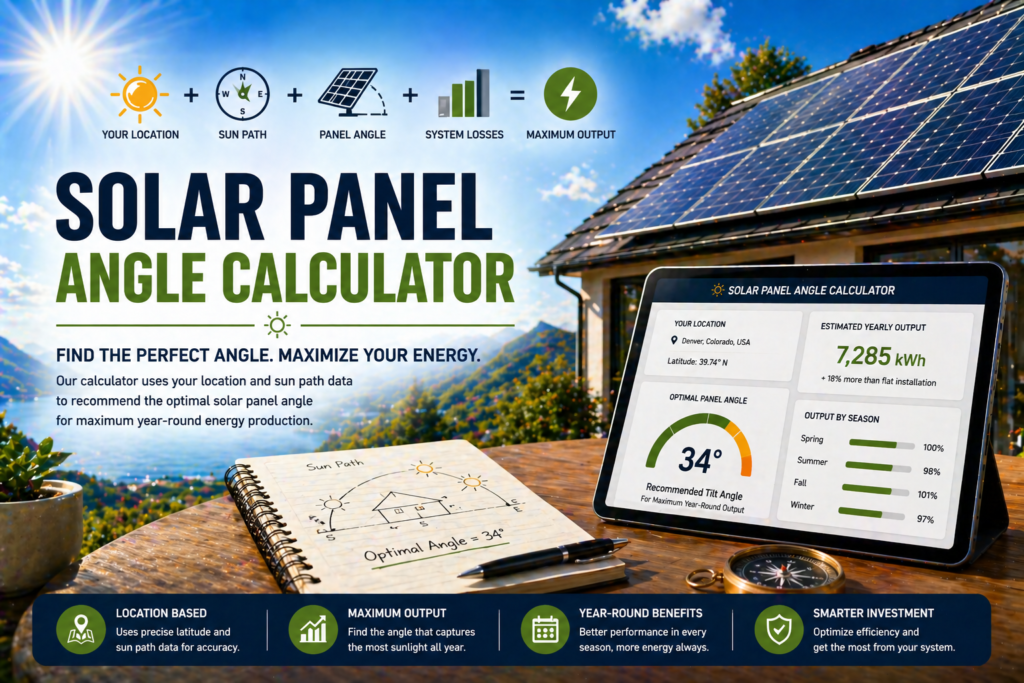
Solar Panel Angle Calculator: Tilt & Direction by Latitude
Use this free solar panel angle calculator to find a starting tilt angle from your latitude and compare the direction your panels face. It also works as a solar panel tilt angle calculator for fixed roof and ground-mounted arrays. Enter a city or latitude, choose your hemisphere, then switch to Advanced Mode to compare your current tilt and compass direction (azimuth).
Solar panel tilt is measured upward from horizontal (0° flat, 90° vertical). Azimuth is measured clockwise from true north: 0° north, 90° east, 180° south and 270° west. Tilt and direction affect sunlight received, but this calculator does not determine a site-specific optimum or quantify kWh gains; use local solar-resource modeling for those decisions.
For a simple starting point, use a tilt near your absolute latitude and face generally toward the equator, subject to practical roof orientation and shading. Seasonal production, local weather, horizon shading and equipment specifications can change the best actual angle. The result is a positioning reference, not an engineering or annual production guarantee.
What Is the Best Angle for Solar Panels?
The best angle for solar panels usually combines the correct tilt angle and the correct direction. A useful fixed-tilt starting point is latitude magnitude, with a reference direction toward the equator (180° true azimuth north of the equator, or 0° south of it). The best practical setup depends on season, climate and obstructions, particularly near the equator.
General rule of thumb:
Panel positioning = Tilt (0°–90°) + True azimuth (0°–360°)
For example, if your home is in the Northern Hemisphere at 35° latitude, a good starting point is a panel tilt of about 35° facing true south. This is a preliminary planning reference, not a site-specific production optimum.
Biggest factors that affect solar panel angle
- Your geographic latitude
- Whether panels face south, north, east, or west
- Roof slope and installation limits
- Year-round use versus seasonal optimization
- Shading, nearby obstacles, and local site conditions
Distinct from the Solar Panel Tilt Calculator: this tool compares the true compass azimuth of your panels and your current tilt with reference orientation. Differences are in degrees, not predicted energy loss. Near the equator, the preferred facing direction can change by season.
Solar Panel Angle Calculator
Estimate latitude-based tilt, direction, and seasonal settings for your solar panel setup.
Set your latitude to see reference tilt angles and panel direction.
Tools and Mounts for Setting Your Solar Panel Angle
Use your calculator result as a starting point, then compare compatible mounting hardware and angle-measuring tools to put that result into practice.
Renogy 28-Inch Adjustable Solar Panel Tilt Mount Brackets Best match
Adjustable mounting brackets for setting compatible solar panels to a chosen tilt angle on RVs, cabins and small off-grid systems. Verify panel dimensions, mounting surfaces and wind-load requirements.
Click for the latest price.Klein Tools 935DAG Digital Electronic Level and Angle Gauge
Magnetic digital angle gauge for measuring panel tilt and checking bracket alignment during installation. Suitable for verifying the angle calculated above.
Click for the latest price.BougeRV Solar Panel Mounting Z Brackets
Four-piece fixed mounting bracket set for compatible solar panel frames. Useful for mounting panels, but these brackets do not provide seasonal tilt adjustment.
Click for the latest price.GemRed 82305 Digital Angle Finder Protractor, 7-Inch
Digital angle finder for measuring and checking bracket angles and installation surfaces. A practical alternative to a magnetic inclinometer.
Click for the latest price.As an Amazon Associate I earn from qualifying purchases. Check product compatibility and installation safety against manufacturer specifications; prices and availability may change.
Continue Planning After Comparing Panel Angles
Use these latitude-based angle references alongside a separate energy estimate, array sizing check and full solar system design.
Solar Panel Tilt Calculator
Compare latitude-based annual and seasonal tilt candidates.
Solar Panel Output Calculator
Estimate daily energy from rated watts, peak sun hours and explicit loss assumptions.
Solar Array Planner
Estimate panel count from daily electricity use and sunlight assumptions.
Off-Grid Solar System Size Calculator
Validate panel positioning within your complete off-grid system.
How to Use the Solar Panel Angle Calculator
This calculator compares latitude-based tilt candidates and an equator-facing reference direction. It does not optimize energy production for your site. To get the most useful result, enter your latitude accurately and select the correct hemisphere for your location.
Enter Your Latitude
Start by entering your geographic latitude in degrees. Latitude provides a fixed-tilt starting point; local weather, shade and mounting constraints may favor another angle.
Choose the Correct Hemisphere
Select whether your location is in the Northern or Southern Hemisphere. This sets an equator-facing reference: true south in the Northern Hemisphere or true north in the Southern Hemisphere. Site conditions may favor another direction.
Review the Fixed Position Recommendation
The calculator shows latitude-based annual and seasonal tilt candidates and a reference direction. Check local resource data, shade, roof limits and mounting requirements before choosing a position.
Compare Seasonal Adjustments
If your mounting system can be adjusted, use the winter and summer tilt suggestions to improve seasonal performance and capture sunlight more effectively during different times of the year.
Understanding Your Solar Panel Angle Results
The results from the Solar Panel Angle Calculator provide guidance on how to position your solar panels for strong energy production throughout the year. The calculation uses latitude and hemisphere to provide reference angles. It does not determine an energy-maximizing tilt or direction.
Annual Tilt Candidate
The annual tilt candidate equals latitude magnitude. This heuristic does not establish the best annual energy yield. Most residential rooftop systems use a fixed tilt because adjusting panels seasonally can add complexity and cost.
Reference Direction
An equator-facing array uses true south as its Northern Hemisphere reference and true north as its Southern Hemisphere reference. Weather, shade, terrain and the timing of demand can favor other directions.
Seasonal Tilt Adjustments
Adjusting panel tilt seasonally can increase solar production. A steeper tilt improves winter sunlight capture, while a lower tilt angle can improve summer performance when the sun is higher in the sky.
Typical Solar Panel Positioning
- Annual tilt candidate ≈ local latitude
- Reference direction (Northern Hemisphere) = True South
- Reference direction (Southern Hemisphere) = True North
- Winter tilt ≈ latitude + 10–15°
- Summer tilt ≈ latitude − 10–15°
How Solar Panel Angle Is Calculated
Solar panel angle refers to the overall positioning of solar panels relative to the sun. It combines two main factors: the tilt angle of the panel and the direction the panel faces, known as the azimuth angle. Together, these determine how directly sunlight strikes the panel surface throughout the day and across different seasons.
Latitude magnitude and an equator-facing direction are starting references. This calculator does not model local weather, shading, hourly demand or yearly energy, so it cannot select the highest-yield position.
Solar Panel Angle Formula
Tilt Candidate ≈ Latitude
Reference Direction (Northern Hemisphere) = True South
Reference Direction (Southern Hemisphere) = True North
For example, 30° latitude in the Northern Hemisphere gives a 30° annual tilt candidate and a true-south reference direction. These values describe the heuristic, not a predicted optimum or energy yield.
Key Factors That Affect Solar Panel Angle
- Your geographic latitude
- Compass direction of the solar array
- Roof orientation and mounting limitations
- Seasonal sun movement across the sky
- Shading from nearby buildings or trees
Example Solar Panel Angle Calculation
The solar panel angle calculator provides latitude-based tilt candidates and a hemisphere-based reference direction. The example below demonstrates how the recommended tilt angle and direction are calculated for a typical solar installation.
Example Location
- Latitude: 35°
- Hemisphere: Northern Hemisphere
- Solar installation: Fixed rooftop solar system
Step-by-Step Calculation
1. Determine your latitude:
Latitude = 35°
2. Calculate the annual tilt candidate:
Tilt candidate ≈ 35°
3. Identify the reference direction:
Reference Direction = True South
4. Optional seasonal tilt adjustment:
Winter Tilt ≈ 50°
Summer Tilt ≈ 20°
Final Recommended Panel Position
For this example location, the recommended solar panel position would be:
- Panel Tilt: 35°
- Panel Direction: True South
- Winter Tilt (optional): 50°
- Summer Tilt (optional): 20°
Most residential systems use a fixed tilt close to the local latitude, which delivers strong year-round solar performance without needing seasonal adjustments.
Did You Know?
South-Facing Panels Produce the Most Power
In the Northern Hemisphere, solar panels that face true south generally receive the most direct sunlight throughout the day, which leads to higher overall energy production.
East and West Panels Still Work Well
Panels facing east or west can still produce strong solar energy, although they usually generate slightly less electricity than south-facing installations.
Angle Adjustments Can Improve Solar Output
Even small improvements in solar panel positioning can increase energy production. A properly aligned solar array can produce noticeably more electricity than poorly positioned panels.
Solar Tracking Systems Follow the Sun
Advanced solar installations sometimes use tracking systems that move panels throughout the day to follow the sun. These systems can significantly increase energy production compared with fixed panels.
Expert Tips for Setting the Best Solar Panel Angle
The best solar panel angle is not just about the math. Real-world solar performance also depends on roof direction, shade patterns, weather, seasonal sunlight, and installation limitations. These practical tips will help you make better decisions when positioning a solar array.
Prioritize Direction First
Evaluate tilt and direction together using site-specific sunlight and shade data. This calculator does not rank their energy impacts or predict production.
Work With Your Roof, Not Against It
If your roof already has a reasonable slope and a decent orientation, it may not be worth adding expensive mounting changes just to gain a small increase in solar production.
Design for Winter When Solar Is Critical
If your system is meant for off-grid use or reliable backup power, optimize around weaker winter sunlight instead of ideal summer conditions. That usually means a steeper angle and more conservative planning.
Do Not Ignore Shade
A well-calculated angle will not fix poor placement. Trees, chimneys, nearby buildings, and roof obstructions can reduce output more than a slightly imperfect tilt or direction.
Practical Rule of Thumb
Use latitude and the equator-facing reference as initial candidates. Compare site-specific production, roof constraints, access and installation cost before selecting a design.
Illustration: Tilt Angle Candidates (Not Energy Data)
Solar panel tilt influences how directly sunlight reaches the panel surface. When panels are angled correctly, they receive stronger sunlight throughout the day. The bars below are decorative and do not represent energy output, efficiency, or measured comparisons.
What This Visual Shows
Low-tilt suitability depends on local resource, shade, soiling, drainage and mounting requirements. A latitude-based candidate alone does not establish annual production.
Winter tilt, snow shedding, wind loading and safe mounting must be assessed for the actual site and equipment; none are determined from this illustration.
Solar Panel Angle Comparison
Different solar panel angles affect how efficiently a system captures sunlight during the day and across the seasons. The comparison below shows how common solar panel positioning strategies influence overall solar performance.
| Solar Panel Setup | Typical Angle | Reference Direction | Performance Notes |
|---|---|---|---|
| Latitude-Based Installation | ≈ Local Latitude | South (North Hemisphere) | Annual reference candidate; verify local production |
| Summer-Optimized Panels | Latitude − 10° to 15° | South | Summer reference candidate; energy gain not calculated |
| Winter-Optimized Panels | Latitude + 10° to 15° | South | Winter reference candidate; energy gain not calculated |
| Roof Pitch Installation | Matches roof slope | Depends on roof direction | Most common residential installation |
| Solar Tracking System | Changes during the day | Follows the sun | Potential production gains depend on site, equipment and tracking design |
Why Angle Matters
Solar panel angle affects how directly sunlight strikes the panel surface. Panels that face the sun more directly throughout the day can convert more solar radiation into electricity, improving the overall efficiency of a solar power system.
Planning Advice for Choosing the Best Solar Panel Angle
The best solar panel angle is the one that gives strong real-world performance for your specific site, not just the one that looks best in a formula. Roof direction, latitude, seasonal sun changes, shading, snow, and mounting limits all affect how well a solar array performs. Smart planning means balancing ideal positioning with practical installation realities.
Optimize Direction Before Chasing Perfect Tilt
Compare direction and tilt using location-specific resource and shade data. Neither the relative energy penalty nor an optimum is calculated here.
Match the Angle to Your Energy Goal
If you want the strongest year-round performance, use a fixed angle close to your latitude. If winter energy is more important, choose a steeper angle. If summer production matters more, a lower angle may make more sense.
Plan Around the Whole Solar System
Panel angle affects output, but output still needs to match your loads and storage. After comparing reference angles, compare the result with the Solar Panel Output Calculator and Solar Battery Size Calculator to build a balanced system.
Respect Site Limitations
Roof pitch, structural constraints, wind exposure, nearby trees, and obstructions can limit the angle you can actually use. A slightly imperfect but practical installation is better than forcing a design that is expensive, unsafe, or hard to maintain.
Smart Next Steps
Once you compare panel-angle candidates, the next step is to confirm how that position affects production, system sizing, and overall energy planning. These related tools help connect panel positioning to the rest of your solar design:
- Solar Panel Tilt Calculator to compare annual and seasonal tilt candidates
- Solar Panel Output Calculator to estimate daily energy production
- Solar Panel Output Calculator to compare another production scenario
Solar Panel Angle — Frequently Asked Questions
Practical answers on solar panel angle, tilt, azimuth, true south, seasonal adjustment, flat roofs, RVs, off-grid cabins, and how angle affects real-world solar production.
Planning note: Solar angle recommendations are estimates. Final output depends on latitude, roof pitch, azimuth, shading, weather, temperature, panel type, wiring losses, and local solar resource.
1What is the best angle for solar panels?+
Start with latitude magnitude as an annual tilt candidate and an equator-facing reference direction. The best site-specific position depends on weather, shade, demand timing and mounting constraints; this calculator does not optimize energy yield.
2What is the difference between solar panel angle and solar panel tilt?+
People often use these terms interchangeably, but they are not exactly the same. Tilt is the vertical angle from flat ground. Panel angle can also include direction, also called azimuth. A good solar setup needs both the right tilt and the right direction.
3Does solar panel angle affect electricity production?+
Yes. Solar panels produce the most power when sunlight hits the panel surface directly. If the angle is too flat, too steep, or facing the wrong direction, the panel captures less sunlight and produces less electricity.
4Can solar panels still work if the angle is not perfect?+
Panels can operate away from the reference angles. This calculator reports angular differences only; it cannot predict the production impact or decide whether a roof change is worthwhile. Compare site-specific resource and shade data.
5Should solar panels face south?+
True south is the equator-facing reference in the Northern Hemisphere; true north is the reference in the Southern Hemisphere. Close to the equator, compare orientations seasonally. Shade, weather and the timing of demand can favor other directions.
6Can solar panels work if they face east or west?+
East- and west-facing arrays can be useful when their generation timing matches demand. Total energy and timing depend on the site. Compare location-specific production rather than assuming that the equator-facing reference always performs best.
7How much production do east or west-facing solar panels lose?+
The calculator cannot quantify this loss. A suitable production model needs location, weather, tilt, orientation, shade and equipment assumptions. The direction difference displayed here is an angle, not an energy penalty.
8What is true south or true north for solar panels?+
True south and true north are based on Earth’s geographic poles, not magnetic compass direction. A phone compass may show magnetic direction, so local magnetic declination can matter if you are trying to align panels accurately.
9Do solar panels need to be adjusted seasonally?+
Most systems do not need seasonal adjustment. Fixed panels are simpler, cheaper, and reliable. Adjustable mounts can improve output if you use the system off-grid, rely on winter power, or can easily change the angle a few times per year.
10What angle is best for solar panels in winter?+
This tool uses min(90°, round(latitude magnitude + 15°)) as a winter tilt candidate. It is a heuristic, not a date-specific optimum or a snow-shedding, structural or wind-load approval.
11What angle is best for solar panels in summer?+
This tool uses max(0°, round(latitude magnitude − 15°)) as a summer tilt candidate. Local weather, shade and demand can favor a different setting.
12Is seasonal adjustment worth the effort?+
The benefit and effort depend on local production, mounting access, hardware and the timing of demand. The calculator does not calculate an energy gain, cost saving or reliability improvement from adjustment.
13What is the best solar panel angle for a flat roof?+
Flat roof panels can work, but a slight tilt is usually better for production, water runoff, and self-cleaning. If possible, use tilt racking to angle panels toward the sun and reduce dirt buildup.
14What is the best solar panel angle for an RV?+
For RVs, flat panels are convenient while driving and parking temporarily. If you camp in one location for several days, adjustable tilt can improve output, especially in winter or northern locations.
15What is the best solar panel angle for an off-grid cabin?+
For an off-grid cabin, the best angle should match the season when power is most critical. A summer cabin can use a lower angle. A year-round or winter cabin should use latitude or a steeper winter-biased angle.
16Should I change my roof angle to improve solar output?+
The calculator cannot recommend rebuilding a roof or estimate its benefit. Compare site-specific production and installation constraints with qualified design advice before changing a structure or mounting system.
17How do I know if my solar panel angle is bad?+
Lower-than-expected output can have many causes, including shade, weather, equipment and mounting. This calculator compares reference angles only; it does not diagnose a fault or estimate the energy loss.
18What matters more: solar panel angle or shading?+
Their relative effects depend on the actual shade pattern, resource, orientation and electrical configuration. This calculator models neither shading losses nor angle-related energy losses, so it cannot rank them for your site.
19Should I add more panels or fix the angle first?+
Compare measured demand and production, resource, shading, mounting constraints, component ratings and cost. This angle calculator cannot choose an expansion or establish electrical compatibility.
20What should I do after finding my best panel angle?+
Treat the output as a reference candidate. Check site-specific production, shading, seasonal resource, mounting safety and equipment compatibility, then compare generation with loads and storage.
Estimate a latitude-based panel angle
Compare latitude-based tilt candidates, reference direction and angular differences. Energy loss, weather and site-specific optimization are not calculated.
Open the Solar Panel Angle Calculator →Solar Panel Tilt and Direction: Sources & Limitations
Latitude-based tilt is a practical starting estimate, not a calculation of the highest-yield angle. The calculator compares angular positions, while actual energy production depends on site-specific solar resources, shading, climate, mounting geometry and equipment.
- PVWatts solar production model — for location-specific simulations using tilt and azimuth.
- NOAA Solar Calculator — for checking solar position and compass azimuth.
- Our calculator methodology and limitations — for interpreting planning estimates.
Before installing panels: verify roof loading, wind requirements, safe mounting, electrical design and local permitting with qualified professionals.
Related Tools for Panel Layout and System Performance
These tools help refine spacing, wiring, efficiency, and financial outcomes without duplicating the main next-step links above.
Solar Panel Spacing Calculator
Compare preliminary row spacing using panel tilt and winter sunlight geometry.
Solar Wire Size Calculator
Estimate cable size and voltage drop under stated conditions.
Solar Panel Efficiency Calculator
Understand how panel efficiency impacts performance from positioning improvements.
Solar Payback Period Calculator
Estimate how improved panel performance affects your return on investment.