
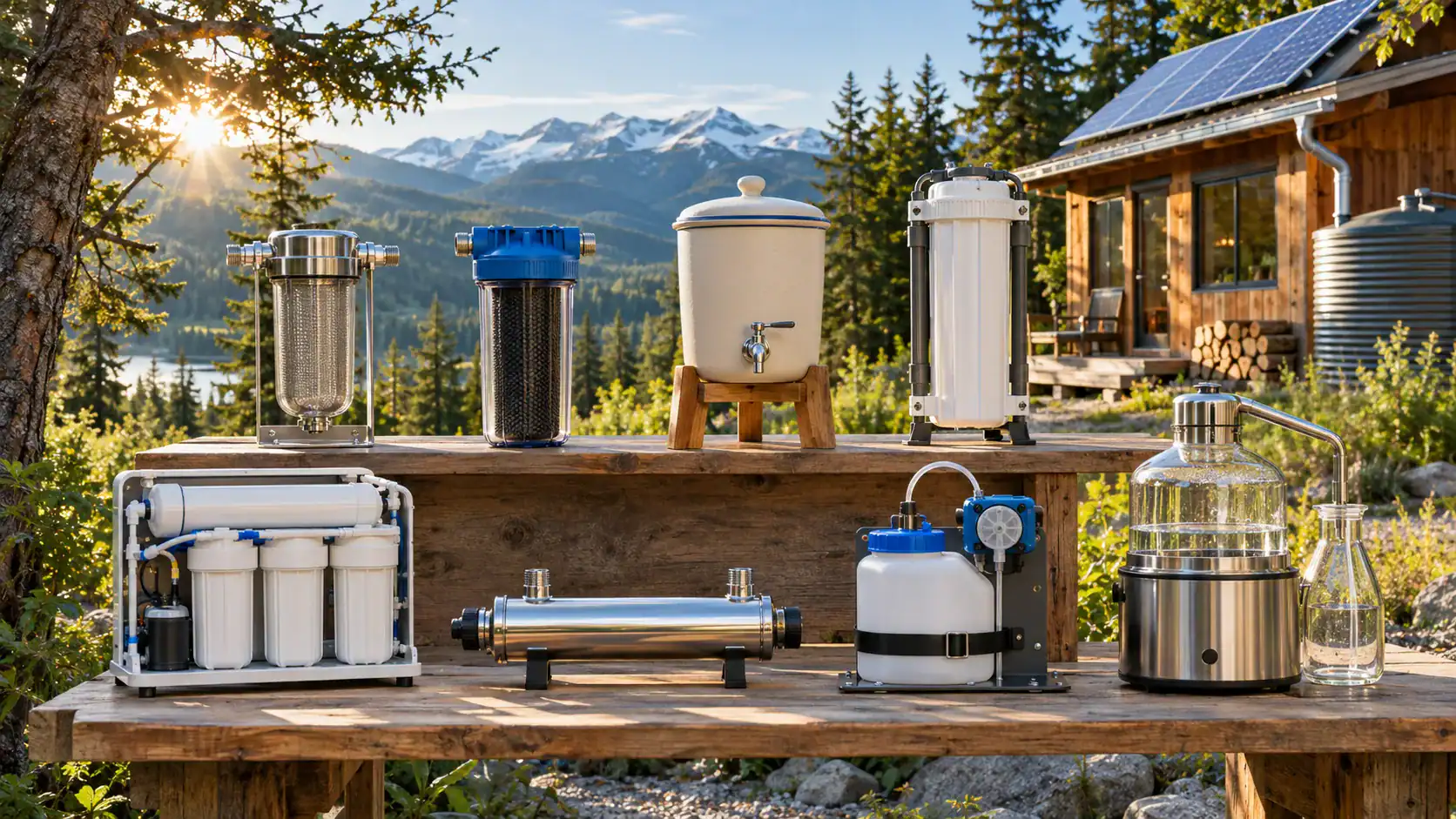
Water Treatment Comparison Tool
Compare eight methods for your water source, daily demand, operating costs and energy needs. Start in Simple mode, or enter product specifications in Advanced mode.
Quick answer
Match treatment to tested contaminants first, then compare capacity, maintenance and cost. Sediment filters address particles; carbon targets taste and selected chemicals; membranes, UV and chlorine have different limits. Multiple compatible barriers may be needed.
This tool never declares water safe to drink. Untested water remains unverified. Use a certified laboratory, product-specific contaminant reduction claims and qualified treatment design. Follow official advisories; suspected fuel, toxic chemical or flood contamination needs local authority advice and an alternative safe supply. Clear water and good taste do not prove safety.
Compare your treatment options
Choose your concerns, then select Compare methods.
Understand all eight methods
1. Sediment filtration
Pretreatment only. Does not establish microbial or dissolved chemical removal. Change cartridges at pressure drop or rated capacity.
Technology to investigate for: Sediment / cloudiness. These are conditional categories, not verified claims for a specific product.
2. Activated carbon
Taste and chlorine reduction; selected organic chemicals only with specific certified claims. Not a disinfectant; ordinary carbon does not remove salts or nitrate. Replace before breakthrough.
Technology to investigate for: Taste / chlorine odor, Organic chemicals / solvents / pesticides. These are conditional categories, not verified claims for a specific product.
3. Ceramic / microfiltration
Protozoa reduction depends on absolute pore rating and integrity. Bacterial reduction is product-dependent; generally no virus or dissolved chemical barrier. Clean and integrity-check as instructed.
Technology to investigate for: Sediment / cloudiness, Protozoa (including Cryptosporidium). These are conditional categories, not verified claims for a specific product.
4. Ultrafiltration
Bacteria and protozoa candidate with verified membrane performance. Virus removal varies; no generic dissolved chemical claim. Backwash and integrity-check.
Technology to investigate for: Sediment / cloudiness, Bacteria, Protozoa (including Cryptosporidium). These are conditional categories, not verified claims for a specific product.
5. Reverse osmosis
Contaminant-specific certified claims required. Household units are not assumed to be microbiological purifiers. Needs pressure, pretreatment, drain and storage hygiene; seawater needs a purpose-built desalination system. Replace membranes and prefilters.
Technology to investigate for: Salinity / dissolved salts, Nitrate, Lead / arsenic / other metals. These are conditional categories, not verified claims for a specific product.
6. Ultraviolet disinfection
Validated dose, maximum flow, UV transmittance and clear prefiltered water required. Check NSF/ANSI 55 Class A suitability; Class B is supplemental. No chemicals removed or downstream residual. Replace lamp and clean sleeve.
Technology to investigate for: Bacteria, Viruses, Protozoa (including Cryptosporidium). These are conditional categories, not verified claims for a specific product.
7. Chlorine disinfection
Site-specific dose, residual, pH, temperature and effective contact time required. Cryptosporidium is highly chlorine-resistant; Giardia needs validated conditions. No dissolved chemical removal. Monitor residual, replenish chemical and service dosing equipment.
Technology to investigate for: Bacteria, Viruses. These are conditional categories, not verified claims for a specific product.
8. Distillation
Some volatile chemicals and solvents carry over. Requires validated operation, cooling-path hygiene and protected storage. Slow and energy-intensive; clean scale and service seals.
Technology to investigate for: Salinity / dissolved salts, Nitrate, Lead / arsenic / other metals, Bacteria, Viruses, Protozoa (including Cryptosporidium). These are conditional categories, not verified claims for a specific product.
How the comparison works
Candidate order reflects only the number of selected concerns with a conditional technology match. Unmatched technologies are excluded from that shortlist. No drinking-water safety score is calculated. A candidate with gaps is not a complete treatment plan.
Source affects the investigation checklist, not assumed removal performance. Rainwater can carry roof contaminants and microbes; surface water varies with runoff and blooms; wells need local microbial and chemical testing. Municipal users should review the utility report, plumbing risks and active advisories. An unknown source cannot be characterized here.
Daily capacity = product flow × 60 × production hours. Delivered volume = smaller of capacity and demand. Annual operating cost = annual service + scheduled changes × 12 / interval months + annual electricity + annual feed water. Electricity = load in kW × powered hours × 365; power remains on for those hours even if production is lower. RO feed volume = product volume / recovery fraction; reject volume is feed minus product. Other water losses must be entered through measured recovery.
Lifecycle cost = initial installation + operating cost × years + equipment replacements strictly before the horizon. Scheduled consumable costs are annualized; equipment replacements retain the same cost. Cost per volume uses actual delivered volume over each horizon, not nameplate capacity. This is an undiscounted constant-cost model: no inflation, finance, tax, salvage, embodied energy or downtime is modeled. Add laboratory testing, storage, pretreatment, pumping and disposal costs to your estimates.
Continuous flow, pressure and peak demand need separate design checks. Chlorine output assumes already validated dosing and contact storage; this tool gives no chlorine dose or safe contact-time prescription. Solar planning needs daily energy plus inverter capacity, starting loads and storage for reliable operation.
Frequently asked questions
Which water treatment method is best?
The right combination depends on a laboratory water analysis, source variability, certified contaminant claims and operating conditions. There is no universally best method.
Does a higher flow rate mean safer water?
No. Production capacity is a volume estimate. It cannot verify disinfection dose, membrane integrity or chemical reduction.
Can UV replace every filter?
No. UV disinfects under validated conditions but does not remove dissolved chemicals. Pretreatment and protected storage may also be required.
Can carbon remove nitrate or salt?
Ordinary activated carbon is not a salt or nitrate removal method. Select treatment with the specific verified claim.
Are the example prices market quotes?
No. All initial values are deliberately illustrative assumptions. Replace them with installed quotes, actual product output and maintenance schedules before comparing purchases.
Plan the rest of your water system
Sources and safety notes
CDC describes technology limitations; NSF explains why certification must match the specific contaminant claim. EPA provides certified-laboratory contacts.
- CDC: Home water treatment systems
- NSF: Treatment standards and specific reduction claims
- EPA: Certified drinking-water laboratories
- CDC: Household treatment and chlorine limitations
Reviewed 1 November 2026. Educational planning only. Test source and treated water, maintain barriers and protect storage from recontamination. No certification, health guarantee or regulatory approval is provided.
Recommended Water Testing & Treatment Equipment
Compare treatment approaches against your source-water test results and the exact contaminants you need to address. These are examples of different treatment types, not interchangeable solutions.
Watersafe Well Water Test Kit
Home screening kit for selected water-quality indicators. Results are limited to the kit’s test parameters and cannot replace accredited laboratory testing, particularly for microbial safety.
Click for the latest price.Sawyer Squeeze SP129 Portable Filter
Portable hollow-fiber filtration for certain microbes and particulates under its rated conditions. It does not reliably remove viruses, dissolved chemicals or salts.
Click for the latest price.iSpring RCC7 Reverse Osmosis System
Point-of-use multi-stage RO system for compatible household water supplies. Verify the manufacturer’s specific contaminant-reduction certifications, feed-pressure needs, wastewater ratio and replacement costs.
Click for the latest price.VIQUA VH200 UV Treatment System
UV disinfection system for suitably pretreated water within its rated flow and UV-transmittance conditions. UV does not remove dissolved contaminants or provide a disinfectant residual.
Click for the latest price.Water safety: Choose treatment using a current source-water analysis, relevant independently verified performance claims and the manufacturer’s installation specifications. No calculator comparison or consumer test kit alone can certify water as safe to drink.
As an Amazon Associate, we earn from qualifying purchases. Product availability and suitability vary by source water and region.
Water treatment equipment to compare
This section contains affiliate links. We may earn a commission.
These are examples of different treatment stages, not interchangeable solutions or proof of safe drinking water. Match equipment to laboratory results, manufacturer specifications, certified contaminant claims, flow, pressure and maintenance requirements.
iSpring WSP-50 Spin-Down Sediment Prefilter
A sediment prefilter for larger particles; it is not a microbial or dissolved-chemical treatment.
Click for the latest price.iSpring FC15 CTO Carbon Block Cartridge
A replacement carbon cartridge for compatible housings; verify model fit and specific reduction claims.
Click for the latest price.Important: Test source and treated water through a qualified laboratory. No item shown guarantees potable water. UV performance depends on validated dose, maximum flow, UV transmission and pretreatment; follow the manufacturer’s installation and replacement instructions.